A production line can stop for many reasons, but an AP delay is one that may start far from the factory floor. A supplier invoice sits in an approval queue. A PO shows a different price. A goods receipt is still pending. By the time someone spots the issue, the due date is close. This is why accounts payable for manufacturing needs to be measured, not just managed.
The right numbers can show where invoices slow down, where errors repeat, and where payment terms may be missed. For a manufacturer, these figures can connect finance work with purchasing, stores, production, and suppliers.
What You Will Learn From This Blog
- Why AP metrics matter in a manufacturing setting.
- Which 10 metrics can show the speed, cost, accuracy, and control of AP work.
- How manufacturing AP solutions can fit into the AP process.
- How to set useful benchmarks for accounts payable for manufacturing without copying targets from a different type of business.
- How to build an AP dashboard that gives managers useful information.
Why AP Metrics Matter in Manufacturing
Link AP to Plant Work
An AP team may sit in the finance office, but its work often starts at the plant. A missing receipt, wrong PO, or price difference can hold an invoice before AP can pay it.
Track Cost Per Invoice
High invoice volume can make small process gaps expensive. For accounts payable in manufacturing, cost per invoice shows what the business spends to process each bill.
Watch Cash Use
Supplier payments form a major part of cash outflow for many manufacturers. Payment data can show whether the business is paying too early, too late, or close to agreed terms.
Find Root Causes
A metric should raise a question, not end the discussion. If invoice exceptions rise, the next step is to find out whether the cause is pricing, quantity, PO data, receipt delays, or approvals.
Set Clear Team Goals
For accounts payable for manufacturing, each metric should have a clear formula and owner. This makes it easier to tell whether a change came from AP, purchasing, plant teams, or suppliers.
10 Accounts Payable for Manufacturing Metrics to Monitor
Invoice Processing Time
Consider two invoices that arrive on the same day. One reaches approval within hours, while the other sits for several days because key data is missing. Invoice processing time shows this gap from receipt to processing and indicates how efficiently accounts payable for manufacturing handles incoming invoices.
Invoice Approval Time
AP may finish its part quickly, yet an invoice can still wait in an approval queue. Tracking approval time shows how long bills remain with buyers, managers, or plant teams before they can move ahead.
Cost Per Invoice
Processing 10,000 invoices does not tell you what the process costs in accounts payable for manufacturing. Divide total AP processing costs by invoices handled to see the cost of each transaction. Include staff time, systems, and outside service costs where relevant.
Invoice Exception Rate
An invoice with a wrong PO price or missing receipt may need manual review. For accounts payable for manufacturing, the exception rate shows how often normal invoice processing breaks from the expected path.
First-Time Match Rate
A clean three-way match can move an invoice forward without extra emails or calls. Track how many invoices match the PO, receipt, and invoice details correctly on the first check.
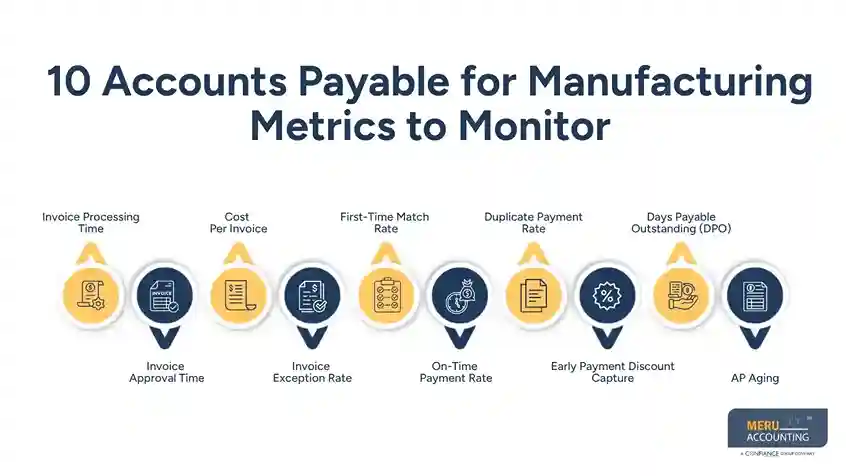
On-Time Payment Rate
Paying on time is more than a finance task. Late payment can lead to supplier queries, missed terms, or added work for the AP team. Track the share of invoices paid by their agreed due dates.
Duplicate Payment Rate
Duplicate invoices can enter AP through repeated submissions, vendor changes, or manual entry. A low duplicate payment rate is a useful control measure, especially when invoice volume is high.
Early Payment Discount Capture
Suppose a supplier offers a 2% discount for payment within 10 days. If the invoice takes eight days to reach approval, that opportunity may be lost. Track discounts available against discounts actually taken.
Days Payable Outstanding (DPO)
DPO shows the average time a business takes to pay suppliers. For accounts payable in manufacturing, this number should be viewed alongside supplier terms, cash needs, and payment policy rather than treated as a target by itself.
AP Aging
AP aging gives a quick view of unpaid bills by age. A rise in older invoices may signal approval delays, disputed bills, missing documents, or cash planning issues that need review.
optional anymore
on running the business
How Manufacturing AP Solutions Improve AP Performance
Cut Manual Entry
Repeated data entry takes time and can create keying errors. Manufacturing AP solutions can capture invoice details and reduce some of this work, leaving staff more time for invoices that need judgment.
Match Key Records
In accounts payable for manufacturing, an invoice does not exist in isolation. Manufacturing AP solutions can compare invoice details with PO and receipt data and flag differences for review.
Route Approvals
In accounts payable for manufacturing, a bill should reach the person who can approve it without sitting in the wrong queue. Manufacturing AP solutions can use set approval rules based on factors such as amount, department, or plant.
Give One View
When invoice data sits across emails, spreadsheets, and systems, it can be hard to see the full AP picture. Manufacturing AP solutions can bring status, exceptions, due dates, and payment data into a common view.
Track Supplier Terms
A supplier’s payment terms can affect both cash planning and discount opportunities. Manufacturing AP solutions can track due dates and discount windows so the AP team can act before important dates pass.
How to Set Benchmarks for Manufacturing AP Metrics
Start With Your Baseline
Before setting a target, know where the process stands today. Review several months of AP data to understand how accounts payable for manufacturing performs across changes in production volume, invoice count, and seasonal buying.
Compare Like With Like
A large plant buying raw materials in bulk will not have the same AP pattern as a smaller facility with many low-value service invoices. When measuring accounts payable for manufacturing, compare sites and periods that have similar operating conditions.
Use External Data With Care
External benchmarks can provide a useful reference point, but they should not become automatic targets. APQC, for example, publishes AP measures that businesses can use for comparison.
Set Cause-Based Targets
For accounts payable in manufacturing, a useful target should address a known process issue. If price mismatches cause many exceptions, reducing those mismatches may matter more than simply asking AP to process invoices faster.
Review Results Each Month
A single month’s result can be misleading. Monthly reviews can show whether a change is temporary or part of a longer trend.
Common Challenges in Measuring Accounts Payable for Manufacturing
Missing Source Data
Some suppliers may send invoices through portals, email, EDI, or other channels. If receipt dates are not captured consistently, invoice cycle time may not be reliable.
Plant-Level Process Gaps
One plant may record receipts on the same day as delivery, while another may take longer, creating inconsistencies in accounts payable for manufacturing metrics. Such differences can affect AP metrics even when the AP team follows the same process.
Poor Exception Codes
Calling every blocked invoice an “exception” does not explain much. Clear codes for price, quantity, PO, receipt, tax, vendor, and approval issues give the team more useful data.
Inconsistent Cost Data
A cost-per-invoice figure can look lower than it really is if key costs are left out. Decide in advance which staff, system, service, and processing costs belong in the calculation.
Data Timing Issues
Month-end accounts payable for manufacturing reports can change when late invoices or receipts are posted.
How to Build an Effective AP Metrics Dashboard
Show Core KPIs
A useful dashboard does not need dozens of numbers. Start with the measures that show speed, accuracy, exceptions, payment status, and cash timing.
Add Trend Data
A KPI of 92% means little without context. Showing the previous month and recent trend can reveal whether performance is moving up, down, or staying steady.
Break Down Exceptions
In accounts payable for manufacturing, a total exception rate can hide the real problem. Show the main causes and, where useful, break them down by plant, supplier, or business unit.
Track Supplier Impact
Late payments, missed discounts, and repeated invoice disputes can affect supplier interactions. Adding these measures gives AP a view beyond internal processing speed.
Set Owner and Action
Every important metric in accounts payable for manufacturing should lead to a clear next step. If approval time rises, the dashboard should make it possible to identify who owns the delayed stage and what action is needed.
How Meru Accounting Supports Manufacturing AP Management
AP Process Review
Meru Accounting reviews key AP steps such as invoice entry, PO matching, approvals, payment checks, and reconciliation. This can show where delays or repeat work occur.
Invoice and Payment Tracking
Our team can track invoice status, due dates, payment activity, and AP aging. This gives manufacturing businesses a clearer view of bills that need review or action.
Exception Management
In accounts payable for manufacturing, Meru Accounting can review invoice exceptions linked to price, quantity, PO, receipt, or approval issues. Clear exception data can make it easier to find the cause of repeated AP delays.
AP Reporting
We can prepare AP reports around cycle time, invoice volume, aging, payment status, and other agreed metrics. These reports can give management a consistent view of AP performance.
Support For AP Controls
Meru Accounting can follow defined AP checks for invoice validation, duplicate review, payment review, and account reconciliation. The exact checks can be set based on the client’s process and control needs.
Our Expert Perspective
In accounts payable for manufacturing, AP performance can change even when the AP team itself has not changed. A rise in invoice volume, new suppliers, higher purchase activity, or delays in receiving can quickly affect invoice time and exception rates. This is why we believe AP metrics should be read with the operating data behind them.
A useful AP review should not stop at asking whether a metric went up or down. It should ask what changed in the process and whether that change is likely to continue. This approach gives finance teams a clearer view of what needs attention and which issues may need a change in process.
Key Takeaways
- Accounts payable for manufacturing should be measured across speed, cost, accuracy, payment, and cash.
- Invoice processing time can show where bills spend too much time in the process.
- Exception and match rates can reveal problems with POs, receipts, prices, and invoice data.
- Payment metrics can show late payments, duplicate payments, and missed discount opportunities.
- DPO and AP aging give a wider view of supplier payment timing.
- Manufacturing AP solutions can reduce manual work and make invoice data easier to track.
- Benchmarks should reflect the size, invoice mix, plant setup, and supplier terms of the business.
- A good dashboard should show the number, the trend, the cause, and the person responsible for action.
FAQs
The key metrics include invoice processing time, approval time, cost per invoice, exception rate, match rate, on-time payments, DPO, and AP aging.
Manufacturing AP performance is measured by tracking invoice speed, processing cost, accuracy, payment timing, exceptions, duplicate payments, and outstanding balances over time.
Invoice exception rate shows how many invoices need extra review because of issues such as PO, price, quantity, receipt, or approval mismatches.
In accounts payable for manufacturing, DPO measures the average number of days a manufacturer takes to pay its suppliers and should be reviewed alongside supplier terms and payment practices.
Manufacturing AP solutions can reduce manual invoice work, speed up matching and approval, track payment dates, and give AP teams clearer performance data.
optional anymore
on running the business