Delayed bookkeeping can leave a business with old, missing, or unclear financial records. Catch up bookkeeping services bring past transactions up to date so the business has a clear view of income, costs, assets, and debts. When books are not kept on time, errors can build up and key reports may not show the true financial position of the business.
The IRS states that business records should clearly show income and expenses and should support items reported on a tax return. Accurate records also aid financial statements, expense tracking, and tax filing.
What You Will Learn From This Blog
- What catch up bookkeeping services are and when a business may need them.
- How late bookkeeping can affect cash flow, tax work, reports, and business choices.
- How catch up bookkeeping solutions can bring old records up to date.
- What factors affect catch up bookkeeping cost.
- How catch up bookkeeping services differ from regular monthly bookkeeping.
- How clean and current books can give owners a clearer view of business finances.
Introduction To Catch Up Bookkeeping Services
What Catch Up Bookkeeping Means
Catch up bookkeeping services bring past financial transactions into the accounting system when books have not been updated for a period. The work may cover a few months or several years, based on the gap.
When A Business Needs Catch Up Work
A business may need catch up bookkeeping services after a period of rapid growth, staff change, poor record upkeep, or a switch in accounting systems. Missing bank entries and old bills are common signs.
What Records Are Reviewed
The work may include bank statements, credit card records, sales invoices, bills, receipts, payroll data, loan records, and asset details. The goal is to build a clear set of books from source data.
Why Old Books Need Care
Old records should not be filled in with guesses. Each entry should be tied to source data where possible, since the IRS expects records to support income, expenses, and tax items.
How The Work Is Done
Catch up bookkeeping services often start with a review of the books, followed by transaction entry, account matching, bank checks, and review of open items. The exact steps depend on the size and state of the records.
What Risks Can Delayed Bookkeeping Create For A Business?
Poor View Of Cash
Late books can make it hard to know how much cash the business has and what bills are due. This can lead to poor timing of payments and spending.
Missed Or Wrong Expenses
When expenses are entered late, receipts or bills may be missed. This can affect profit reports and may also create issues when records are used for tax work.
Tax Filing Pressure
Old books can make tax work harder because income, costs, assets, and other items may need review at the same time. Good books give the tax preparer a better source of data.
Weak Financial Reports
A profit and loss report is only as useful as the data behind it. Delayed entries can make sales look low, costs look high, or balances appear wrong for a given period.
Unclear Business Decisions
An owner may delay hiring, buying stock, cutting costs, or taking on debt because the latest financial data is not ready. Catch up bookkeeping services can bring past data into a usable form.
Higher Error Risk
The longer books stay out of date, the more work may be needed to find old errors. A large backlog can also make it harder to link transactions to the right documents.
How Catch Up Bookkeeping Services Reduce The Risks Of Delayed Bookkeeping
Review The Bookkeeping Gap
Catch up bookkeeping services first identify how far the books are behind and which accounts need work. This gives the business a clear work plan before entries are made.
Match Bank And Card Records
Bank and card records provide key source data for many small businesses. Matching these records with the books can show missing entries, duplicate entries, and wrong balances.
Record Missing Transactions
Old sales, bills, fees, transfers, and other valid business entries can be added to the right periods. Each entry should be based on available records rather than an unsupported guess.
Check Open Balances
Old unpaid invoices, bills, loans, and other balances need review. Catch up bookkeeping services can flag items that need owner or accountant review before the books are treated as current.
Bring Reports Up To Date
Once past entries are posted and reviewed, reports such as the profit and loss statement and balance sheet can give a more useful view of the business.
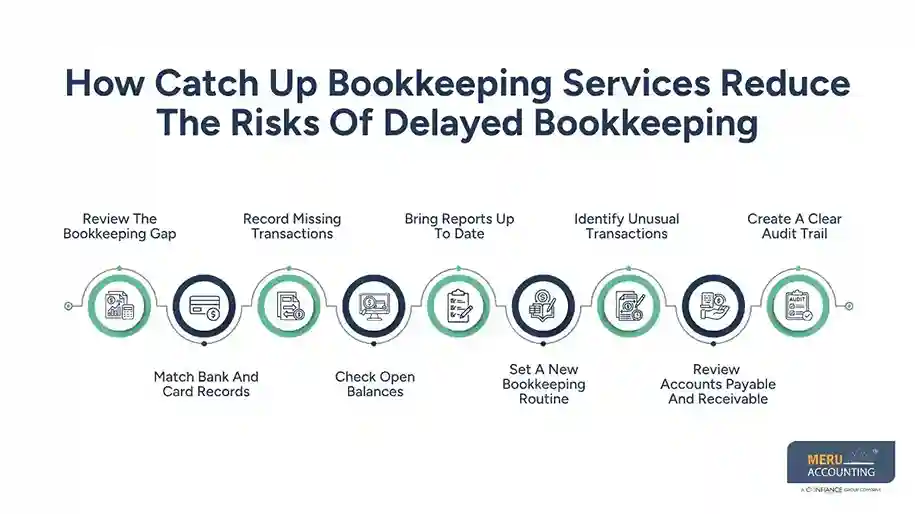
Set A New Bookkeeping Routine
Catch up work should not be the end of the process. After the backlog is cleared, regular bookkeeping can keep new transactions from building into another large gap.
Identify Unusual Transactions
Catch up bookkeeping services can bring attention to unusual payments, large expenses, duplicate entries, or transactions that do not match past records. These items can then be checked before the books are finalized.
Review Accounts Payable And Receivable
Past-due customer invoices and unpaid bills can affect the accuracy of financial reports. Reviewing accounts receivable and accounts payable shows which amounts are still due and which old balances may need correction.
Create A Clear Audit Trail
Each major adjustment should be linked to available records such as bank statements, invoices, receipts, or bills. A clear audit trail makes it easier to understand why an entry was made and review it later.
How Much Do Catch Up Bookkeeping Services Cost?
What Sets The Cost
Catch up bookkeeping cost depends on the number of months behind, transaction volume, number of accounts, accounting system, and condition of the existing records.
Number Of Months
A business that is three months behind may need far less work than one that has not updated its books for two years. The age of the backlog is one key factor in catch up bookkeeping cost.
Number Of Transactions
A firm with 100 transactions a month has a very different workload from one with 2,000. Higher transaction volume can raise catch up bookkeeping cost because more entries need review.
Condition Of Existing Books
If accounts are partly complete and bank records are clear, the work may be more direct. Missing statements, unclear entries, and old errors can raise catch up bookkeeping cost.
Software And Accounts
The accounting software, number of bank and card accounts, payroll records, loans, and sales channels can also affect the work. More accounts often mean more records to match.
How To Judge The Cost
Do not judge catch up bookkeeping cost only by the number of months. A proper review should also consider transaction volume, account count, record quality, and the level of cleanup needed.
optional anymore
on running the business
How Catch Up Bookkeeping Improves Financial Record Accuracy
Bank Reconciliation
Bank reconciliation compares book entries with bank activity. This can reveal missing transactions, duplicate entries, fees, and other items that need review.
Correct Account Coding
Transactions need to be placed in suitable income, expense, asset, liability, or equity accounts. Correct coding makes later reports more useful.
Better Source Records
The IRS notes that invoices, receipts, bills, deposit slips, and other source documents support entries in business books.
Clearer Profit Reports
When old transactions are entered in the right period and account, profit reports can give a more useful view of sales and costs. This matters when an owner reviews past results.
Better Balance Sheet Data
A balance sheet shows assets, liabilities, and equity at a set date. Catch up bookkeeping services can bring old balance sheet accounts up to date so the report is not based on stale data.
Fewer Unclear Items
A proper review can mark items that need more information instead of hiding them in a general account. This gives the owner and tax professional a clear list of items that need review.
Catch Up Bookkeeping Vs. Regular Bookkeeping: What Is The Difference?
Main Purpose
Catch up bookkeeping services focus on past work that was not completed on time. Regular bookkeeping records new transactions as they occur or on a set monthly schedule.
Time Period Covered
Catch up work may cover several past months or years. Regular bookkeeping usually focuses on the current period and keeps records current from month to month.
Workload
Catch up work may involve a large batch of old transactions at once. Regular bookkeeping spreads the work across shorter periods, which can make review more manageable.
Record Review
Catch up bookkeeping services may need a deeper review of old statements, unpaid items, account balances, and missing documents. Regular bookkeeping usually has fewer old issues to trace.
Cost Pattern
Catch up bookkeeping cost may be a one-time or project-based expense for clearing a backlog. Regular bookkeeping is more often a recurring monthly or periodic cost.
Best Long-Term Approach
Catch up work can clear the old gap, but regular bookkeeping keeps new records current. Using both in the right order can prevent the same backlog from forming again.
Why Choose Meru Accounting For Catch Up Bookkeeping Services?
Review Of Backlogged Records
Meru Accounting provides catch up bookkeeping services for businesses with old or delayed books. The work starts with a review of the records and the period that needs to be brought up to date.
Accounting Software Experience
Meru Accounting provides bookkeeping services using platforms such as QuickBooks, Xero, Zoho Books, NetSuite, and Odoo. The right process depends on the business and its accounting setup.
Focus On Financial Records
The service covers transaction records, account review, reconciliations, and financial reports. This gives businesses a clearer base for ongoing accounting work.
Support For US Businesses
Meru Accounting provides services for US businesses and works with records that may need to meet US accounting and IRS recordkeeping needs. Tax treatment can vary by business and should be reviewed with a qualified tax professional.
Clear Review Process
The work can include finding missing records, reviewing account balances, and marking items that need further information. This keeps uncertain items visible instead of treating them as confirmed facts.
From Catch Up To Regular Books
After catch up bookkeeping services bring the backlog up to date, regular bookkeeping can be used to keep new transactions current. This creates a more stable process for future financial reporting.
Our Expert Perspective
A backlog is not just an old data entry task. It can affect reports, tax work, cash review, and the owner’s view of the business.
From an accounting perspective, the first goal should be to find the gap, trace entries to source records, and mark anything that cannot be confirmed. Catch up bookkeeping services are most useful when the cleanup ends with books that can be kept current going forward.
Key Takeaways
- Catch up bookkeeping services bring old financial records up to date.
- Delayed bookkeeping can create errors, unclear cash data, and weak financial reports.
- Bank statements, invoices, receipts, bills, and other source records should be used during cleanup.
- Catch up bookkeeping cost depends on the age of the backlog, transaction count, account count, and record quality.
- Current books give owners better data for cash, cost, profit, and tax review.
- Catch up work should be followed by regular bookkeeping to prevent another backlog.
- The IRS says business records should support income, expenses, deductions, and tax return items.
FAQs
Catch up bookkeeping services bring past-due financial transactions up to date so a business has current and organized accounting records.
A business may need catch up bookkeeping solutions when its books are months behind, transactions are missing, or financial records have not been regularly updated.
Catch up bookkeeping solutions can reduce risks by finding missing transactions, checking account balances, reconciling bank records, and bringing delayed books up to date.
Catch up bookkeeping cost depends on the number of months behind, transaction volume, number of accounts, accounting software, and condition of the existing records.
Yes, catch up bookkeeping solutions can bring delayed books up to date by reviewing past transactions, adding missing entries, reconciling accounts, and checking financial records.
optional anymore
on running the business