
You agree to a monthly bookkeeping fee, expecting that number to cover the work your business needs. Then an extra charge appears for cleanup, year-end work, account reconciliations, or a report you thought was already included. With monthly bookkeeping services, the number on the quote is only part of the cost.
The real question isn’t just how much a bookkeeper charges each month. It’s what you get for that fee and what falls outside the agreed scope. Two providers can quote very different prices for what sounds like the same service, while the actual work and extra charges vary quite a bit.
If you’re comparing bookkeeping options, especially outsourced monthly bookkeeping, knowing what to ask before you sign can save you from unexpected costs later. Let’s look at what a typical monthly fee covers, what can drive it up, and which charges are worth checking before you agree to a plan.
What You Will Learn From This Blog
- What monthly bookkeeping services may cost
- What a normal monthly package may include
- Which factors can raise or lower your fee
- What hidden fees to look for
- How providers set and quote monthly fees
- How to compare bookkeeping quotes with less guesswork
What Do Monthly Bookkeeping Services Cost?
There is no single price for monthly bookkeeping services because each business has a different set of books and needs. A small firm with a few bank accounts and a low number of monthly entries may pay less than a firm with many accounts, payroll, sales tax, bills, and a high flow of sales.
For basic work, small firms may see monthly fees in the range of a few hundred dollars. More work can push the fee higher. Some firms also use hourly rates, while others set a flat fee after they review the books.
The quote should match the work that must be done each month. For example, a fee that only covers basic data entry is not the same as a fee that covers bank and card checks, A/P, A/R, payroll entries, month-end close, and reports.
When you review monthly bookkeeping services, ask for a clear list of what the base fee covers. Then ask what can lead to an added fee. This makes it much easier to compare two quotes that may look very close at first.
What Is Included in a Monthly Bookkeeping Package?
A good monthly package should spell out the work in plain terms. While each firm may set its own scope, common tasks can include:
- Recording income and costs
- Bank account checks
- Credit card checks
- A/P and A/R support
- Bank and card match work
- Monthly account checks
- General ledger review
- Profit and loss reports
- Balance sheet reports
- Catch-up work when needed
- Tax-ready book records
Some firms may also include sales tax support, payroll entries, bill pay, or custom reports. These tasks can add time, so they may not be part of a base plan.
This is where outsourced monthly bookkeeping can vary a lot from one firm to the next. One provider may offer a broad set of tasks for one flat rate. Another may charge a base fee and then bill for each added task.
Before you agree to a plan, ask for the scope in writing. A clear scope helps both sides know what work is due each month and what falls outside the plan.
What Factors Affect Monthly Bookkeeping Costs?
Several factors can change the price of monthly bookkeeping services. The main ones are tied to the amount and type of work needed.
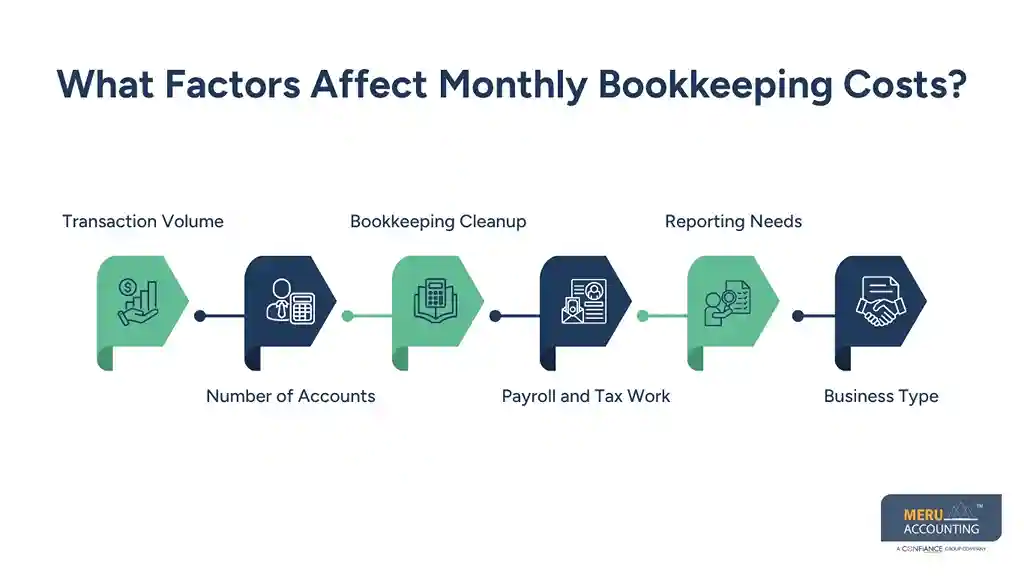
Transaction Volume
A firm with 100 bank and card entries each month takes less time to review than one with 2,000. High sales, many bills, refunds, and other entries can all add work.
Number of Accounts
Each bank, card, loan, and other account may need its own check and match work. More accounts can mean more time at month-end.
Bookkeeping Cleanup
Books that have old errors, missed entries, or poor account use may need clean-up before regular work can start. This is often a one-time fee, not part of the normal monthly rate.
Payroll and Tax Work
Payroll can add work for entries, wage accounts, and payroll reports. Sales tax work may also carry an added fee. Tax prep is often handled by a CPA or tax pro and may not be part of the book fee.
Reporting Needs
A basic P&L may be part of a plan. Custom reports, job-level reports, class reports, or other views may cost more if they take added time to build and review.
Business Type
A simple service firm may have a more basic set of books than a firm with stock, rental units, job costs, or many locations. More complex books can lead to a higher monthly fee.
For this reason, the cost of monthly bookkeeping services should be tied to the work, not just the number on the quote.
optional anymore
on running the business
What Are the Hidden Fees in Monthly Bookkeeping Services?
Hidden fees do not always mean a provider is trying to hide costs. In many cases, the base price simply covers a set scope, while extra work is billed as needed. The issue comes when those fees are not clear before you start.
Here are some common costs to ask about.
Setup or Onboarding Fees
Some providers charge a one-time fee to review your books, set up systems, connect accounts, and build the workflow. Ask if this is part of the first month or billed on top of it.
Catch-Up or Cleanup Fees
If your books are months behind, regular monthly work may not be enough. A provider may need to fix old entries, match old bank activity, and fix account errors first.
Year-End Fees
Some monthly plans do not include year-end work. Ask if the provider charges extra for year-end close, tax-ready reports, or support for your tax pro.
Payroll Fees
Payroll may be outside the base plan. If you need payroll entries or payroll account checks, find out if they are included.
Extra Report Fees
A monthly P&L and balance sheet may be included, while custom reports may cost more. Ask what reports you get as part of the base fee.
Software and Add-On Costs
Some firms may use software that has its own monthly cost. Make sure you know whether software fees are part of your quote or billed to you as a separate cost.
Extra Support
You may also see added fees for special projects, urgent work, new account setup, or requests that fall outside the agreed scope.
The best way to avoid surprise costs is to ask, “What work is not included in this monthly fee?” That one question can reveal more than a long list of included tasks.
How Bookkeeping Providers Calculate Monthly Fees
Most bookkeeping providers look at the amount, type, and level of work before setting a fee. A good quote starts with a review of the current books.
The provider may look at your bank and card accounts, monthly transaction count, payroll needs, A/P and A/R work, past-due books, software, and report needs. They may also ask about the level of support you want.
Some providers use fixed monthly plans. This can make the cost easy to plan for, as long as the scope is clear. Others use an hourly model, which can work well when the amount of work changes from month to month.
For outsourced monthly bookkeeping, the key is not just the rate. Look at how the provider defines a month of work. A flat fee can be a good fit when it covers the tasks you need on a set cycle.
Monthly Bookkeeping Services by Meru Accounting
Monthly bookkeeping is rarely just about entering transactions. The quality of the work depends on how accounts are reconciled, how income and expenses are tracked, how A/P and A/R are handled, and whether the monthly reports tell the right story.
At Meru Accounting, our team works with businesses across different industries and accounting setups. We first look at the current books, account structure, reporting needs, and workflow before setting up the monthly process. That helps us keep routine work consistent while making room for the tasks that are specific to each business.
What Our Monthly Bookkeeping Support Covers
- Monthly bookkeeping and account reconciliation
- Bank and credit card reconciliation
- Income and expense tracking
- Accounts payable and accounts receivable support
- Payroll accounting support
- Monthly financial statements and reports
- Catch-up and bookkeeping cleanup
- Tax-ready financial records
- Support within your existing accounting workflow and software
We work with QuickBooks, Xero, and Zoho Books, so your bookkeeping process can stay aligned with the tools your business already uses. Whether the need is ongoing monthly work or a mix of regular bookkeeping and cleanup, the scope can be built around the actual work your books require.
Our Expert Insight
In our experience, bookkeeping costs can vary even between businesses with similar revenue because the accounting workload is not always the same. Transaction volume, payment processors, credit cards, payroll, A/R, A/P, inventory, and multiple accounts can all add review and reconciliation work.
We also look at the condition of the books before estimating ongoing work. Unreconciled accounts, old transactions, duplicate entries, or large numbers of uncategorized transactions may require cleanup before regular monthly bookkeeping can run smoothly.
That is why we recommend looking beyond the monthly price. A useful bookkeeping arrangement should have a clear scope, properly maintained accounts, and financial records that are ready to support tax filing and day-to-day business decisions.
Key Takeaways
- Monthly bookkeeping services can range in price based on the work and needs of the business.
- Transaction volume, account count, payroll, cleanup, and reporting needs can affect the fee.
- Setup, cleanup, year-end work, payroll, reports, and software may carry extra costs.
- Always ask what is included and what falls outside the monthly scope.
- Outsourced monthly bookkeeping can offer flexible support without the cost of a full-time bookkeeper.
- The best quote is one that clearly matches the work your business needs each month.
FAQs
Many small businesses pay a few hundred dollars a month for basic bookkeeping. Cost varies based on transaction volume, accounts, payroll, cleanup, and reporting needs.
Cleanup work, payroll, year-end work, custom reports, and tasks outside the regular monthly scope can increase the cost.
It can be, especially if you don’t need a full-time employee. Compare the total cost of hiring, benefits, software, and the bookkeeping services included.
Yes, regular bank reconciliation is a standard part of maintaining accurate books. Confirm how often reconciliations are performed and whether they’re included in the monthly fee.
Ask what’s included in the monthly fee, what costs extra, how cleanup is billed, which reports you’ll receive, and whether pricing changes as your business grows.
optional anymore
on running the business