




Bookkeeping for funded startups changes the moment a startup moves from founder-funded operations to outside capital. A bank balance can look strong after a funding round, but that does not mean the business has more revenue, better margins, or more time to spend.
The books now need to tell a much clearer story: where the money came from, where it is going, what the company owns, and what it still owes.
A funded startup also has more people looking at its numbers. Founders, investors, board members, lenders, tax professionals, and finance teams may all need different views of the same records. That makes a clean monthly process far more useful than a year-end scramble to fix old entries.
What You Will Learn From This Blog
- Why bookkeeping for funded startups needs to change after a funding round.
- Which cash, equity, cost, payroll, asset, and bill records need close tracking.
- How bookkeeping needs vary across six common startup business models.
- Which tax and compliance areas may need more attention after funding.
- When outsourced bookkeeping for startups may make sense as the finance workload grows.
- How to set up a bookkeeping system that can handle more staff, sales, vendors, and funding rounds.
Bookkeeping for Funded Startups: What Changes After Raising Capital?
Funding is Not Sales Income
A large deposit can change the bank balance overnight, but it does not turn into sales. Bookkeeping for funded startups should show investor funds based on the type of transaction, such as equity or debt, rather than mixing them with customer income.
More Spend Needs Clear Codes
After a raise, spend often goes to new hires, tools, ads, trips, legal work, and outside firms. Clear account codes make bookkeeping for funded startups easy to read when someone asks where the new funds went.
Monthly Close Matters
A funded startup cannot rely on a rough bank balance when monthly numbers are needed for review. A set close date gives the team a point at which bank accounts, bills, payroll, and key entries are checked.
Investor Data Must Match
Funding records should agree with signed deal documents, bank activity, and the company’s equity records. When these records tell different stories, even a simple investor review can turn into a long search for the missing entry.
Cash Burn Needs a Clear View
A startup may have $2 million in the bank after a raise and still face a high monthly cash burn. Bookkeeping for funded startups should make it easy to see how much cash enters and leaves the business each month.
Keep Deal Files Safe
Bookkeeping for funded startups becomes easier to review when funding documents stay close to the related entries. Keep signed agreements, payment proof, equity records, and other key files in an organized system.
What Funded Startups Need to Track From Day One
Cash and Bank Balances
For bookkeeping for funded startups, bank reconciliation should not be treated as a task saved for year-end. Match bank and card activity each month and check unusual transfers before they become hard to trace.
Investor Funding and Equity Transactions
A funding entry should have a clear link to its source document. Bookkeeping for funded startups should record the amount, date, transaction type, and related details in line with the company’s accounting setup.
Operating Expenses and Vendor Payments
Rent, software, ads, legal fees, travel, and vendor bills can rise fast after a raise. Grouping them in clear accounts makes it easy to see which costs are up and which are one-time costs.
Payroll, Benefits, and Contractor Costs
A new round may lead to new hires, higher pay, more benefits, or more staff on a contract. Keep pay and staff costs within the right time span, and keep the files needed for tax work.
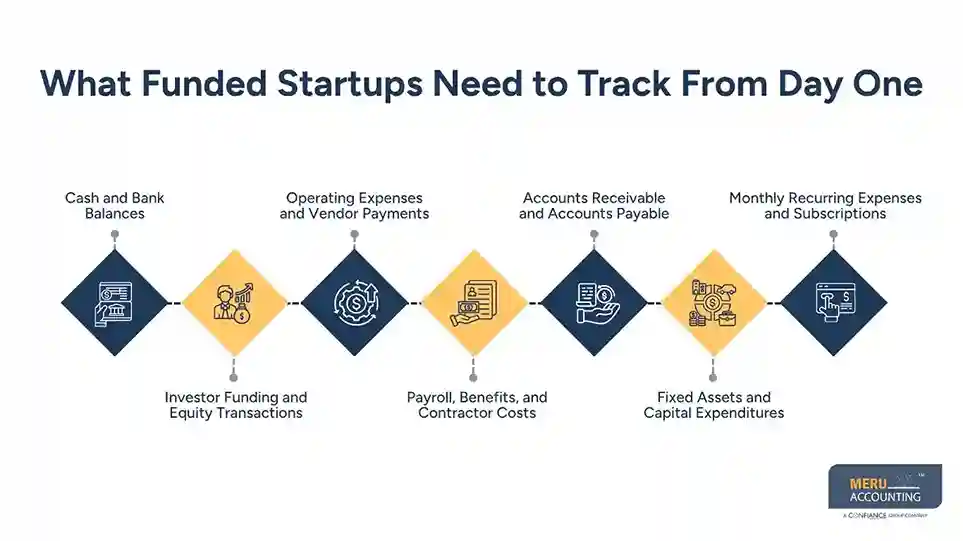
Accounts Receivable and Accounts Payable
Cash due from clients and cash due to vendors show two sides of the cash flow. Check both on a set plan, not just the cash held in the bank.
Fixed Assets and Capital Expenditures
A startup may use funds to buy PCs, tools, gear, or other high-cost items. Put these purchases in the right accounts and keep the bills and proof needed for tax work and asset cost write-off.
Monthly Recurring Expenses and Subscriptions
Ten small app plans can be hard to spot next to one big bill. Keep a list of repeat costs, check it each month, and see if the tool is still in use.
How Bookkeeping Requirements Differ By Startup Business Model
SaaS and Subscription Startups
Bookkeeping for funded startups looks different for SaaS firms because customer plans may renew each month or year. The books may need to track billing, refunds, deferred revenue, and customer payments with care.
E-commerce Startups
An e-commerce firm has more than sales to record. Inventory, shipping, refunds, payment fees, discounts, and sales tax can all affect the numbers, while platform payouts may not equal the actual sales figure.
Marketplace Businesses
A marketplace can collect money from buyers before sending part of it to sellers. The books need to make a clear split between money that belongs to the company and money that is due to another party.
Fintech and Financial Services Startups
Fintech firms may deal with fees, transfers, customer funds, and several types of financial transactions. Bookkeeping for funded startups in this space needs a clear view of how money moves through each part of the business.
Professional Services and Consulting Startups
For service firms, time and client work often sit at the heart of the numbers. Track invoices, project costs, staff time, contractor fees, and amounts still due so the books reflect the work being done.
Hardware and Product-Based Startups
Hardware firms have a different cost trail. Parts, stock, freight, production costs, equipment, and product purchases may all need separate treatment, making bookkeeping for funded startups more detailed than a simple service model.
How Tax and Compliance Needs Change After Funding
Payroll Tax Work Can Grow
More hiring means more payroll records and tax work. Bookkeeping for funded startups should keep wage, benefit, withholding, and payment records in order so the tax team has reliable data.
Contractor Reports Need Care
A startup may add contractors after a funding round to keep work moving without adding full-time staff. Their records should be kept separately, and worker status should be reviewed based on the actual working relationship.
Sales Tax Can Expand
New products, new states, and new sales channels can change sales tax needs. Bookkeeping for funded startups should capture the sales data needed for the tax team to review where obligations may apply.
Corporate Records Should Match
A funding round can affect more than the bank account. Deal documents, equity records, board records, and accounting entries should tell the same story.
Tax Files Need Proof
A number in the ledger is much more useful when the related invoice, receipt, contract, or bank record can be found. Bookkeeping for funded startups should make that trail easy to follow during tax work or review.
Set a Review Owner
Someone should own the month-end review. That person does not have to enter every transaction, but they should know which items are open, which records are missing, and when the books are ready.
Common Bookkeeping Mistakes Funded Startups Should Avoid
Coding Investor Cash as Revenue
A funding deposit can make revenue look much higher if it is placed in the wrong account. That can distort reports and give investors or management the wrong picture of sales.
Mixing Personal and Business Spend
Founder and business expenses should stay separate. Mixed transactions create extra work and can make tax records harder to review.
Ignoring Small Repeat Costs
A $30 monthly tool may not seem important, but dozens of similar charges can become a large annual cost. Review recurring spend rather than waiting for a major expense to stand out.
Waiting for Tax Season
Bookkeeping for funded startups should not become a yearly repair job. Monthly records give the tax team cleaner data and give management more useful numbers during the year.
Failing to Match Reports
Bank records, payroll data, accounting reports, and equity records should not operate as separate islands. When figures differ, find the cause rather than forcing an entry just to make totals match.
Losing Source Files
A missing invoice or funding document can slow down a review even when the accounting entry is correct. Keep key records in a secure and organized location with clear file names.
When To Consider Outsourced Bookkeeping For Startups
The Close Takes Too Long
If the founder spends several days every month chasing bills and checking transactions, the process may need a change. Outsourced bookkeeping for startups can take routine bookkeeping tasks off the founder’s list.
Transactions are Growing
More cards, banks, vendors, employees, and sales channels mean more records. Outsourced bookkeeping for startups may become useful when transaction volume starts taking time away from product, sales, or management work.
The Team Lacks Bookkeeping Skills
A founder may know the business inside out without having time to manage accruals, reconciliations, fixed assets, and month-end checks. Outsourced bookkeeping for startups can provide a defined process without requiring an immediate full-time finance hire.
Investor Reporting is Due
Investor reporting puts more pressure on the quality and timing of monthly numbers. Outsourced bookkeeping for startups can handle routine records while internal leaders focus on reviewing results and explaining business changes.
You Need a Set Month-End Process
An outside team should not only enter transactions. Ask how it handles reconciliations, open items, reports, document storage, and communication with the tax team before deciding on a scope.
Cost Must Match Need
The right question is not simply whether outsourcing costs less than hiring. Compare the work needed, review time, skill level, reporting needs, and expected growth before setting the scope.
How To Build A Scalable Bookkeeping System For A Funded Startup
Set a Clear Chart Of Accounts
Bookkeeping for funded startups starts with a chart of accounts that reflects how the company earns and spends money. Avoid creating dozens of accounts that make reports hard to read.
Set a Monthly Close Date
Pick a repeat date for the close and work backward from it. Bank checks, bills, payroll data, and account reviews can then follow the same order each month.
Link Source Files to Entries
A clean ledger is useful, but a ledger with a clear source trail is better. Keep bills, slips, deals, fund records, and bank proof easy to find.
Use Role-Based Review
The person who logs a deal does not always need to be the one who checks it. Split key tasks where you can, most of all for pay, payroll, funds, and big buys.
Build Simple Reports
Bookkeeping for funded startups should give reports that answer key needs. Profit and loss, balance sheet, cash flow, money due in, bills due, and cash burn can give the team a clear view each month.
Review After Each Raise
A new funding round can change headcount, spending plans, legal records, and reporting needs. Bookkeeping for funded startups should be reviewed after each major change rather than relying on a setup made before the raise.
Our Expert Perspective
A funding round is a good time to check if the deal docs, cash entry, equity records, and report setup all match. Keep the month-end close clear, with checks for bank use, bills, pay, account sums, and key reports. Make sure cash burn is based on sound book data, not a side sheet that no one checks.
The book process should also fit the type of firm, as SaaS, hardware, and other startups have their own sales plans, cost mix, pay flows, and report needs. As deal flow and reporting needs grow, outsourced bookkeeping for startups can keep the books on track and the records set for the next step.
Key Takeaways
- Bookkeeping for funded startups should show funds, sales, costs, cash, equity, bills, pay, and assets in clear form.
- Investor funds should not mix with day-to-day sales cash.
- The book setup should match the startup’s real type of work.
- SaaS, e-commerce, market, fintech, service, and tech firms have key data to track.
- Tax, pay, staff, and sales tax needs may grow after a fund raise.
- Outsourced bookkeeping for startups may help when deal flow and report work rise.
- A set close date and clear check plan can keep month-end books in good shape.
- Source files should be easy to find when a figure needs a check.
- Bookkeeping for funded startups should grow with the firm, not be built from scratch after each fund raise.
FAQs
Bookkeeping for funded startups keeps track of funds, sales, costs, pay, cash, assets, bills, and stock in clear books.
Funded startups should track cash, funds from backers, sales, costs, pay, money due in, bills due, assets, and fixed costs.
Bookkeeping gets more in-depth after a fund raise, as firms need clear books for cash, spend, stock, pay, and key reports.
A funded SaaS startup should track sales, client pay, fixed costs, pay, tool costs, held sales, and cash flow.
A funded startup can use outsourced bookkeeping for startups when more deals, pay work, fund data, or month-end work is too much to run in-house.


