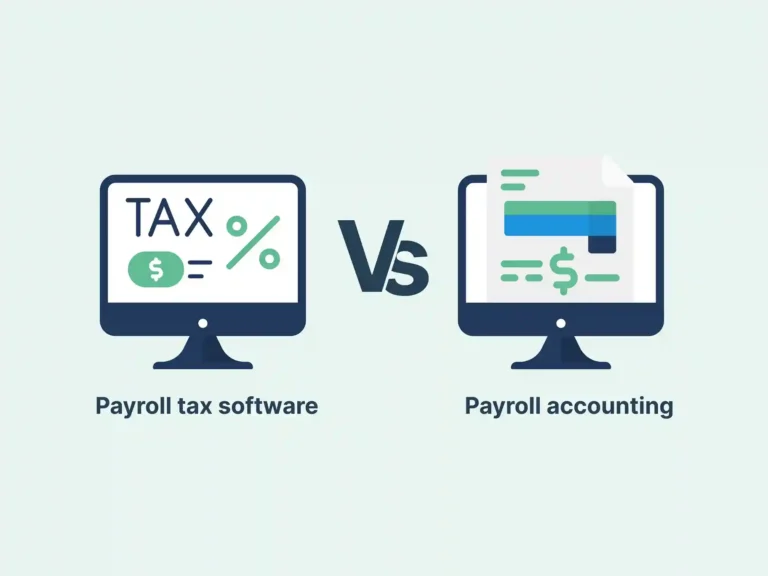
A payroll run can be completed, and taxes can be filed, yet the books may still have errors. A tax payment might remain in the wrong liability account, or a payroll entry may not match the bank activity. Payroll tax software for accountants helps with the tax side, but it does not always cover the accounting work that follows.
That is where payroll accounting software comes in. It helps record payroll costs, track liabilities, and keep payroll activity in line with the general ledger. While both tools can work together, they serve different purposes.
Understanding the difference can help accountants choose the right tools and catch gaps before they affect the books or month-end close.
What You Will Learn From This Blog
This blog will help you:
- See what payroll tax software for accountants does.
- See what payroll accounting software does.
- Know the main gaps between the two.
- See how both tools can work in one pay flow.
- Know what to check when you pick payroll accounting software.
- Spot payroll book issues that a tool may not catch.
- Know when hands-on book help may be useful.
What Is Payroll Tax Software for Accountants?
Payroll tax software for accountants is built to help with the tax side of payroll. It can help work out tax data, track tax due, prep tax forms, and support tax filing work. The exact tools will vary by the firm, plan, and tax setup.
For an accountant, the main goal is to keep payroll tax data in line with the rules that apply to the firm or its clients.
Common tasks may include:
- Tax withholding data
- Employer tax data
- Tax due dates
- Tax form prep
- Tax filing support
- Tax payment data
- State and local tax data
- Payroll tax reports
This can be a big help when a firm has many clients or deals with more than one state. A good tax tool can help cut down on manual work and give the team a set way to check tax data.
Still, tax software is not the same as full bookkeeping. A tax tool may show what is due, but the books still need to show what was paid, what is owed, and where each cost was set up.
Can Payroll Tax Software and Payroll Accounting Software Work Together?
Yes. In many payroll flows, both types of tools can have a role.
A common flow may look like this:
Employee pay data → Payroll run → Tax data → Payroll entry → Bank payment → Account review
The payroll system first uses pay data to run payroll. Tax data can then feed tax reports or filing work. The accounting side records the payroll cost and related debts. When money leaves the bank, the payment should then be matched to the right account.
For example, a payroll run may create $50,000 in gross wages. It may also create employee tax withholdings, employer tax costs, benefit costs, and a net pay amount. The books need to show these parts in the right accounts.
This is where payroll tax software and payroll accounting software can work as a team. One helps with the tax side, while the other helps keep the books in line.
But an app link does not mean every record is right. Data can map to the wrong account, a payment can hit the wrong bank account, or an old debt can stay open. A review is still needed.
optional anymore
on running the business
What Is Payroll Accounting Software?
Payroll accounting software is built more for the book side of payroll. It helps a firm track payroll costs, debts, pay data, and the entries that flow into the general ledger.
For example, payroll can create a gross wage cost, employee tax withholdings, employer tax costs, benefit costs, and net pay. Each part can affect a set of accounts in the books.
Payroll accounting software may help with:
- Wage expense records
- Payroll tax debt accounts
- Benefit and deduction records
- Payroll journal entries
- Payroll reports
- Bank pay records
- Payroll payment matching
- Month-end book work
The main aim is not just to run pay. It is to make sure the pay run is shown correctly in the books.
This is where payroll accounting software can be useful for firms that need clean records for month-end close, reports, tax work, or client review.
Payroll Tax Software vs. Payroll Accounting Software: Key Differences
The key gap is what each tool is built to do.
Area | Payroll Tax Software | Payroll Accounting Software |
Main focus | Payroll tax work | Payroll bookkeeping |
Tax data | Strong focus | Tracks tax debts in the books |
Tax forms | May support prep and filing | May store or report tax data |
Wage records | May use wage data | Records wage costs |
Journal entries | May not be the main task | Core part of book work |
Bank match | May be limited | Helps match pay to bank data |
Month-end close | Not the main goal | Supports the close |
General ledger | May link to it | Key part of the work |
Tax work vs. book work
The first big difference is the end goal. Tax software is aimed at tax tasks. Accounting software is aimed at the books.
A tax tool may tell an accountant that a payroll tax payment is due. The books still need to show that debt and the later payment.
Filing vs. financial records
A tax filing can be right while the books are still wrong. For example, a tax payment may be filed and paid, but the related debt may not clear in the ledger.
This is why payroll tax software for accountants should not be seen as a full replacement for book review.
Tax data vs. account balances
Tax software may focus on tax data by worker, pay run, state, or tax type. Accounting work looks at the full account balance.
An accountant may need to ask:
- Does the tax debt match the tax report?
- Did the payment clear the right account?
- Are old balances still open?
- Did the payroll entry hit the right wage account?
These checks go past basic tax filing.
Can Payroll Tax Software and Payroll Accounting Software Work Together?
Yes. In many payroll flows, both types of tools can have a role.
A common flow may look like this:
Employee pay data → Payroll run → Tax data → Payroll entry → Bank payment → Account review
The payroll system first uses pay data to run payroll. Tax data can then feed tax reports or filing work. The accounting side records the payroll cost and related debts. When money leaves the bank, the payment should then be matched to the right account.
For example, a payroll run may create $50,000 in gross wages. It may also create employee tax withholdings, employer tax costs, benefit costs, and a net pay amount. The books need to show these parts in the right accounts.
This is where payroll tax software and payroll accounting software can work as a team. One helps with the tax side, while the other helps keep the books in line.
But an app link does not mean every record is right. Data can map to the wrong account, a payment can hit the wrong bank account, or an old debt can stay open. A review is still needed.
What Should Accountants Look for in Payroll Accounting Software?
When picking payroll accounting software, accountants should look past the payroll run itself. The key question is how well the tool helps keep the books clean.
Payroll journal entry support
The system should make it easy to record payroll costs and debts. The entry should show wages, taxes, benefits, and other key pay items in the right accounts.
Liability tracking
Payroll creates many short-term debts. The system should make it easy to see what is owed and what has been paid.
This can help an accountant find old balances before they cause a problem at close.
Bank matching
Payroll payments should match the bank records. Good software can help make this match easier, but the final check still needs care.
Clear payroll reports
Reports should help an accountant check wage costs, tax debts, benefits, and other payroll data. Clear reports also make it easier to find gaps.
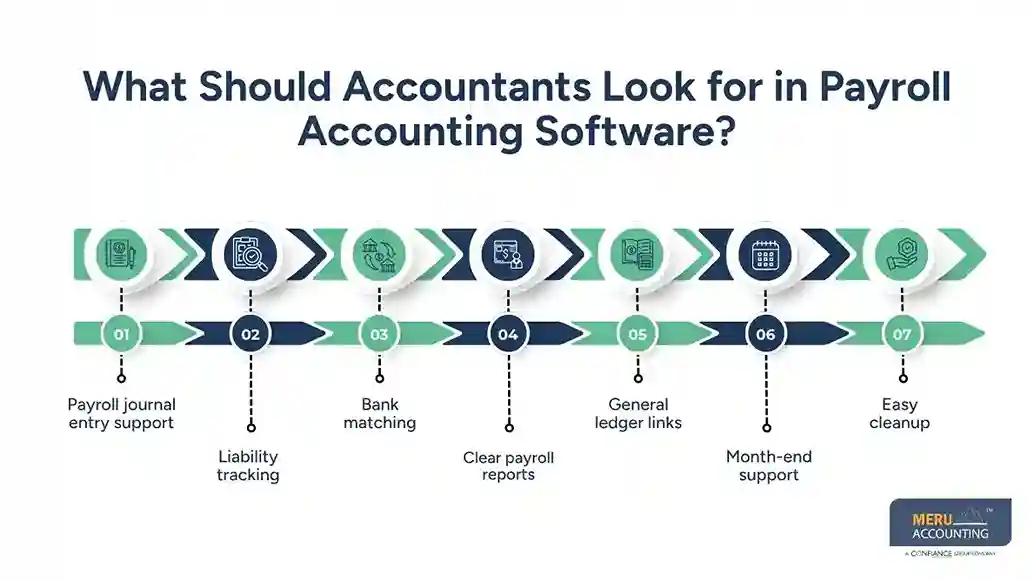
General ledger links
A good link to the general ledger can cut down on manual entry. It can also help keep payroll data in line with the rest of the books.
Month-end support
Payroll should fit into the close. The tool should help an accountant review pay entries, clear paid debts, and spot open items.
Easy cleanup
Older payroll books may have wrong entries or old debt balances. A useful system should make it easy to trace and fix these items.
Meru Accounting’s Payroll Accounting Services
Payroll records can look fine in the payroll system while the books still have gaps. Meru Accounting reviews the full payroll flow to make sure payroll entries, liabilities, payments, and account balances line up.
Our Payroll Accounting Support:
- Payroll records: Wage, benefit, deduction, and payroll expense entries
- Tax liabilities: Payroll tax and liability account checks
- Journal entries: Payroll entries and account coding
- Reconciliation: Payroll payments matched to bank activity
- Month-end review: Open balances, payroll accounts, and related records
- Cleanup: Past payroll cleanup and catch-up bookkeeping
- Tax-ready records: Organized payroll records for tax and financial reporting
- Software support: Work with your existing payroll and accounting setup
Our team can adapt the review to your payroll process and software, with a focus on keeping payroll activity accurate from the pay run through the month-end close.
Our Expert Insight
Payroll liability accounts can be misleading if you only look at the ending balance. A balance does not always mean a tax payment is still due. It may be caused by a payment posted to the wrong account, a timing gap between payroll and payment, or an old balance that was never cleared.
In practice, we look at the payroll report, liability ledger, and bank activity together. If those three records do not agree, we trace the difference back to the specific pay run or payment instead of making a quick adjustment.
This approach is especially useful during month-end close. It helps accountants fix the source of the issue and avoid carrying the same payroll error into the next period.
Key Takeaways
- Payroll tax software for accountants focuses on payroll tax data, forms, payments, and filing support.
- Payroll accounting software focuses on wages, payroll debts, journal entries, and book records.
- The two tools can work together in one payroll flow.
- Tax filing does not prove that the books are right.
- Payroll tax debts should be checked against both payroll reports and ledger balances.
- Bank payments should be matched to the right payroll accounts.
- Payroll accounting software should support journal entries, liability checks, reports, and month-end work.
- A hands-on review can help find gaps that software alone may not catch.
FAQs
Look for tax filing support, state tax coverage, tax reports, payment tracking, and software integrations.
Yes. Many accountant-focused tools support separate client accounts and payroll tax records.
The payment may be posted to the wrong account, period, or liability code.
Yes. It can help accountants review payroll expenses, liabilities, entries, and payments.
Yes. Tax software can handle tax tasks while accounting software manages the related book entries and balances.
optional anymore
on running the business