Your books may look fine at first glance. Sales are coming in, bills are being paid, and the bank has money in it. But can you say what your real profit is? Do you know which clients still owe you money? Can you tell if next month’s cash will cover your bills? These are the points where a small business accountant can add real value.
The right choice is not just about who can enter data. It is about finding someone who can keep the books in order, handle tax work, build clear reports, and give sound input when money calls need to be made.
What You Will Learn From This Blog
- When it makes sense to hire a small business accountant.
- What to check before you choose one.
- Which book, tax, pay, report, and plan tasks may be part of the job.
- How to read and compare accounting fees.
- Which red flags may point to poor service.
- How to compare a small business accounting firm with other options.
When Should You Hire a Small Business Accountant?
Your Books are Falling Behind
One late month can turn into three. Then tax time comes, and you have a pile of bills, bank entries, and sales records to sort out. A small business accountant can set a fixed month-end process so your books are checked while the data is still fresh.
Tax Work is Becoming Difficult to Manage
Tax work can seem easy when the firm is small. More sales, staff, assets, and types of costs can soon change that.
If tax work now takes time away from core work, an experienced accounting professional can take on the task and keep the records in shape for filing.
You Need Better Financial Reports
You may know how much money came in last month, but that does not tell the full story. You also need to know what you spent, what you made, and what clients still owe.
A qualified accountant can turn book data into reports that give you a much clearer view of the firm.
Your Business is Growing
Growth sounds good until the work behind it starts to pile up. More sales can mean more bills, staff, tax work, bank entries, and client dues.
A small business accountant can build a workflow that can handle the added load before the books become hard to control.
optional anymore
on running the business
How to Choose a Small Business Accountant
Define Your Accounting Needs
Do not start with the question, “Who is the best accountant?” Start with, “What do I need done?”
Make a list of the work that takes your time now. This may include books, tax, pay, bills, client dues, cash plans, or month-end reports. A small business accounting firm can then be checked against a real list.
Check Industry and Business Experience
A firm that sells goods may have stock and sales tax needs that a small service firm does not. A firm with staff may also need more pay and tax work.
Ask the small business accountant about past work with firms like yours. Relevant work is often more useful than a long list of general claims.
Review Qualifications and Credentials
Check the person’s training, tax skills, work record, and any key license or mark needed for the work.
Also ask who will do the work and who will check it. The accountant you choose should be clear about both roles.
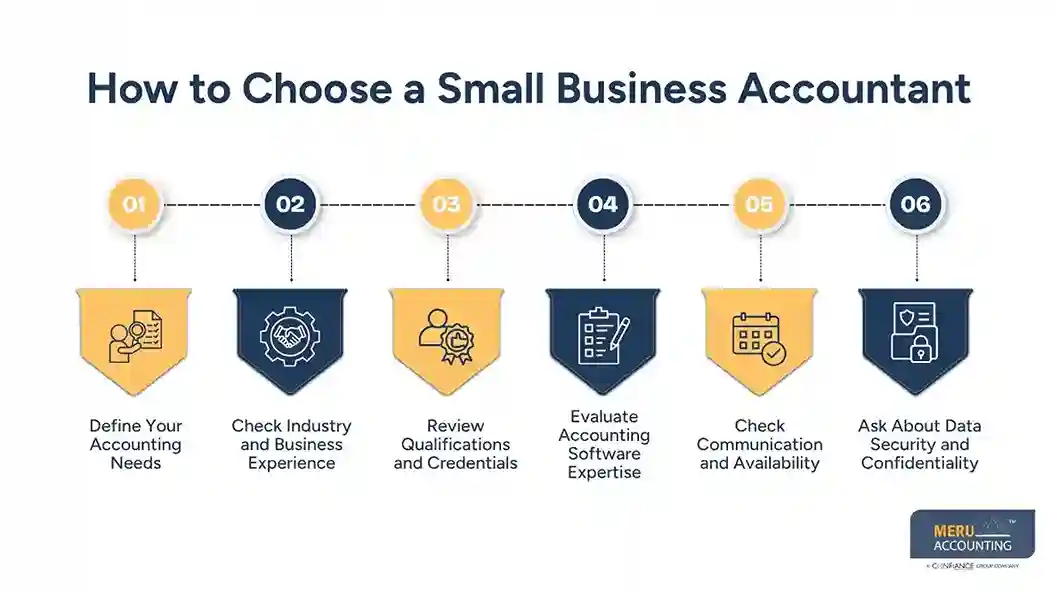
Evaluate Accounting Software Expertise
The right tool can save time, but only when it is set up and used well. Ask if the accountant knows the tool your firm uses and how they deal with bank feeds, user access, reports, and data checks.
QuickBooks, Xero, Zoho Books, NetSuite, and Odoo are some tools a small business accountant may work with.
Check Communication and Availability
You do not need an accountant who is online all day. You do need one who tells you when reports will come, who will answer your mail, and what to do when a tax or pay issue is urgent.
Ask these things before you sign. It is much easier than trying to fix poor contact later.
Ask About Data Security and Confidentiality
Your books may hold bank data, tax files, pay data, and client details. Ask how these files are stored and shared, who can view them, and how old user access is removed.
A small business accounting firm should have clear rules for data access and file safety.
What Services Should a Small Business Accountant Provide?
Monthly Bookkeeping
Monthly bookkeeping keeps sales, costs, bank entries, and account totals up to date. It also gives you a chance to spot a bad entry before it gets buried in months of data.
Ask the small business accountant if bank and card checks are part of the month-end work.
Accounts Payable and Accounts Receivable
You need to know two things: what you owe and what others owe you.
Payable and receivable work keeps due bills and open client dues in view. This can make cash plans far more useful than a bank balance on its own.
Tax Preparation and Filing
Tax work can cover data checks, tax prep, review, filing, and replies to tax queries. But not every fee covers all of these tasks.
Ask what your small business accountant will do and what may cost extra before you agree to the plan.
Payroll Accounting
Payroll can touch wages, tax, staff data, pay slips, and pay reports. Even a small error can lead to a bad pay run or a wrong tax record.
Ask if your accounting professional will also check payroll data against the main books.
Financial Statements and Reporting
A report should tell you more than a set of totals. If costs rise, you should be able to see which cost drove the change.
A qualified accounting professional should be able to walk you through key reports and flag odd or large changes.
Cash Flow and Budget Planning
Here is a common case: a client owes you $20,000, but payment is due in 30 days. Your rent, pay, and supplier bills are due this week.
The firm may show a profit, yet cash can still be tight. Cash flow plans let you see such gaps in time to act.
Business and Financial Planning
A new hire, new site, loan, or large tool buy can change your cash needs. A small business accountant can use past and current data to test what such a move may cost.
This gives you a sound base for a plan, rather than a guess based on sales.
How Much Does a Small Business Accountant Cost?
Hourly vs. Monthly Accounting Fees
Hourly fees may suit a one-off job, such as a book clean-up. A set monthly fee may be a better fit when you need books, tax, pay, or reports on a set cycle.
Ask what each fee covers and when an extra bill can arise.
Factors That Affect Accounting Costs
There is no one rate for all firms. Fees can vary with sales count, bank accounts, staff, tax work, stock, sites, and report needs.
A small business accounting firm may also charge more when the plan has book work, tax, pay, review, and reports in one scope.
What to Check Before Comparing Quotes
Give each small business accountant the same work list. If one quote covers only book entry and another also has tax and reports, the two prices are not a fair match.
Check for set-up fees, old book clean-up, tax forms, pay work, extra meetings, and added reports.
Red Flags to Watch for When Choosing an Accountant
Unclear Pricing
A low price can look good until the first extra bill arrives. Ask for a clear list of what the fee covers and what may cost more.
The quote should also state how and when you will be billed.
Limited Communication
A late reply is more than an annoyance when a tax date or pay run is close. Ask how normal and urgent questions are handled. Your accounting provider should give you a clear way to reach the right person.
Lack of Relevant Experience
Years in the field do not mean much if the accountant has not dealt with firms like yours.
Ask what types of firms they serve, what book tools they use, and which tax or report tasks they handle most often.
Poor Data Security Practices
If an accountant cannot tell you who can see your files, where they are kept, or how access is set, treat that as a warning sign.
A small business accounting firm should have a clear way to keep bank, tax, staff, and client data safe.
No Clear Review or Reporting Process
Ask what takes place after the books are entered. Who checks the work? When do you get the report? What happens if a number does not look right?
A skilled small business accountant should be able to give a clear answer to each point.
How to Evaluate and Compare Small Business Accountants
Compare Services
Make one list of the tasks you need and check each small business accountant against it. Note what is in the fee and what is not.
This gives you a fair way to compare two firms with very different service plans.
Compare Experience
Look at the type of firms served, tax work, book tools, team size, and years of work in your field.
The best fit may be the small business accountant who knows your type of work well, not the one with the most years on paper.
Compare Pricing
Look at the likely yearly cost, not just the rate per hour or month. Add tax work, pay, book clean-up, reports, and any extra fees you may face.
This gives you a more useful cost view.
Compare Technology
Ask how the small business accounting firm will use your book tool, share files, set user rights, keep backups, and send reports.
The tech setup should make your books easy to view and check.
Check References and Reviews
Look for views on work quality, bill clarity, reply time, and follow-up. If you can speak with a past client, ask what the service was like after the first few months.
That can give you a view that a sales call may not show.
Why Choose Meru Accounting for Small Business Accounting?
Meru Accounting provides bookkeeping, tax, pay, accounts payable and receivable, reporting, and business plan services for firms that need a set way to manage their accounts.
Meru Accounting works with tools such as QuickBooks, Xero, Zoho Books, NetSuite, and Odoo. The scope can cover daily bookkeeping, tax tasks, pay records, and key money reports.
For US work, Meru Accounting provides services based on US GAAP and IRS needs. The work of a small business accounting firm can be set to match the firm’s book, tax, and report needs.
The team can also work with firms that need regular monthly accounting tasks and clear financial reports. This gives business owners a clear view of their books and key money data.
Meru Accounting can also fit its services to the size and needs of each firm, so businesses can choose the work they need rather than pay for tasks that do not fit their scope.
Our Expert Perspective
Do not judge a small business accountant by the fee alone. A low fee has little value if you still have to sort the books, chase reports, or work out what the numbers mean.
Look at what happens after the data is entered. Can the accountant tell you why cash fell? Can they point out a rise in costs? Can they flag a tax issue before filing?
Those answers give you a much better way to judge the fit than a sales pitch.
Key Takeaways
- Pick a small business accountant based on the work your firm needs.
- Check past work, tax skill, book tool skill, and reply time.
- Ask what book, tax, pay, report, and plan work is in the fee.
- Compare the full cost, not just the lowest rate.
- Ask how bank, tax, staff, and client data will be kept safe.
- Read your reports each month so you can act on key changes.
- Pick a small business accounting firm that can explain your numbers, not just enter them.
FAQs
Choose a small business accountant based on your needs, field work, tax skills, software skills, fees, clear communication, and data safety. Check a few good picks before you make your choice.
Look for work in your field, clear fees, good software skills, tax skills, set reports, clear communication, and a safe way to keep your data.
A small business accountant may charge by the hour or set a flat fee each month. The cost can vary by bookkeeping, tax, payroll, reports, the number of deals, and other work.
Choose based on the work you need, the level of tax and bookkeeping work, cost, team size, and skill range. A small business accounting firm may offer more types of work, while one accountant may fit a small scope.
Ask about their work record, services, fees, tax work, accounting software, report plan, data safety, communication, and who will check your books. Also ask about any extra fees before you sign a deal.
optional anymore
on running the business