Ecommerce bookkeeping gives an online store a clear view of sales, costs, stock, cash, and profit. High sales can still mean low returns when product cost, ads, shipping, refunds, and fees are not tracked well.
Online sales can make many money records each day. Orders may come from a store site, Amazon, eBay, Etsy, or social sales, while cash may come later as one payout.
Accurate ecommerce bookkeeping links these records so an owner can see what was sold, what it cost, and what cash is due. Bookkeeping services for ecommerce businesses can be useful as order volume and sales channels grow.
What You Will Learn From This Blog
- How ecommerce bookkeeping tracks sales, costs, stock, cash, and profit.
- Which KPIs show sales value, margin, stock use, and customer spend.
- Which reports an ecommerce owner should check each month.
- How to record stock buys, returns, refunds, damage, and stock gaps.
- How to check profit by item and sales channel after key fees.
- When bookkeeping services for ecommerce businesses may suit a growing store.
What is Ecommerce Bookkeeping and Why Does it Matter?
Ecommerce bookkeeping is the work of recording and checking sales, costs, payouts, refunds, fees, and other money data from each sales channel. An online store may sell through its own site, Amazon, eBay, Etsy, or other sites, so each source must match order and payout data. This gives the firm a clear view of total sales, rather than one site’s sales alone.
Sales alone do not show how much a firm earns. Product costs, packing, shipping, ads, payment fees, site fees, refunds, and other order costs can cut the amount left from each sale.
A sale may take place days before the cash hits the bank, while a market site may group many orders into one payout. Accurate ecommerce bookkeeping links sales with cash and costs, so gaps, missed entries, or wrong sums can be found early.
Clear records also matter for tax work, as tax rules can vary by place, item, and sales site. Keep sales, tax, fee, refund, and cost data in a form a tax pro can check and trace.
Bookkeeping services for ecommerce businesses can keep these records in order and give owners a clear view of item costs, cash, sales sites, and profit after key costs.
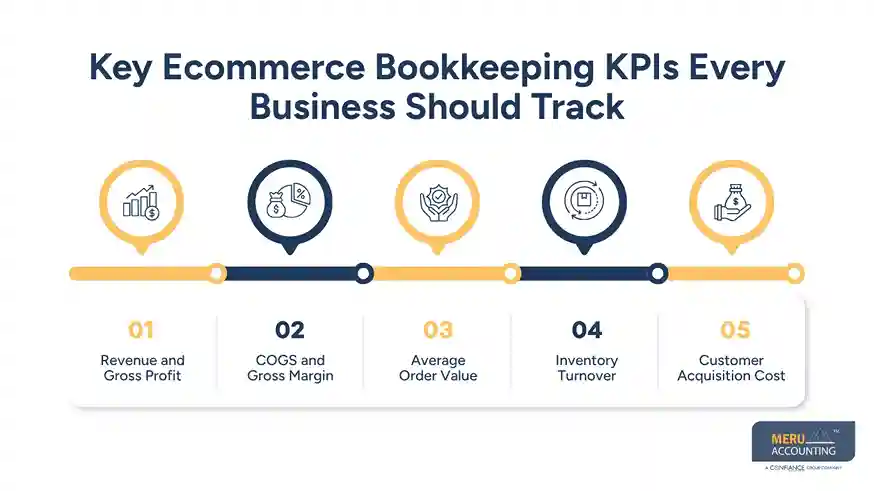
Key Ecommerce Bookkeeping KPIs Every Business Should Track
Revenue and Gross Profit
Revenue shows sales for a set time. Gross profit is sales less COGS, so both sums should be read as one.
COGS and Gross Margin
COGS is the cost of goods sold. Gross margin is gross profit divided by net sales. It can flag price, vendor, sale, or item mix changes.
Average Order Value
AOV is sales divided by order count. For example, $20,000 from 500 orders gives a $40 AOV. Check it with margin, not sales alone.
Inventory Turnover
Inventory turnover shows how often stock is sold and replaced. A low rate may mean cash is tied up in stock that sells slowly.
Customer Acquisition Cost
CAC is the cost to gain a new customer. Check CAC with AOV, gross margin, repeat sales, and payback time before you judge ad results.
Ecommerce Financial Reports You Need To Review
Profit and Loss Statement
The P&L shows sales, COGS, costs, and profit. Check ads, pay, software, shipping, refunds, and fees as set cost lines where it helps.
Balance Sheet
The balance sheet shows assets, debt, and owner equity at a set date. Stock, cash, loans, and unpaid sums are key areas for an ecommerce firm.
Cash Flow Statement
Cash flow shows how cash moves. Profit is not cash, since stock buys, loan pay, and payout times can change the bank balance.
Sales and Expense Reports
Sales reports can show results by item, site, or date. Expense reports show where costs rise and which lines need a check.
Month-End Review Pack
Bring the P&L, balance sheet, cash flow, sales, stock, fees, and KPIs into one month-end pack. List open items such as lost payouts or stock gaps.
How to Manage Inventory With Ecommerce Bookkeeping
Inventory Costs and Valuation
Stock is an asset until sold. Use a clear ecommerce bookkeeping stock cost method, such as FIFO or weighted average, based on the rules that apply to the firm.
Stock Purchases and Adjustments
Record vendor bills, stock buys, returns, and valid direct stock costs in the right time span. Do not book goods as an expense if they are still held for sale.
Returns, Refunds, and Damaged Stock
A return can change sales, stock, fees, and cash. Link the refund to the order and check if the item can go back to sellable stock.
Inventory Reconciliation
Compare book stock with store or site data at set times. Find the cause of gaps before you post an entry to fix them.
Stock Count Controls
Use item codes, clear units, count sheets, and review checks. Note who did the count, when it was done, and why any stock value changed. Bookkeeping services for ecommerce businesses can set this check as a set task.
optional anymore
on running the business
How Ecommerce Bookkeeping Helps Measure Profitability
Product-Level Profit Margins
A store can have both profit and loss items. Item margin checks show which SKUs earn enough after COGS and direct costs.
Channel and Marketplace Profitability
A sales site may show high sales but also high fees. Check sales, refunds, fees, and margin by site before you move more ad spend there.
Shipping, Payment, and Platform Fees
Fees can take a big share of a low-value order. A $50 sale with $20 in item cost and $18 in fees and shipping cost leaves $12 before other costs.
Net Profit Vs. Gross Profit
Gross profit is sales less COGS. Net profit is what stays after costs such as ads, pay, rent, and software.
Cash Profit Checks
A store can show profit and still face cash strain when too much cash sits in stock or payouts come late. Ecommerce bookkeeping should show this gap. Check cash with margin and net profit.
Best Practices for Accurate Ecommerce Bookkeeping
Set a Fixed Month-End Process
Close books on a set date. Match sales, payouts, bank entries, fees, refunds, and key costs before you use the reports.
Reconcile Sales Payouts
Do not post a market payout as one sales lump. Break out sales, refunds, fees, tax where needed, and the final cash sum.
Keep Source Records
Save vendor bills, order reports, payout files, fee reports, refund data, and stock records so key sums can be checked and traced.
Separate Business and Personal Costs
Keep business and personal spend apart. This gives a clean view of the true cost of the store.
Review KPIs Each Month
Review the same ecommerce bookkeeping KPIs each month, such as margin, AOV, CAC, stock turn, refunds, and site results.
Our Expert Perspective
In our view, good ecommerce bookkeeping should explain a sum, not just show it. If margin falls, the records should point to price, COGS, returns, fees, or item mix.
Why Choose Meru Accounting For Ecommerce Bookkeeping
Ecommerce-Focused Bookkeeping
Meru Accounting provides bookkeeping services for ecommerce businesses that need sales, costs, payouts, stock, and reports kept in order.
Multi-Channel Records
We provide services that can bring site and market sales, fees, refunds, and payouts into one clear process.
Inventory and Reconciliation
Meru Accounting provides services for stock records, buy entries, changes, and checks based on the client’s setup.
Clear Financial Reports
At Meru Accounting, we provide reports that show sales, costs, assets, debt, and profit for a clear month-end view.
Accounting Software Knowledge
Meru Accounting works with QuickBooks, Xero, Zoho Books, NetSuite, and Odoo. The right setup will vary by order count, sales sites, and stock flow. Bookkeeping services for ecommerce businesses can fit the setup to these needs.
Our Expert Perspective
High sales do not always mean high profit. COGS, refunds, ad spend, fees, and shipping can cut returns even when order count is high. Check profit by item and sales site, not just total sales. High stock can also tie up cash, so set stock checks can flag slow items. Market payouts may not match sales due to fees, refunds, tax, and other cuts, so check each payout with its source report. A month-end check of sales, margin, stock, fees, cash, and net profit gives owners a clear base for key calls, while bookkeeping services for ecommerce businesses can make these checks part of a set month-end task.
Key Takeaways
- Track sales, COGS, fees, refunds, stock, and cash as linked records.
- Review revenue with gross profit and margin.
- Use the P&L, balance sheet, cash flow, sales, and expense reports each month.
- Check stock and market payouts instead of using site totals alone.
- Test profit by item and site after direct costs and fees.
- Use a set month-end process and keep source records, especially when using bookkeeping services for ecommerce businesses.
- Bookkeeping services for ecommerce businesses can add value as order volume and site count grow.
FAQs
Ecommerce bookkeeping records and checks sales, COGS, stock, market fees, refunds, costs, payouts, and bank deposits.
An ecommerce business should track revenue, gross margin, average order value, stock turn, customer acquisition cost, and net profit.
An ecommerce business should review the P&L, balance sheet, cash flow, sales report, cost report, and stock report.
Ecommerce bookkeeping records stock buys and costs, then links sales, returns, damaged goods, and stock changes to the stock balance.
Ecommerce profit is found by taking COGS, shipping, payment fees, site fees, ad costs, refunds, and other costs from sales.
optional anymore
on running the business