Hiring a CPA can raise a simple question: how much will it cost? The CPA hourly rate is often one of the first things small business owners look at, but the rate alone does not tell you what you’ll pay. The type of work, time needed, and level of support can all affect your final bill.
Some CPAs charge by the hour, while others offer flat fees for certain services. Knowing how these fees work can help you compare quotes and avoid unexpected costs. In this guide, we’ll break down the CPA cost for small business needs and explain what you should consider before hiring a CPA.
What You Will Learn From This Blog
This guide covers:
- The usual CPA hourly rate for small business work
- What goes into the CPA cost for small business
- Why CPA fees can vary
- Hourly rates vs. flat fees
- How to plan for CPA costs
- When CPA help may be worth the cost
- How outsourced CPA and accounting help can fit your needs
What Is the Average CPA Hourly Rate?
There is no one set CPA hourly rate for all firms. Many CPA firms charge about $150 to $400 or more per hour. The rate may be lower for basic work and much higher for niche work.
For small firms, the key point is that the rate is only part of the cost. The time spent on the job also matters. A CPA who bills $200 per hour for three hours may cost less than one who bills $150 per hour but needs eight hours.
The type of work also plays a role. Basic tax prep may have one rate. Tax planning, audit work, or business advice may have another. A CPA with great skill in a niche field may also charge more.
Rates can also vary by area. A firm in a large U.S. city may have higher rates than one in a small market. Still, price alone should not be the main factor when you pick a CPA.
Ask what is included in the rate. Find out if calls, emails, review time, tax work, and follow-up work are billed on top of the base fee.
How Much Does a CPA Cost for a Small Business?
The CPA cost for small business needs can range from a few hundred dollars for a small task to several thousand dollars a year for wider help. The total will depend on the work you need and how often you need it.
For example, a very small firm may need help with tax prep once a year. Another firm may need help each month with books, tax plans, reports, and key finance tasks.
A rough way to view costs is by type of need:
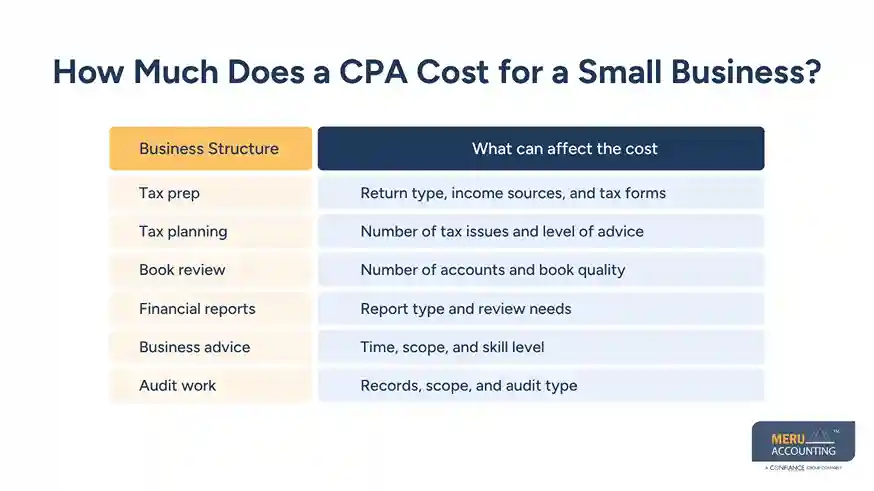
These are not fixed prices. They are a way to see why the CPA cost for small business work can differ from one firm to another.
A business should also look at the full cost, not just the rate. Clean books can cut CPA time. Poor books may lead to more review, fixes, and follow-up work.
optional anymore
on running the business
What Determines a CPA Hourly Rate?
Several factors can shape a CPA hourly rate.
CPA Experience
A CPA with many years of work may charge more than a new CPA. Deep skill can be worth the added cost when the work is hard or has a high tax risk.
Type of Work
Simple work may need less time and skill. Tax planning, audits, business setup, and complex tax issues may need more.
Business Size
A firm with one bank account and a few sales may need less CPA time. A firm with many accounts, staff, loans, and sales channels may need far more work.
Book Quality
Good books can make CPA work much faster. If bank accounts are not matched, sales are not booked right, or old items are still open, the CPA may need to fix the books first.
Records and Data
A CPA may need to sort bank data, bills, sales data, loan files, payroll data, and tax forms. The more data there is, the more time the work may take.
Level of Support
Some firms need a CPA for one tax task. Others need help all year. Ongoing help may cost more, but it can also help the owner spot issues sooner.
CPA Hourly Rate vs. Flat-Fee Pricing
Not all CPAs bill by the hour. Some use a flat fee for set work. Others use both models.
With hourly billing, you pay for the time spent on the job. This can work well when the scope is not clear. It can also make it harder to know the final bill if the work grows.
With flat pricing, the CPA sets a fee for a defined task. This may make costs easier to plan. But the scope must be clear. Extra work may still lead to added fees.
For example, a CPA may set one fee for a basic tax return. If the return has more forms or a new tax issue, the final fee may change.
When you compare firms, ask:
- What work does the fee cover?
- What is billed by the hour?
- Are calls and emails billed?
- Is tax planning part of the fee?
- What work leads to an extra charge?
- Will I get a cost range before work starts?
The best choice is not always the firm with the lowest CPA hourly rate. A clear scope and good work can matter more than a low rate.
How to Estimate Your Small Business CPA Costs
Start by listing the work you need. Do not start with price alone.
For example, your list may include:
- Tax return prep
- Tax planning
- Monthly book review
- Bank and card checks
- Financial reports
- Payroll review
- Sales tax help
- Year-end close
- Business advice
Next, look at the state of your books. Are your accounts matched each month? Are old items still open? Do your sales and costs tie to your bank data? If not, cleanup may be needed before tax work starts.
Then ask for a clear quote. Tell the CPA how many bank accounts you have, what book system you use, how many sales you make, and what type of return you file.
You can then compare the likely hours, fee model, and scope.
It also helps to split the work. A business may not need a CPA to do every book task. A bookkeeper can often handle routine bookkeeping work, while a CPA can focus on tax, review, and advice.
This can help control the CPA cost for small business needs without cutting out CPA support where it adds the most value.
Meru Accounting’s CPA Services for Small Businesses
Small business finances can involve sales, payroll, vendor bills, loans, and several bank accounts. Keeping all of it in sync takes more than data entry. At Meru Accounting, our team helps businesses keep their books accurate and organized across different industries and accounting systems, including QuickBooks, Xero, and Zoho Books.
Our Services Include
- Monthly bookkeeping and account review
- Bank and credit card reconciliation
- Accounts payable and accounts receivable
- Payroll accounting support
- Monthly financial statements
- Book cleanup and catch-up
- Tax-ready books and records
- CPA and tax support
- Accounting workflow and software support
Our team also reviews the details behind the numbers. For example, a bank deposit may be net of payment fees, while a loan payment may include both principal and interest. We check these details so transactions are recorded in the right accounts and reports reflect the actual business activity.
Whether you need ongoing bookkeeping, year-end cleanup, or accounting support for your CPA, Meru can work within your current setup and provide the level of help your business needs.
Our Expert Insight
One thing we tell small business owners is not to compare CPA quotes by hourly rate alone. A $175 hourly rate may look better than $250, but the lower rate does not always mean a lower bill. The real cost depends on how much work is included and how the CPA handles extra tasks.
Before you agree to a fee, ask what the quote covers. Does it include tax planning, email support, book review, and follow-up questions? Also ask what happens if the CPA finds an issue after work begins.
A clear scope can make pricing much easier to compare. You can then judge the CPA hourly rate along with the work you will actually receive, rather than choosing based on the lowest number.
Key Takeaways
- The CPA hourly rate can vary by firm, work type, skill, and market.
- Many CPA firms charge around $150 to $400 or more per hour, but rates are not fixed.
- The CPA cost for small business needs depends on the work, time, and level of support.
- Clean books can reduce the time a CPA needs to spend on review and fixes.
- Ask what the fee covers before you hire a CPA.
- Compare the full scope of work, not just the hourly rate.
- Routine book work and CPA work can be split to help manage costs.
- Good monthly records can make tax work faster and easier.
FAQs
Sometimes. A CPA may adjust the rate or offer a set fee based on the work and expected hours. It is worth asking before you sign an engagement letter.
Some do. Others include routine calls and emails in their fee. Ask how communication is billed before you start.
Extra hours may come from added tax forms, missing records, book corrections, or work outside the original scope. Ask for an estimate and scope up front.
Usually, yes, because CPAs often handle higher-level tax, review, and advisory work. Many small businesses use a bookkeeper for routine work and a CPA for specialized needs.
Ask for the billing method, hourly rate or fixed fee, services included, extra charges, and estimated total cost. This makes it easier to compare the full CPA cost for small business services.
optional anymore
on running the business