An Amazon accountant does more than track sales and costs. For a Fulfillment by Amazon (FBA) seller, the books must cover Amazon sales, FBA fees, stock, refunds, tax data, bills, and bank payouts. A clear set of books shows what the firm earns, spends, and keeps.
Amazon sellers may have high sales but low cash. FBA fees, ad spend, returns, stock buys, and tax bills can cut into cash. An Amazon accounting pro can bring these numbers into one clear view.
Selling on Amazon can lead to a high flow of data. Each sale may bring sales income, Amazon fees, tax, refunds, shipping costs, and other costs. The seller then gets a net payout, not the full sale sum.
This is why an Amazon accountant must know both core books and FBA work. Good books can show item profit, cash needs, unpaid bills, stock value, and tax risk.
What You Will Learn From This Blog
- What an Amazon accountant does for an FBA firm.
- Which Amazon sales, fees, costs, and stock data need close checks.
- How FBA data moves from Amazon reports to the books.
- What sellers need to know about income tax and sales tax.
- What Amazon accounting services can cover.
- How to check the ROI of an Amazon accountant.
What Does an Amazon Accountant Do?
Amazon bookkeeping and transaction recording
An Amazon accountant logs sales, refunds, fees, bills, bank data, and other firm costs. The goal is to keep the books in line with real sales and costs, not just bank payouts.
FBA fee and expense tracking
FBA may have fees for shipping, stock hold, sales, stock pull, and more. Amazon gives sellers fee and cost data that can help them check the cost of each sale.
Bank and Amazon Account Reconciliation
An Amazon accountant checks Amazon payout data against bank pay-ins and the books. This can find gaps, wrong entries, double entries, or sums that need a check.
Accounts Payable and Accounts Receivable
Supplier bills, tool costs, ship bills, and other unpaid sums form part of accounts payable. Receivables may also be part of the books when a firm sells through other sales paths.
Financial Reporting and Analysis
An Amazon accounting pro can turn raw data into sales, profit, cost, stock, and cash reports. These reports give the seller a sound base for pricing and stock plans.
Why Accounting Matters for Amazon FBA Sellers
Tracking Sales and Amazon Payouts
Amazon sales and Amazon payouts are not the same sum. A payout is often what is left after fees and other cuts. Good books track both sides of this flow.
Managing FBA Fees and Other Selling Costs
FBA fees can cut into item profit in ways that sales data may not show. Amazon has tools such as Fee Preview and its Revenue Calculator to help sellers check these costs.
Knowing the Real Profit on Each Product
A $40 item does not mean $40 in profit. Item cost, FBA fees, ads, returns, shipping costs, and other costs can cut the gain. An Amazon accounting pro can bring these costs into the item check.
Avoiding Cash Flow Gaps
A seller may have good sales but still need cash for the next stock buy or tax bill. A cash check gives the seller a clear view of what cash is free to use.
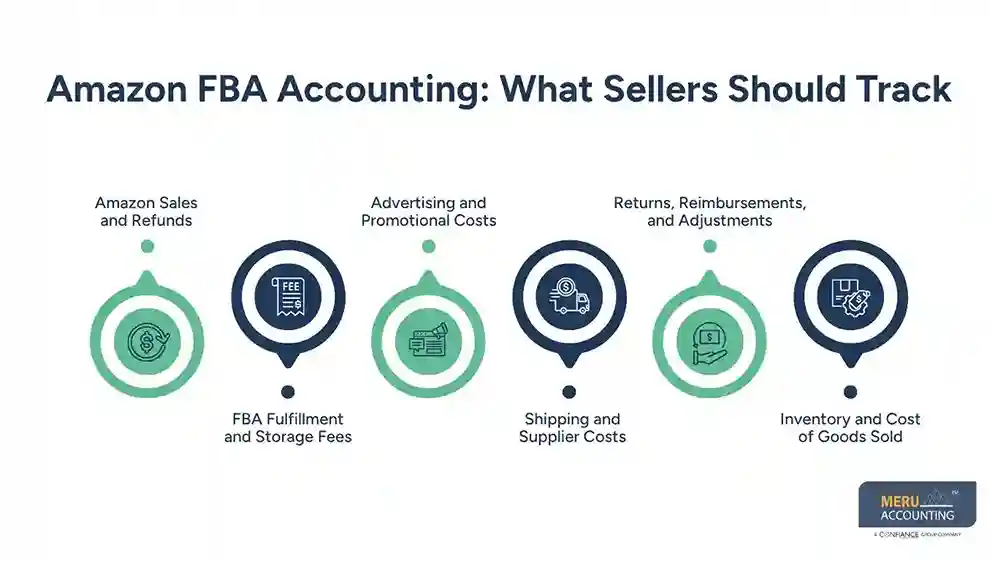
Amazon FBA Accounting: What Sellers Should Track
Amazon Sales and Refunds
Sales must be tracked with refunds and other sales cuts. If the books track only bank cash, key data may be left out.
FBA Fulfillment and Storage Fees
Ship and stock hold fees can vary by item and stock level. Amazon says FBA fees can cover tasks such as stock hold, pick, pack, and ship work.
Advertising and Promotional Costs
Ads and sales deals can take a large part of sales. An Amazon accountant should post these costs to the right cost heads so the seller can see their effect on profit.
Shipping and Supplier Costs
Supplier bills, freight, customs, and inbound shipping costs may form part of item cost or firm cost, based on the book and tax rules in use. These costs also help set the value of stock.
Returns, Reimbursements, and Adjustments
Returns and pay-backs can lead to entries that do not match the first sale. Each item must be checked so the books show what took place.
Inventory and Cost of Goods Sold
Stock is a key part of FBA accounting. An Amazon accountant can track stock buys, units sold, stock on hand, and cost of goods sold to give a clear view of profit.
How Amazon FBA Accounting Works
From Amazon Sales to Financial Statements
The work starts with data from Amazon and other sales paths. The data is sorted, checked, matched, and then used to make the key books and reports.
Amazon Settlement Reports and Accounting Records
Settlement reports show the data that sits behind Amazon payouts. An Amazon accountant can use these reports to match sales, fees, refunds, and other entries with the books.
Accrual vs. Cash-Basis Accounting
Cash-basis books record income and costs when cash moves. Accrual books record them when income is earned or a cost is due, based on the rules that apply. The right method can vary by firm and tax case.
Matching Amazon Transactions with Bank Deposits
One bank pay-in may group many Amazon sales and costs. Matching each pay-in to its Amazon set helps stop the books from treating one pay-out as the full sale.
Handling Multi-Channel E-commerce Sales
Some sellers use Amazon with Shopify, Walmart, eBay, or their own site. An Amazon accountant can keep each sales path clear while also bringing all data into one view.
optional anymore
on running the business
Amazon Tax Accounting: What Sellers Should Know
Federal Income Tax
FBA income is part of the seller’s tax base, based on the firm type and tax case. Good books give the tax pro the data needed to work on the tax return.
State Sales Tax
Sales tax rules can vary by state. Sellers should check where they may have tax duties and if market tax rules apply. An Amazon accountant should not use one rule for each state.
Marketplace Facilitator Rules
Many states have market laws that make Amazon collect and pay some sales tax on market sales. This does not mean all tax work ends, so sellers still need a state-by-state check.
Sales Tax Nexus for Amazon Sellers
Nexus may come from a link such as a site, sales level, or stock in a state, based on state law. FBA sellers should check their own facts and not rely on one broad rule.
Tax Deductions for FBA Businesses
Some valid costs may be tax write-offs. These can include ads, tools, pro fees, stock used for work, and other normal firm costs. The right tax use can vary by cost and tax case.
1099-K and Amazon Tax Reporting
Form 1099-K is a tax info form. It should be checked against the seller’s books and not used as the full profit figure. Under current US tax rules, third-party firms such as pay firms may need to file a 1099-K when gross payouts pass set limits. Other rules may also apply.
Working With a Tax Professional
Tax work can vary by seller, state, firm type, and tax year. An Amazon accountant can set up and sort the books, while a tax pro can check the tax case and filing needs.
Amazon Accounting Services: What is Included?
Monthly Bookkeeping
Amazon accounting services may cover monthly bookkeeping, account checks, bank match work, and basic firm reports. Monthly work can keep small issues from piling up till year-end.
Tax Preparation and Filing
Some firms add tax prep to their book work, while others work with the seller’s CPA or tax pro. Sellers should check who will handle each tax filing.
FBA Accounting and Reconciliation
Amazon accounting solutions can cover settlement checks, Amazon-to-bank match work, fee checks, refunds, and other FBA entries. The full work list should be set before the work starts.
Inventory Accounting
Stock work may cover stock value, cost of goods sold, buy records, and stock changes. This is key as stock can have a direct effect on the profit shown in the books.
Financial Reporting
Amazon accounting services may provide profit and loss reports, balance sheets, cash flow reports, and other firm data. The main value is in making these reports fit real firm needs.
Sales Tax Support
Some firms may offer sales tax data checks, tax setup, filing aid, or report prep. State tax rules vary, so sellers should check the exact work that is part of the deal.
CFO and Financial Advisory Services
At a larger scale, Amazon accounting services may cover cash plans, margin checks, budgets, price checks, and cash flow views. This work is more about firm plans than day-to-day books.
How to Calculate the ROI of an Amazon Accountant
Accounting Cost vs. Financial Gains
Start with the full yearly cost of the Amazon accountant. Then check it against clear gains such as time saved, fewer errors, better tax books, and better cost control.
Time Saved by the Seller
Say a seller spends 12 hours each month on books and money checks. At $30 per hour, that time has a value of $4,320 a year. If an Amazon accounting pro takes on most of this work, the time saved is one part of the ROI.
Tax Savings and Error Reduction
Tax savings should not be promised without a review of the books and tax facts. Still, good books can make valid tax cuts easier to find and may lower the risk of costly book errors.
Better Inventory and Cash Flow Decisions
Clear reports can show which items have good margins and which ones tie up cash. An Amazon accountant can also flag high stock costs, low margins, or large bills due soon.
Example ROI Calculation
Say an Amazon accountant costs $500 each month, or $6,000 a year. The seller saves $4,320 in time, finds $2,500 in costs that can be cut, and gains $1,500 from better money choices. The total gain is $8,320.
ROI can then be seen as:
($8,320 − $6,000) ÷ $6,000 × 100 = 38.7%
This is just an example. A seller should use real firm data to see if the cost is worth it.
Why Choose Meru Accounting for Amazon Accounting Services?
- Meru Accounting provides accounting services that cover Amazon sales, fees, refunds, costs, payouts, and other key FBA data.
- Amazon settlement reports, bank pay-ins, and book data can be checked and matched to keep the books clear and correct.
- Profit and loss reports, balance sheets, cash flow reports, and other key reports can give sellers a clear view of firm results.
- Stock costs, cost of goods sold, supplier costs, ad costs, and other costs can be tracked to give sellers a clear view of real profit.
- The team works with tools such as QuickBooks, Xero, Zoho Books, NetSuite, and Odoo, so the bookkeeping can fit the seller’s own setup.
- Meru Accounting also provides financial reports and virtual CFO services for firms that need more help with cash flow, costs, margins, and firm results.
- Well-kept books give sellers and their tax pros a clear base for tax checks and tax filing work.
The right Amazon accounting services should fit the seller’s sales size, stock needs, sales paths, and report needs. Meru Accounting provides services that can be set to fit these needs as an FBA firm grows.
Our Expert Perspective
In our view, Amazon sellers can see their sales with ease. The hard part is to know what those sales leave as real profit. FBA fees, ad spend, refunds, stock buys, and other costs can change the result a lot. Sellers should check these figures each month, not wait till year-end to see if the firm made a good profit.
We also see accounting as a tool for firm plans, not just a record of past sales. If one item has high sales but low profit, more stock may not be the best move. If cash sits in slow stock, the seller may need to act before the next stock buy. This is where an Amazon accountant can add value: by turning FBA data into clear numbers that the owner can use to make sound choices.
Key Takeaways
- An Amazon accountant tracks and checks Amazon sales, fees, refunds, costs, and payouts.
- FBA accounting needs close checks on stock and cost of goods sold.
- Amazon payouts should not be seen as the same as gross sales.
- FBA fees, ads, returns, supplier costs, and shipping costs can change item profit.
- Sales tax rules depend on the seller’s facts and the states where the firm has tax duties.
- Amazon accounting services can cover bookkeeping, matching work, tax work, stock books, and firm reports.
- The ROI of an Amazon accounting pro can be seen through time saved, fewer errors, cost cuts, and better choices.
- Sellers should use the latest IRS and state rules when they check tax duties.
FAQs
An Amazon accountant tracks sales, FBA fees, refunds, costs, stock, payouts, and key reports for an Amazon firm.
An Amazon accounting pro gives sellers a clear view of profit, cash flow, stock costs, fees, and tax data.
Amazon accounting services can cover bookkeeping, FBA match work, stock books, firm reports, tax preparation, and sales tax aid.
Amazon FBA profit is found by taking item costs, FBA fees, ads, shipping costs, refunds, and other firm costs away from sales income.
The cost of an Amazon accountant can vary based on sales size, the number of entries, stock, sales paths, and the type of accounting work needed.
optional anymore
on running the business