A business may have clean books, steady sales, and a good handle on its daily finances, yet tax filing can still bring unexpected challenges. Complex deductions, multi-state tax rules, and changes in tax laws can make CPA tax preparation harder to manage with an in-house team, especially as the business grows.
Hiring a full-time tax professional isn’t always cost-effective, but leaving tax work to staff without the right expertise can lead to missed deductions or filing errors. Outsourcing gives businesses access to tax professionals without the cost of adding a permanent role.
But how do you know when it’s time to make the switch? Let’s look at the signs that your business may benefit from outsourced tax preparation and what to consider before choosing a provider.
What You Will Learn From This Blog
- What CPA tax preparation includes and how it supports a business.
- Signs that your business may need outside tax support.
- How in-house and outsourced tax work differ.
- Which business tax returns an outside CPA can help prepare.
- What records to gather before you outsource tax work.
- How to choose the right tax preparation partner.
What Is CPA Tax Preparation and What Does It Include?
CPA tax preparation is the process of reviewing a business’s financial records, working out its tax position, and preparing the required tax returns. A Certified Public Accountant (CPA) has met state licensing rules and can offer tax services based on their training and work scope.
For a business, this work goes beyond filling out tax forms. It also calls for a review of income, costs, payroll records, and tax rules that apply to its business type.
Common tasks include:
- Business tax return preparation: Reviewing financial data and preparing the right federal, state, and local tax returns.
- Tax deductions and credits: Checking eligible costs, credits, and tax breaks that may lower the tax bill.
- Tax compliance: Helping the business meet filing dates, payment rules, and tax reporting needs.
- Estimated tax payments: Reviewing income and tax data to help plan quarterly payments.
- Tax record review: Checking books, payroll data, and support files for gaps or errors before filing.
- Tax planning: Looking at tax costs and business plans to help make sound choices before the year ends.
The exact scope depends on the CPA firm and the needs of the business. Some firms only prepare and file returns, while others also offer tax planning and support for tax notices.
optional anymore
on running the business
When Should a Business Consider Outsourcing CPA Tax Preparation Services?
There is no set revenue level or staff count at which a business must outsource tax work. The right time depends on the level of tax work, the skills of the in-house team, and the cost of doing it alone.
Here are some signs that outside support may be worth a look.
1. Tax Deadlines Are Hard to Manage
If your team often rushes to meet tax dates, it may be time to seek help. Tax work can involve many forms, payment dates, and state rules. A small delay in one task can affect the rest of the filing process.
An outside CPA team can help set a clear work plan, track due dates, and prepare returns on time. Your staff can then focus on their core tasks instead of handling every tax step.
2. Your Business Tax Needs Have Become More Complex
A growing business may face tax needs that were not part of its early years. It may add new owners, change its legal setup, hire staff, or sell in more states.
These changes can affect tax returns, tax payments, and reporting rules. An outside CPA with the right business tax skills can review these changes and help your company meet its tax duties.
3. Your In-House Team Lacks Tax Skills
Bookkeeping and tax preparation are not the same tasks. Your bookkeeper may keep records, track costs, and prepare reports, but may not have the skills needed to handle complex tax rules.
If your team has to spend too much time learning tax rules or fixing return errors, outside help may be a better choice. A CPA can review tax issues that need more skill and offer support based on your business needs.
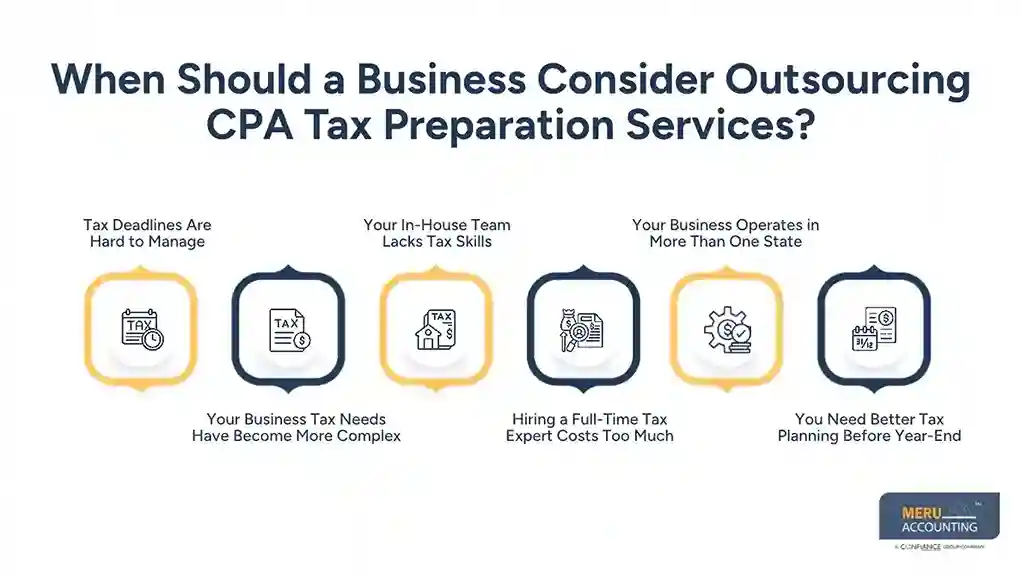
4. Hiring a Full-Time Tax Expert Costs Too Much
A full-time tax hire can add costs beyond salary. You may also need to pay for benefits, training, tax tools, and staff time during slow periods.
For a business with seasonal or limited tax needs, outsourcing can be a more cost-effective option. You pay for the agreed work rather than keeping a full-time tax role on staff.
5. Your Business Operates in More Than One State
Businesses with staff, offices, or sales in more than one state may face added tax rules. State filing needs can vary based on where the business works, sells, or has a tax presence.
This can make tax work harder to manage with a small team. A CPA who knows multi-state tax rules can help review filing needs and keep track of state tax duties.
6. You Need Better Tax Planning Before Year-End
Waiting until tax season to review your tax position can limit the choices you have. By then, some steps that could have helped lower your tax bill may no longer be open.
Outside tax support can help review income, costs, asset purchases, and planned changes before the year ends. This gives owners more time to ask questions and make sound choices.
In-House vs. Outsourced CPA Tax Preparation: Key Differences
Both options can help a business meet its tax needs. The better choice depends on the amount of work, the level of skill needed, and the budget.
Factor | In-House Tax Preparation | Outsourced Tax Preparation |
Staffing | Needs an employee or tax team on staff | Uses an outside tax team |
Cost | Includes salary, benefits, and tools | Based on the agreed scope and fees |
Tax skills | Depends on the staff hired | Gives access to outside tax experts |
Workload | Staff may face a heavy load during tax season | Work can be assigned based on tax needs |
Flexibility | May need new hires as work grows | Support can be scaled as needs change |
Oversight | Direct control over daily work | Needs clear roles and review steps |
An in-house team may suit a large business with steady tax work and enough funds to hire skilled staff. Outsourcing may suit a small or mid-sized business that needs expert help but does not need a full-time tax team.
The choice is not always one or the other. A business can keep its daily bookkeeping in-house and outsource tax return work to a CPA firm.
What Business Tax Returns Can an Outsourced CPA Help Prepare?
The type of return your business needs depends on its legal structure and tax status. An outside CPA can help prepare different business tax returns, based on their skills and the scope of work.
Common return types include:
- Sole proprietorships: Business income and costs are often reported on Schedule C with the owner’s Form 1040.
- Partnerships: A partnership files Form 1065 and gives each partner a Schedule K-1.
- Multi-member LLCs: An LLC taxed as a partnership may file Form 1065. Its tax status can vary based on elections made with the IRS.
- S corporations: These firms file Form 1120-S and issue Schedule K-1 forms to their owners.
- C corporations: These firms file Form 1120 to report income, costs, and taxable profit.
An outside CPA may also help with state income tax returns, payroll tax forms, and other business tax filings. The exact forms depend on the business type, state rules, and tax needs.
What Should Businesses Prepare Before Outsourcing Tax Preparation?
A smooth handoff starts with clean and well-kept records. Before you hire an outside CPA, gather key files and make sure your books are up to date.
Here are the main records to prepare:
- Year-end financial reports: Keep your profit and loss statement, balance sheet, and cash flow report ready.
- Income records: Gather sales reports, invoices, payment records, and other proof of business income.
- Expense records: Keep bills, receipts, loan interest data, and records of major purchases.
- Payroll records: Share wage reports, payroll tax forms, and employee benefit costs.
- Contractor records: Gather W-9 forms and 1099 data for payments made to eligible contractors.
- Bank and card statements: Make sure all business accounts are reconciled and match your books.
- Past tax returns: Share prior-year returns and any open tax notices from the IRS or state tax agencies.
- Business details: Provide your legal business name, tax ID, entity type, and details of any recent changes.
It also helps to agree on who will handle each task. Set clear rules for file sharing, review, approval, and filing. This can help avoid delays and missed details.
Outsourced CPA Tax Preparation Services by Meru Accounting
Tax work needs more than a set of forms. It calls for sound records, careful review, and a clear view of the rules that apply to each business. Meru Accounting helps businesses manage tax preparation needs with support from skilled accounting professionals.
Our outsourced CPA tax preparation support can help businesses with:
- Business tax return preparation and filing support.
- Review of income, costs, and tax records.
- Tax-ready books and year-end reports.
- Payroll and contractor tax record review.
- Support for federal and state tax filing needs.
- Tax planning support based on business records and goals.
We work with businesses across more than 20 industries and use a range of accounting tools to support different client needs. Our team can work with your current staff and processes, so you do not have to change your full accounting setup to get outside tax support.
Whether you need help during tax season or want support through the year, we can shape the work around your needs. You can add expert tax support without the cost of hiring and managing a full-time in-house team.
Need help with business tax preparation? Contact Meru Accounting to discuss your tax needs and find the right level of support for your business.
Our Expert Insight
One tax issue businesses should watch is how owner payments are recorded. For example, S corporation owners who work in the business generally need reasonable W-2 compensation before taking shareholder distributions. Treating all payments as distributions can lead to payroll tax issues.
Businesses should also review large purchases, advance payments, and changes in ownership before year-end. These transactions can affect taxable income and may require different tax treatment based on the business structure and accounting method.
Our advice is to have major financial changes reviewed before filing season. This gives your CPA time to check the tax impact and address potential issues before the return is prepared.
Key Takeaways
- Outsourcing can help when tax work becomes too complex or hard to manage.
- A business does not need to reach a set size before seeking outside tax support.
- An outside CPA can help with tax returns, tax records, and planning.
- Clean books and clear records make the handoff easier.
- In-house and outsourced support can work well together.
- Choose a provider based on tax skills, business experience, data safety, and clear work terms.
FAQs
A CPA typically needs financial statements, bank records, payroll reports, prior-year tax returns, and income and expense details.
Yes. A CPA can identify eligible deductions, tax credits, and depreciation options that may lower taxable income.
Not necessarily. Filing requirements depend on whether the LLC is taxed as a sole proprietorship, partnership, or corporation.
The IRS may charge late-filing penalties and interest on unpaid taxes. Filing an extension does not extend the deadline for paying taxes owed.
Yes. CPAs with valid IRS representation rights can represent businesses during audits and other IRS matters.
optional anymore
on running the business