A new employee joins on Monday, an existing employee earns a bonus, and another puts in extra hours to meet a deadline. By Friday, all three have different pay details that need to be handled correctly. This is where how to process payroll becomes more than a routine task. Every paycheck must reflect the right hours, pay rate, taxes, and deductions.
For a business owner, the challenge is to make sure payday runs smoothly without spending hours fixing pay errors or chasing missing records. A clear payroll process for small business operations helps bring all these tasks together, from the first day of a new hire to the final tax filing.
In this guide, we’ll cover the seven steps of payroll processing, common mistakes to watch for, and the key rules businesses need to follow when paying their employees.
What You Will Learn From This Blog
- What payroll processing means and how it works.
- How to process payroll in seven clear steps.
- How to work out gross pay, taxes, cuts, and net pay.
- Which payroll errors and tax risks to watch for.
- When to use payroll software or hire an outside payroll team.
What Is Payroll Processing and How Does It Work?
Payroll processing is the set of tasks a firm does to pay its staff for work done in a set pay period. It starts with staff data and time records. It ends with pay, tax deposits, tax reports, and payroll records.
The process has three key parts:
- Pay calculation: Work out wages, salary, overtime, bonus pay, and other earnings.
- Tax and deduction checks: Work out tax due and take out items such as health plan costs and 401(k) funds, where they apply.
- Pay and records: Send staff their net pay, give them pay stubs, file tax forms, and keep records.
Most firms run payroll each week, every two weeks, twice a month, or once a month. The right cycle can vary by state law, staff type, and firm policy. A set cycle helps staff know when they will be paid and gives the firm a clear plan for each pay run.
optional anymore
on running the business
How to Process Payroll in 7 Steps
A set process makes it easier to pay staff on time and keep tax records in order. Here are the seven steps most firms should follow.
Step 1: Set Up Your Business and Employee Payroll Records
Before the first pay run, set up your firm and staff data. Good records help you work out pay and tax with fewer errors.
Start by getting the key details for each worker, such as:
- Full legal name, home address, and Social Security number.
- Form W-4 for federal tax withholding.
- State and local tax forms, where needed.
- Hire date, job title, and pay rate.
- Bank details for direct deposit, if used.
You must also decide how each worker is classed. Staff may be paid by the hour or on a salary. A worker may also be a part-time or full-time employee. Do not treat a worker as an independent contractor just because you pay them by the job or do not set fixed hours. The true work setup and level of control help decide their status.
Next, set the pay rate, pay cycle, work week, and pay method. Check that your setup meets state and federal rules before the first pay run.
Step 2: Track Employee Work Hours and Attendance
The next step is to track how much each worker has worked in the pay period. This is key for firms that pay by the hour, but it also helps track overtime and paid leave for other staff.
Use time sheets, a time clock, or a digital tool to record:
- Regular work hours and work days.
- Overtime hours.
- Sick leave, paid time off, and holidays.
- Unpaid time off and other work gaps.
Review each time sheet before you run payroll. Check for missed shifts, wrong clock-in times, and hours that do not match the work plan. Ask the right manager to approve any changes.
For most nonexempt workers covered by the Fair Labor Standards Act, overtime is due at one and a half times the regular rate for hours worked over 40 in a workweek. Do not use the pay period as a stand-in for the workweek. Check the rules that apply to your state, too, as they may give staff more rights.
Step 3: Calculate Employee Gross Pay
Gross pay is the full amount a worker earns before tax and other cuts. To work out how to process payroll with care, start with the right pay rate and approved hours.
For hourly staff, use this basic method:
Gross pay = Regular pay + Overtime pay + Other earnings
For example, if a worker earns $20 per hour and works 40 hours, their base pay is $800. If they work five extra hours at time and a half, the overtime pay is $150. Their gross pay is $950 before any other earnings or cuts.
For salaried staff, divide their yearly pay by the number of pay periods in the year. Then add any bonus, sales pay, or other earnings due in that cycle.
Also check paid leave, tips, shift pay, and sales fees where they apply. Some pay items may need a special tax check. Keep the math clear so you can trace each amount if a worker has a pay query.
Step 4: Calculate Payroll Taxes and Other Deductions
Once gross pay is set, work out the tax and other amounts that must be taken from pay. The right amount will vary based on the worker’s W-4, pay, tax status, and work state.
Common payroll tax items include:
- Federal income tax withholding.
- Social Security and Medicare taxes.
- State and local income tax, where due.
- State payroll taxes, such as unemployment tax, where they apply.
Employers also pay some payroll taxes from their own funds. For example, the firm pays its share of Social Security and Medicare tax. Federal and state unemployment taxes may also apply. These costs should not be taken from a worker’s pay unless the law allows it.
Other cuts may include health plan costs, dental cover, 401(k) funds, and court-ordered payments. Check the plan terms and laws before taking any amount from pay.
A key part of the payroll process for small business owners is to keep staff cuts apart from taxes paid by the firm. This helps avoid wrong pay and wrong expense records.
Step 5: Calculate Net Pay and Review Payroll
Net pay is the amount an employee takes home after all required taxes and approved cuts. Once you have gross pay and each deduction, use this formula:
Net pay = Gross pay − Taxes − Other deductions
For example, if an employee earns $3,500 in gross pay, has $650 in taxes, and $150 in other deductions, their net pay is $2,700.
Before you approve the pay run, review each worker’s pay details. Check for:
- Wrong hours, pay rates, or overtime amounts.
- Missing bonuses, tips, or paid leave.
- Tax amounts that differ from the employee’s records.
- Duplicate payments or unapproved deductions.
- Large changes from the last pay period.
Compare the total gross pay, tax amounts, and net pay with the last pay run. A sudden change may be valid, such as a bonus or a new hire, but it should be checked before payment.
A second review by another staff member can help catch errors. Keep a record of any changes made and who approved them. This gives you a clear trail if a worker asks about their pay.
Step 6: Pay Employees and Distribute Pay Stubs
After you check and approve payroll, send the net pay to each worker on the set payday. Most firms use direct deposit, but some may still issue paper checks.
Before you send payments:
- Check that each bank account and pay amount is correct.
- Confirm that funds are ready in the business account.
- Send the payment file to the bank or payroll service.
- Check that payments have been sent and are not rejected.
Give each worker a pay stub that shows the pay period, gross pay, taxes, other deductions, and net pay. State laws may set rules for the form and timing of pay stubs, so check the rules where your staff work.
Pay staff on time, even when a bank holiday or a change in work hours affects the pay run. Plan ahead for bank cut-off times and payment dates. This can help avoid late pay and build trust with your team.
Step 7: File Payroll Taxes and Maintain Payroll Records
Paying staff is not the last step. Employers must also deposit payroll taxes, file tax forms, and keep records. These tasks have their own due dates and should be part of each payroll plan.
For US firms, common federal payroll duties include:
- Deposit federal income tax withheld from staff pay.
- Deposit employee and employer shares of Social Security and Medicare taxes.
- File Form 941 each quarter, unless the IRS has told the firm to file another form.
- File Form 940 for federal unemployment tax, where required.
- Give staff Form W-2 and file the forms with the Social Security Administration.
The due date for tax deposits depends on the firm’s IRS deposit schedule. Do not assume that tax is due on the same day as payday. Use the current IRS rules to check each due date. The IRS explains these duties in its 2026 Employer’s Tax Guide.
Keep payroll records such as time sheets, pay rates, gross pay, tax amounts, deductions, and proof of payment. Under federal FLSA rules, covered employers must keep key payroll records for at least three years and records used to work out wages for at least two years. State rules may require longer periods.
Finally, match payroll reports with your books. Check that wages, employer taxes, benefits, and other payroll costs are posted to the right accounts. This helps keep your books clear and makes it easier to review labor costs.
Common Payroll Processing Mistakes and How to Avoid Them
Even a good payroll setup can fail if staff data or pay records are not checked. Some common errors include:
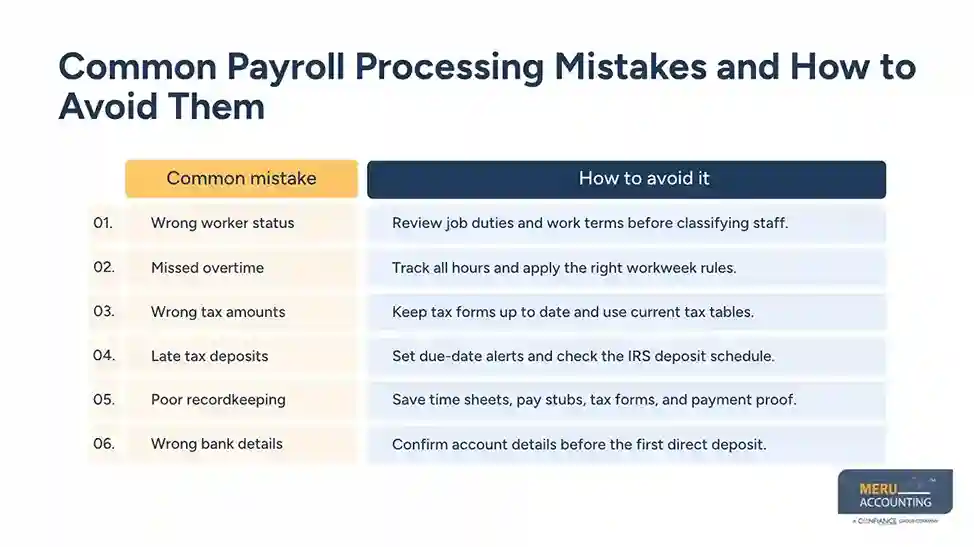
Common mistake | How to avoid it |
Wrong worker status | Review job duties and work terms before classifying staff. |
Missed overtime | Track all hours and apply the right workweek rules. |
Wrong tax amounts | Keep tax forms up to date and use current tax tables. |
Late tax deposits | Set due-date alerts and check the IRS deposit schedule. |
Poor recordkeeping | Save time sheets, pay stubs, tax forms, and payment proof. |
Wrong bank details | Confirm account details before the first direct deposit. |
Do not wait until year-end to find and fix payroll errors. Review each pay run, fix issues as soon as you find them, and keep a note of any change. If you find a past tax error, check the right IRS or state process to correct it.
Payroll Compliance Requirements Businesses Should Understand
Payroll rules cover more than tax. US employers must follow federal, state, and local rules on pay, work hours, staff records, and tax reports.
Here are key areas to review:
- Minimum wage: Pay at least the higher rate that applies under federal, state, or local law.
- Overtime: Pay covered, nonexempt staff at least one and a half times their regular rate for hours worked over 40 in a workweek, unless an exemption or special rule applies.
- Payday rules: Follow state rules on how often staff must be paid and when wages are due.
- Tax duties: Withhold, deposit, and report payroll taxes by the right due dates.
- Worker status: Classify employees and contractors based on the facts of the work setup.
- Recordkeeping: Keep clear records of hours, pay, tax, and deductions.
Meru Accounting Helps Businesses Manage Payroll
A payroll run involves more than calculating wages. Employee pay, overtime, tax withholdings, employer contributions, and payroll entries must all line up. Meru Accounting helps businesses handle these connected tasks through dedicated payroll and accounting support.
Our payroll services cover:
- Payroll Setup and Employee Records: Organizing employee pay details, salary structures, payment schedules, and payroll records.
- Wage and Overtime Calculations: Calculating regular pay, overtime, bonuses, commissions, and other employee earnings.
- Payroll Tax Support: Assisting with tax calculations, withholding records, employer tax liabilities, and payroll tax reporting.
- Pay Run Processing: Preparing payroll figures, reviewing deductions, and calculating employee take-home pay.
- Payroll Reporting and Reconciliation: Matching payroll costs with accounting records and preparing reports for financial review.
Whether you need support with specific payroll tasks or a dedicated team to manage recurring payroll work, Meru Accounting can help you build a more organized and reliable process.
Our Expert Insight
One mistake business owners make is treating employee wages as the full cost of payroll. In reality, employer taxes, health benefits, retirement contributions, and workers’ compensation can add a lot to labor costs.
We recommend tracking total employee costs, not just gross wages. For example, a business with rising overtime may see its labor costs increase even when its headcount stays the same. Reviewing these costs each month can help owners spot budget issues, plan staffing needs, and make better hiring decisions.
Key Takeaways
- Payroll starts with correct staff data, tax forms, and pay rates.
- Track work hours and leave before you work out gross pay.
- Check taxes and other deductions before you set net pay.
- Review each pay run before sending staff payments.
- Deposit and report payroll taxes by the right due dates.
- Match payroll costs with your books and keep clear records.
- Use payroll software or outside support when in-house work becomes hard to manage.
FAQs
Using payroll software or an outsourced payroll service can make the process easier. Both can help manage pay calculations, tax withholdings, employee records, and pay schedules.
It can take a few hours for a small team with clear records. The time may rise as staff numbers, pay types, overtime, and tax needs grow. Payroll software can help speed up the work.
Common pay schedules include weekly, every two weeks, twice a month, and monthly. The right schedule depends on business needs and state payday laws. Employers must follow the pay frequency rules in each state where their employees work.
A payroll tax error can lead to incorrect employee pay, tax adjustments, penalties, or interest. Employers should review the error, correct the payroll records, and file amended tax forms when required.
In-house payroll may suit businesses with a small team and staff who understand payroll rules. Outsourcing can be a better choice when payroll takes too much time, employee needs become more complex, or the business needs ongoing payroll support.
optional anymore
on running the business