Rental property tax deductions allow US landlords to reduce the taxable income earned from residential and commercial real estate. Owners can claim deductible expenses for rental properties, including mortgage interest, property taxes, insurance, repairs, management, and depreciation. However, each cost must meet IRS requirements before it can reduce rental income.
The type of investment also matters. A single-family home, apartment building, vacation rental, or commercial property may have different operating costs and tax rules. Personal use, rental days, ownership expenses, and property improvements can change the amount an investor can claim.
For example, repairing a leaking roof may qualify as a current expense, while replacing the entire roof generally requires capitalization and depreciation. Knowing this difference can prevent incorrect claims and missed tax benefits.
This article explains rental property tax deductions, depreciation rules, eligible costs, and tax planning methods for different real estate investments.
What You Will Learn From This Blog
- How rental property tax deductions reduce taxable rental income.
- Which operating costs qualify as deductible expenses for rental properties.
- How depreciation works for buildings, appliances, and furniture.
- Which tax rules apply to residential, vacation, and commercial investments.
- How landlords can record expenses and plan their tax claims.
What are Rental Property Tax Deductions and How do they Reduce Taxable Rental Income?
Rental property tax deductions are eligible costs that landlords subtract from gross rental income to calculate taxable rental profit. These costs must relate to earning rental income and meet IRS rules.
For example, an owner receives $40,000 in annual rent and pays $8,000 in eligible operating costs. The remaining $32,000 is rental income before depreciation and other applicable adjustments. If the owner also claims $7,000 in depreciation, taxable rental income may fall to $25,000.
The actual tax result depends on the owner’s income, ownership structure, and applicable tax limits.
Deductible expenses for rental properties generally fall into two main groups:
- Current expenses: Repairs, insurance, advertising, and management fees that generally qualify for deduction in the year paid or incurred.
- Capital expenses: Costs that add value, extend useful life, or adapt a building to a new use. These are generally recovered through depreciation.
Most individual landlords report rental income and expenses on Schedule E of Form 1040.
What are the Most Common Deductible Expenses for Rental Properties?
Landlords pay several costs to keep buildings ready for tenants. The following deductible expenses for rental properties are common, provided they meet IRS requirements.
Mortgage Interest
Interest on a loan used to buy or improve a rental building is generally eligible for rental property tax deductions. However, the principal portion of a mortgage payment is not a current expense. Owners should use annual lender statements to identify the eligible interest amount.
Property Taxes
Real estate taxes paid to state and local authorities are generally deductible as rental expenses. However, special assessments for improvements, such as new roads or drainage systems, may need to be added to the property’s tax basis.
Repairs and Maintenance
Fixing leaking pipes, broken windows, damaged locks, and faulty heating systems may qualify as current expenses. The work must restore the existing condition rather than create a major improvement or extend the property’s useful life.
Insurance Premiums
Premiums for eligible fire, theft, liability, and flood insurance may qualify as rental property tax deductions. If a policy covers several years, the cost may need to be spread across its coverage period rather than claimed in full in one year.
Management and Professional Fees
Fees paid to property managers, accountants, and attorneys for rental-related services may qualify for rental property tax deductions. These can include rent collection, bookkeeping, lease preparation, and property management charges.
Utilities and Advertising
Landlords who pay electricity, water, gas, internet, cleaning, or tenant advertising costs may claim eligible amounts. Utility bills paid between tenants may also qualify when the building remains available for rent.
How Does Depreciation Maximize Rental Property Tax Savings?
Depreciation allows owners to recover the cost of eligible property over a fixed period. It is a non-cash expense and forms an important part of rental property tax deductions.
How Rental Property Depreciation Works
Depreciation applies to eligible buildings and assets used to earn rental income. It begins when the property is ready and available for rent, not simply when the owner purchases it. Land cannot be depreciated because it has no fixed useful life.
Calculating Depreciation on Residential Rental Properties
Under the General Depreciation System (GDS), residential rental buildings are generally depreciated over 27.5 years using the straight-line method.
For example, a property costs $300,000, including $60,000 for land. The depreciable building basis is $240,000. Its approximate full-year depreciation is $8,727, subject to the placed-in-service date and other tax rules.
Depreciation Deductions for Furniture, Appliances, and Equipment
Refrigerators, washing machines, furniture, and certain equipment may have separate recovery periods under rental property tax deductions. Owners should record each asset’s cost and purchase date rather than adding every item to the building’s value.
How Depreciation Recapture Affects Rental Property Tax Savings
Depreciation reduces the property’s adjusted tax basis. When the owner sells the building, previous depreciation may affect the taxable gain. Certain gains may qualify as unrecaptured Section 1250 gain, subject to a maximum federal rate of 25%.
Which Rental Property Tax Deductions Apply to Different Rental Investments?
Different investments have different costs, ownership arrangements, and tax requirements. Investors must review the actual use of each building before claiming expenses.
Tax Deductions for Single-Family Rental Properties
Owners may claim deductible expenses for rental properties, including mortgage interest, insurance, property taxes, repairs, lawn care, pest control, and management fees. For example, fixing a damaged fence may qualify as a repair, while building a new outdoor structure may require depreciation.
Tax Deductions for Multifamily and Apartment Investments
Apartment owners often pay for lifts, parking, security, common utilities, and shared cleaning. Eligible operating costs can qualify for deductions, while major upgrades, such as installing a new lift, generally require capitalization.
Tax Deductions for Vacation Homes and Short-Term Rentals
Vacation rentals may have costs for guest supplies, cleaning, booking fees, utilities, and repairs. If the owner uses the property personally, expenses must be divided between rental and personal use. A home rented for fewer than 15 days may qualify for a special IRS rule when used as a residence.
Tax Deductions for Commercial Rental Properties
Commercial landlords may claim rental property tax deductions for eligible insurance, security, repairs, maintenance, and management costs. Under GDS, commercial buildings are generally depreciated over 39 years. Separate equipment may have a different recovery period.
Tax Deductions for Condos, Duplexes, and Owner-Occupied Rentals
Condo owners may claim eligible rental-related HOA fees, insurance, and repairs. If an owner lives in one half of a duplex and rents the other, shared costs must be divided using a reasonable method, such as floor area.
optional anymore
on running the business
How Can Rental Property Investors Maximize Tax Savings Legally?
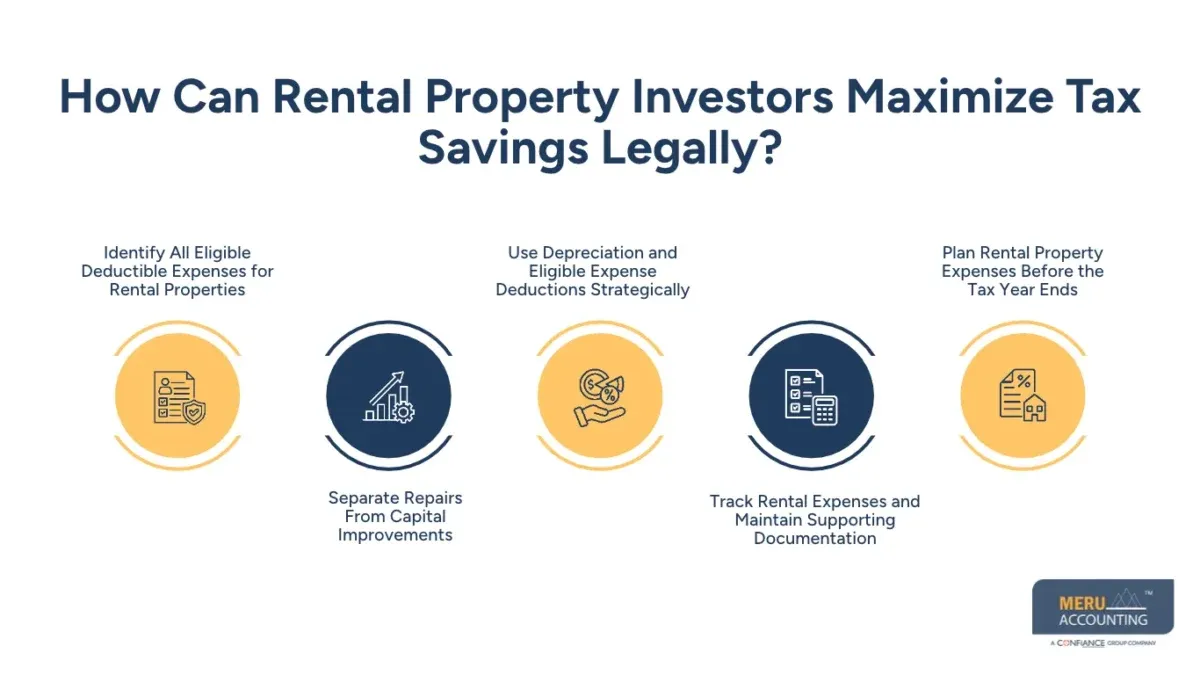
Claiming rental property tax deductions requires correct expense classification, clear records, and regular review of rental accounts.
Identify All Eligible Deductible Expenses for Rental Properties
Review deductible expenses for rental properties, including cleaning, advertising, pest control, bank fees, and routine maintenance. Separate records for each property make it easier to identify missed costs.
Separate Repairs From Capital Improvements
A repair restores existing property, while an improvement adds value, extends useful life, or changes its use. Fixing a damaged pipe may qualify for a current deduction, while installing a new plumbing system generally requires depreciation.
Use Depreciation and Eligible Expense Deductions Strategically
Maintain separate records for land, buildings, appliances, and later improvements to track eligible rental property tax deductions. Also review passive activity loss limits because rental losses cannot always reduce other income in full.
Track Rental Expenses and Maintain Supporting Documentation
Keep invoices, bank statements, insurance papers, loan records, contractor bills, and property tax receipts. Each record should show the amount, date, purpose, and property linked to deductible expenses for rental properties.
Plan Rental Property Expenses Before the Tax Year Ends
Review rent receipts, repair bills, planned improvements, and depreciation records to assess eligible rental property tax deductions before year-end. Do not spend money only to claim a deduction; assess the actual property benefit and tax treatment first.
Why Choose Meru Accounting?
Managing several rental investments can create a high volume of financial records. Meru Accounting provides accounting and bookkeeping services for real estate businesses and property investors.
- Rental Income Recording: Recording monthly rent, advance payments, and other property receipts.
- Expense Classification: Recording insurance, repairs, utilities, and management costs under suitable accounts.
- Asset Records: Maintaining purchase costs and improvement details for depreciation calculations.
- Accounts Payable: Recording contractor bills, vendor invoices, and property maintenance payments.
- Financial Reporting: Preparing income statements and property-level expense reports.
Accurate financial records give investors a clear view of rental performance and make year-end tax preparation more organized. A qualified US tax professional should review tax eligibility and return positions.
Our Expert Perspective
One area that deserves close attention is the difference between repairs and capital improvements. For example, fixing a broken window and installing new windows throughout an apartment building may involve similar materials, but their tax treatment can differ.
Investors should also review depreciation claimed through rental property tax deductions before selling a property. Previous deductions can affect the adjusted basis and the gain reported on the sale. Keeping purchase records, improvement bills, and depreciation schedules is therefore important.
Key Takeaways
- Rental property tax deductions reduce taxable rental income when costs meet IRS rules.
- Mortgage interest, insurance, property taxes, and repairs are common eligible expenses.
- Residential rental buildings generally have a 27.5-year GDS recovery period.
- Commercial buildings generally have a 39-year GDS recovery period.
- Land cannot be depreciated.
- Personal use can limit vacation rental expense claims.
- Repairs and capital improvements have different tax treatment.
- Depreciation can affect the taxable gain when a property is sold.
- Proper records make tax reporting more accurate.
FAQs
US landlords can generally claim rental property tax deductions for eligible mortgage interest, property taxes, insurance, repairs, maintenance, advertising, utilities, and property management fees.
Routine repairs may qualify for current deductions, while major renovations that add value or extend a property’s useful life generally require capitalization and depreciation.
The IRS generally allows residential rental buildings to be depreciated over 27.5 years, excluding land value and applying the required first-year convention.
Yes, eligible expenses such as cleaning, insurance, utilities, and booking fees may be deductible, subject to rental days, personal use, and applicable IRS rules.
Potentially, yes. Eligible expenses may remain deductible when a property is temporarily vacant but genuinely held and available for rent, subject to applicable tax limitations.
optional anymore
on running the business