A growing trucking business needs more than a system to record income and expenses. As the number of trucks, drivers, routes and customer accounts increases, financial data becomes harder to manage. A Trucking accountant must track fuel costs, driver payments, repair bills, freight income and cash flow while keeping financial records accurate. The choice between cloud accounting software, a Transportation Management System (TMS) and Enterprise Resource Planning (ERP) software can affect how well these tasks are handled.
Each system serves a different purpose. Cloud accounting software focuses on financial records, TMS connects freight operations with key financial data, and ERP brings several business functions into one system. A Trucking accountant must assess the fleet size, reporting needs, cost structure and plans for growth before recommending a solution. This blog compares all three options and explains when accounting services for trucking companies may be needed to maintain clear financial records.
What You Will Learn From This Blog
- Why growing trucking fleets need a well-planned accounting system.
- What a Trucking accountant does to manage fleet costs, payroll and freight income.
- How cloud accounting, TMS and ERP software differ in their features and use.
- Which financial system suits small, mid-sized and large trucking businesses.
- How accounting services for trucking companies address common financial issues.
- When a fleet should consider changing its current accounting software.
Why Growing Trucking Fleets Need the Right Accounting System
A small fleet may manage its income and costs through basic accounting software and spreadsheets. However, adding trucks, drivers and new routes creates more financial records to review. Without a clear system, fuel bills, repair costs, unpaid invoices and driver payments may not match the right truck or trip.
A Trucking accountant needs access to reliable financial data to review each cost and report the true result of fleet operations. The right software also cuts down on manual entries, limits errors and gives owners a clear view of cash flow. This is where accounting services for trucking companies and suitable software work together.
What Does a Trucking Accountant Do for Transportation Businesses?
A Trucking accountant manages the financial records of a transport business and tracks the costs that affect fleet income. Key duties include:
Managing Fleet Expenses and Operating Costs
Every truck has costs such as insurance, tolls, permits, lease payments and repairs. A Trucking accountant records these costs under the right expense heads and reviews monthly spending to find cost changes.
Tracking Driver Payroll, Fuel Costs and Maintenance Expenses
Driver wages, fuel use and repair bills form a large part of fleet spending. A professional accountant checks these records against trip details, mileage and approved pay terms to keep cost reports accurate.
Managing Accounts Payable and Accounts Receivable
Transport firms must pay fuel vendors, repair shops and other suppliers on time while collecting freight charges from clients. Accounting services for trucking companies include invoice tracking, payment records and overdue account reviews.
Preparing Financial Statements and Cash Flow Reports
Profit and loss statements, balance sheets and cash flow reports show the financial state of a fleet. A Trucking accountant reviews these reports to assess income, costs, unpaid bills and funds available for daily operations.
Monitoring Profitability Across Trucks, Routes and Loads
A profitable load must earn enough to cover fuel, driver pay, tolls and other trip costs. A professional accountant compares revenue with these costs to find which trucks, routes and loads earn the best returns.
optional anymore
on running the business
Understanding the Three Main Accounting Solutions for Trucking Companies
Not every trucking firm needs the same software. The right choice depends on the number of trucks, volume of freight, staff size and level of financial control.
Cloud Accounting Software: Features, Benefits and Limitations
Cloud accounting software records sales, expenses, bank transactions, invoices and payments online. Owners and accountants can view financial data from different locations, while bank feeds and payment tools can cut down on manual work.
However, basic cloud tools may not track truck-level costs, load margins or driver activity in detail. A Trucking accountant may need extra software or custom reports to review fleet performance.
Transportation Management Systems (TMS): Accounting and Operational Capabilities
A TMS manages freight orders, dispatch, route plans, load details, delivery status and carrier payments. Some systems also connect with accounting software to send billing and cost data to financial records.
A TMS gives a Trucking accountant more detail about loads and trips, but it may not offer full accounting features such as balance sheets, bank reconciliation or tax reports.
Enterprise Resource Planning (ERP): Integrated Financial and Fleet Management
ERP software brings accounting, payroll, purchasing, inventory and other business tasks into one system. Large transport firms can use it to review financial and operational data from a central platform.
For a Trucking accountant, ERP can provide detailed reports across departments and fleet units. However, setup, staff training and software costs may be high for a small fleet.
Cloud Accounting vs. TMS vs. ERP: A Detailed Comparison
Cloud accounting, Transportation Management Systems (TMS) and Enterprise Resource Planning (ERP) software serve different financial and operational needs. The following table compares their key features for growing trucking fleets.
Comparison parameters | Cloud accounting software | Transportation Management System (TMS) | Enterprise Resource Planning (ERP) |
Accounting and financial reporting capabilities | Records income, expenses, invoices, bank transactions and financial statements. | Tracks freight charges, trip costs and billing data. | Manages financial reports, general ledger, accounts payable and accounts receivable. |
Fuel, maintenance and fleet expense tracking | Records fuel bills, repair costs, insurance and other fleet expenses. | Links fuel, maintenance and trip costs with trucks and loads. | Tracks fleet expenses across trucks, departments and cost centres. |
Driver payroll and contractor payment management | Records payroll expenses and payments through accounting or payroll tools. | Calculates driver payments based on mileage, hours, loads or agreed rates. | Connects payroll, employee records, contractor payments and financial reports. |
Freight billing and revenue tracking | Creates customer invoices, records freight income and tracks unpaid payments. | Generates freight bills using load details, delivery records and transport rates. | Connects freight revenue, customer billing and financial reporting. |
Automation, integrations and scalability | Connects with banks, payroll tools and payment platforms. | Integrates dispatch, route planning, load tracking and freight billing. | Connects accounting, payroll, purchasing, inventory and fleet operations. |
Implementation costs and ongoing expenses | Usually has lower initial costs, with monthly fees based on users and features. | Costs depend on fleet size, dispatch needs and software features. | Often involves higher setup, training, data migration and maintenance costs. |
A Trucking accountant should assess fleet size, transaction volume, reporting needs and software costs before recommending a system. Accounting services for trucking companies can also maintain accurate financial records across these systems.
- Cloud accounting: Suitable for small trucking companies that need basic financial records and expense tracking.
- TMS: Suitable for growing fleets that need better control over freight operations, driver payments and trip costs.
- ERP: Suitable for large transportation businesses that need integrated financial and fleet management.
How to Choose the Right Accounting Solution for a Growing Trucking Fleet
The best system depends on the fleet’s current size and its next stage of growth. A Trucking accountant can review daily tasks, reporting gaps and future needs before the owner makes a decision.
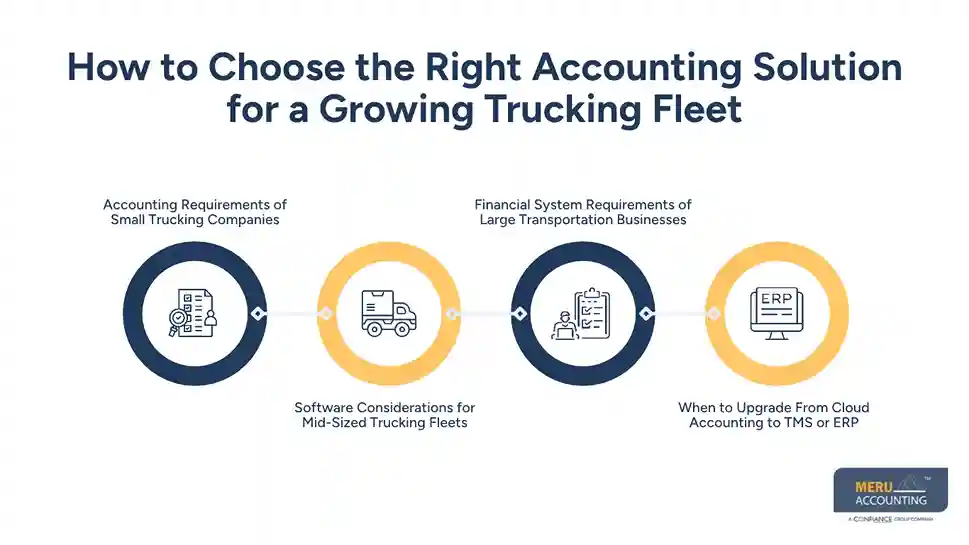
Accounting Requirements of Small Trucking Companies
Small fleets with a few trucks may need cloud accounting for invoices, expenses, payroll entries and bank reconciliation. A separate TMS may not be needed if freight volume and dispatch work remain easy to manage.
Software Considerations for Mid-Sized Trucking Fleets
Mid-sized fleets often deal with more drivers, customer accounts, repair bills and freight orders. A cloud accounting system linked with a TMS can connect trip data with invoices and cost reports.
Financial System Requirements of Large Transportation Businesses
Large fleets may need ERP software to manage accounting, payroll, purchasing, fleet costs and several business units. Detailed access controls and approval steps also matter when many staff members handle financial tasks.
When to Upgrade From Cloud Accounting to TMS or ERP
A fleet should review its system when staff spend too much time moving data between tools, load costs are hard to track or financial reports take too long to prepare. A Trucking accountant can identify these gaps and suggest an upgrade based on actual business needs.
Key Financial Challenges That Accounting Software Should Address
Even a well-run trucking firm can face cash flow and cost issues. Suitable software and accounting services for trucking companies can bring these issues into view before they affect daily operations.
Managing Fluctuating Fuel and Maintenance Costs
Fuel prices and repair bills can change from month to month. A Trucking accountant should compare fuel spend per mile, repair costs and past records to find unusual increases and assess their effect on profit.
Tracking Unpaid Invoices and Delayed Customer Payments
Late freight payments can leave a company short of cash for fuel, wages and vendor bills. Ageing reports show which clients have unpaid invoices and how long each amount has been due.
Controlling Operating Expenses and Cost Per Mile
Cost per mile shows how much a truck spends to cover one mile. A Trucking accountant can calculate this figure by adding relevant operating costs and dividing them by miles travelled during the same period.
Managing Cash Flow During Seasonal Demand Changes
Freight demand may rise or fall at different times of the year. Cash flow reports allow owners to plan for low-income periods, fuel payments, wages, insurance and other fixed costs.
Measuring Profitability by Truck, Driver and Route
Total revenue does not show whether every truck or route earns a profit. Cost reports linked with trip and mileage data give owners a clearer view of revenue and expenses at each level.
How Meru Accounting Provides Accounting Services for Trucking Companies
Meru Accounting provides accounting and bookkeeping services for businesses that need clear financial records and regular reporting. For transport firms, a Trucking accountant needs well-classified data to review fleet costs, freight income and cash flow.
Our accounting services for trucking companies can include:
- Accounts Payable and Receivable: Recording supplier bills, customer invoices, payment entries and outstanding balances.
- Expense Classification: Recording fuel, tolls, repairs, insurance, permits and other operating costs under the right expense heads.
- Bank Reconciliation: Matching bank transactions with accounting records to identify missing entries and differences.
- Payroll Accounting: Recording driver wages, contractor payments and related payroll expenses based on approved records.
- Financial Reporting: Preparing profit and loss statements, balance sheets and cash flow reports for business review.
Meru Accounting works with established accounting platforms and reporting processes to maintain financial data. A Trucking accountant can use these records to review fleet spending and assess business results. Software selection, dispatch management and route planning remain separate decisions based on each firm’s operational needs.
Our Expert Perspective
A trucking firm should not buy an expensive system simply because its fleet is growing. The first step is to identify where financial data is lost, delayed or entered more than once. In our view, a well-maintained cloud accounting system linked with a TMS may be enough for many mid-sized fleets, while firms with several departments and complex reporting needs may gain more from ERP. The choice should match the work, budget and reporting needs of the business.
Key Takeaways
- Cloud accounting is a suitable choice for small fleets that need basic financial records, invoices and expense reports.
- TMS connects freight operations, trip details, dispatch data and load billing with financial records.
- ERP combines accounting, payroll, purchasing and other business functions in one system.
- A Trucking accountant should review fuel costs, driver pay, repairs, invoices and cash flow on a regular basis.
- Fleet owners should compare software costs, setup needs, features and future growth before choosing a system.
- Accounting services for trucking companies can maintain financial records and provide reports for better cost and cash flow review.
FAQs
Cloud accounting suits small fleets, TMS suits businesses managing more freight operations, and ERP suits large fleets that need integrated financial and operational records.
Cloud accounting manages financial records, TMS manages freight and transport operations, while ERP combines accounting, payroll, purchasing and fleet management.
No, a TMS mainly manages loads, dispatch and freight billing. Most trucking companies still need accounting software for financial statements, bank reconciliation and tax records.
A trucking company should consider an upgrade when it struggles to track truck-wise costs, manage freight billing, process more transactions or prepare timely financial reports.
A Trucking accountant should compare fleet size, reporting needs, payroll, freight billing, software costs and integration options before recommending a system.
optional anymore
on running the business