Financial modeling outsourcing allows businesses to assign financial model preparation, forecasting, valuation, and analysis to skilled finance professionals without building a large in-house team. Companies use financial models to review costs, estimate future income, assess investment plans, and make business decisions based on financial data.
However, financial modeling requires knowledge of accounting, business operations, industry trends, and financial planning. Hiring full-time experts for every modeling task can increase staff and operating costs. This is why many companies choose financial modeling outsourcing to manage complex financial work with flexible resources. By choosing outsourced financial modeling services, businesses can access skilled professionals for specific projects, regular forecasts, and long-term financial planning.
What You Will Learn From This Blog
- What financial modeling outsourcing means and how the process works.
- Why businesses choose outsourced financial modeling services.
- Financial modeling needs across different industries.
- Types of financial models companies can outsource.
- How outsourcing can reduce staffing and technology costs.
- How to select a suitable financial modeling partner.
- Ways to review service quality and business results.
What Is Financial Modeling Outsourcing and How Does It Work?
Financial modeling outsourcing is the practice of assigning financial model preparation and analysis to an outside service provider. The work may include financial forecasts, budgets, cash flow estimates, company valuations, and investment analysis.
The process starts with the business sharing its financial data, goals, and project needs. The service provider reviews the information, sets key assumptions, builds the model, and checks the results before delivery. Companies can also request changes when business conditions or financial plans change.
With financial modeling outsourcing, businesses can choose project-based work or regular services. Outsourced financial modeling services may cover a single valuation project or ongoing financial forecasts.
Why Do Businesses Outsource Financial Modeling Services?
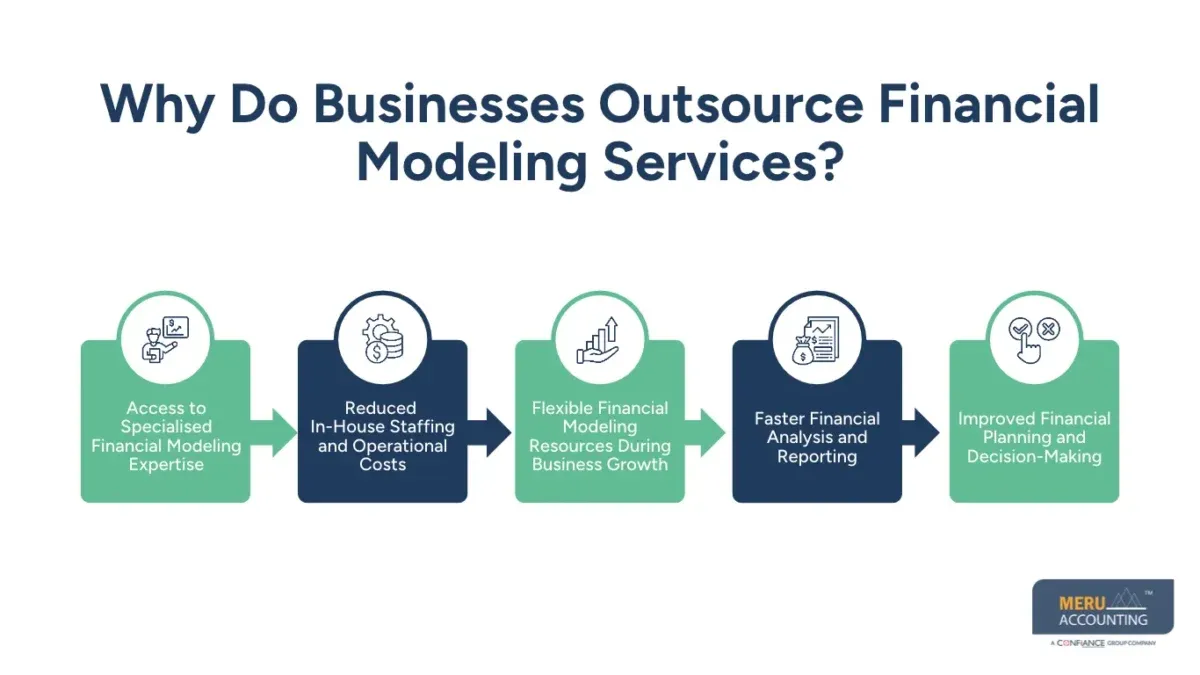
Access to Specialised Financial Modeling Expertise
Financial models need knowledge of accounting, valuation, forecasting, and financial analysis. Financial modeling outsourcing gives companies access to professionals who work with these tasks across different business types. Their experience can be useful for complex forecasts and investment reviews.
Reduced In-House Staffing and Operational Costs
Hiring a full-time financial analyst involves salary, training, recruitment, and employee benefits. Working with external financial experts can reduce these costs when the business does not need a full-time team. Companies pay for the work they require instead of maintaining extra staff.
Flexible Financial Modeling Resources During Business Growth
A company may need more financial analysis during expansion, funding rounds, or new project launches. Outsourcing financial analysis allows businesses to increase or reduce work based on current needs. This avoids long-term hiring costs when demand changes.
Faster Financial Analysis and Reporting
Financial decisions often depend on timely forecasts and reports. An experienced outsourcing team can work on defined modeling tasks while internal staff focus on daily finance work. Clear deadlines and agreed review steps also make delivery easier to track.
Improved Financial Planning and Decision-Making
Financial models show how changes in sales, costs, debt, and investment can affect future results. Financial modeling outsourcing gives businesses structured forecasts for reviewing different business plans. These estimates can guide decisions, but they must be based on sound data and clear assumptions.
Industry-Wise Financial Modeling Outsourcing Solutions
Financial Modeling Outsourcing for Real Estate Companies
Real estate firms use financial models to estimate rental income, property costs, loan payments, and project returns. Financial modeling outsourcing can cover property valuation, cash flow forecasts, and investment analysis. These models allow investors to compare project costs with expected income.
Financial Modeling for Manufacturing Businesses
Manufacturers need to track raw material costs, labour, production volume, stock levels, and sales. Outsourced financial modeling services can include production cost forecasts, profit estimates, and working capital plans. These models show how changes in input costs can affect profit.
Financial Modeling for Healthcare Organisations
Healthcare businesses deal with staff costs, equipment purchases, patient revenue, and operating expenses. External financial analysis can cover revenue forecasts, budget plans, and cash flow estimates. Hospitals and clinics can use these models to review future costs and funding needs.
Financial Modeling for Technology and SaaS Companies
Technology firms often track monthly recurring revenue, customer acquisition costs, subscription income, and customer churn. Professional financial analysis can include revenue forecasts, cash burn analysis, and growth estimates. These models are useful when reviewing funding needs and future business targets.
Financial Modeling for Retail and eCommerce Businesses
Retail firms need to study product sales, stock costs, returns, discounts, and seasonal demand. Outsourced financial modeling services can include sales forecasts, inventory budgets, and profit analysis. These models help businesses assess the effect of pricing and stock changes.
Financial Modeling for Construction Companies
Construction firms manage project budgets, labour costs, material purchases, subcontractor payments, and project income. Financial modeling outsourcing can cover project cash flow, cost estimates, and profit forecasts. These models give firms a view of expected spending at each project stage.
Financial Modeling for Financial Institutions and Investment Firms
Banks, investment firms, and financial institutions use models for valuation, lending reviews, portfolio analysis, and risk estimates. Financial modeling outsourcing can cover investment forecasts and valuation models. The work must follow relevant accounting rules, internal policies, and regulatory needs.
Types of Financial Models Businesses Can Outsource
Three-Statement Financial Models
These models connect the income statement, balance sheet, and cash flow statement. They show how sales, expenses, assets, debt, and cash may change over time.
Budgeting and Forecasting Models
These models compare planned income and costs with expected business activity. They are used for annual budgets, monthly forecasts, and cash planning.
Discounted Cash Flow (DCF) Valuation Models
A DCF model estimates a company’s value by discounting expected future cash flows to the present. It is often used in investment reviews and business valuation.
Merger and Acquisition (M&A) Financial Models
M&A models assess the financial effect of buying, selling, or combining businesses. They may include purchase price estimates, funding needs, and expected cost savings.
Project Finance Models
Project finance models estimate a specific project’s costs, income, debt payments, and cash flow. They are common in infrastructure, energy, and real estate.
Revenue and Profitability Forecasting Models
These models estimate future sales, operating costs, and profit margins. They allow managers to review expected results under different business conditions.
Scenario and Sensitivity Analysis Models
These models show how financial results may change when key inputs change. For example, a company can assess the effect of a 10% rise in material costs or a fall in sales.
optional anymore
on running the business
How Financial Modeling Outsourcing Reduces Business Costs
In-House Financial Modeling Costs vs. Outsourcing Costs
An in-house team may require salaries, employee benefits, software, training, and office costs. Financial modeling outsourcing replaces some of these fixed costs with project-based or agreed service fees. The actual savings depend on the scope and frequency of work.
Savings on Recruitment, Training, and Employee Salaries
Recruiting a financial analyst takes time and money. Businesses must also train employees and pay regular salaries. Outsourced financial modeling services can reduce these expenses when the work does not require a permanent employee.
Reduced Software and Technology Expenses
Financial modeling may require spreadsheet tools, data systems, and financial software. An outsourcing provider may already have the tools needed for the agreed work. Businesses should confirm software access, licensing, and data transfer terms before signing an agreement.
Cost Flexibility Based on Project Requirements
Some businesses need one valuation model, while others need monthly forecasts. Financial modeling outsourcing allows companies to choose services based on project size and workload. This makes spending easier to plan.
Long-Term Financial Benefits of Outsourcing
Regular outsourcing can reduce the need to maintain extra staff for occasional financial work. Companies can direct internal resources towards core business tasks while using external professionals for agreed modeling needs.
How to Choose the Right Financial Modeling Outsourcing Partner
Evaluate Financial Modeling Expertise and Industry Experience
Check whether the provider has experience with the type of model your business needs. A provider with manufacturing experience may not have the same knowledge of SaaS revenue models or property valuation.
Review Previous Projects and Relevant Case Studies
Ask for sample models or case studies with confidential details removed. Review the model structure, formulas, assumptions, and level of detail before making a choice.
Assess Financial Modeling Methodologies and Quality Checks
Ask how the provider builds, reviews, and tests its models. Check whether formulas, links, assumptions, and outputs are reviewed by another professional before delivery.
Check Data Security and Confidentiality Policies
Financial data may include payroll, revenue, customer details, and investment plans. Review confidentiality agreements, access controls, file storage, and data deletion policies before sharing business records.
Understand Pricing Structures and Service Agreements
Compare fixed project fees, hourly rates, and monthly service plans. The agreement should state the scope, deliverables, revision limits, deadlines, and extra charges.
Evaluate Communication, Reporting, and Turnaround Times
Ask who will manage the project and how often updates will be shared. Clear communication and agreed delivery dates reduce confusion during the work.
Common Challenges in Financial Modeling Outsourcing and How to Manage Them
Data Security and Confidentiality Risks
Sharing financial records with an outside provider creates data risks. Use confidentiality agreements, restricted file access, secure transfer methods, and clear data retention rules.
Inaccurate Financial Assumptions and Projections
Wrong sales estimates or cost assumptions can affect the full model. Share reliable source data and ask the provider to document all key assumptions for review.
Communication Gaps and Reporting Delays
Poor communication can lead to missed deadlines and unclear results. Set one point of contact, agree on update schedules, and record changes to the project scope.
Differences in Accounting Standards and Business Requirements
Businesses may follow different accounting rules and reporting methods. Explain the required standards and reporting format before work begins, especially when dealing with more than one country.
Lack of Transparency in Project Deliverables
A completed model should not be a spreadsheet with unexplained figures. Ask for clear labels, working formulas, source notes, assumptions, and instructions for future updates.
How to Measure the Performance of Financial Modeling Outsourcing
Accuracy of Financial Projections
Compare forecast results with actual financial performance. Review major differences and check whether they came from wrong assumptions, missing data, or changes in business conditions.
Model Delivery Time and Turnaround
Track whether the provider meets agreed delivery dates. Also review the time taken to respond to questions and complete approved changes.
Cost Savings Against Internal Operations
Compare outsourcing fees with the full cost of doing the same work in-house. Include salaries, benefits, recruitment, training, software, and management time.
Compliance With Agreed Modeling Standards
Review whether the model follows the agreed format, accounting rules, and quality checks. Consistent documentation makes future reviews easier.
Business Value and Decision-Making Improvements
Assess whether the model gives management useful information for budgets, investment plans, and cash flow decisions. The value lies in how well the analysis fits actual business needs.
Financial Modeling and Accounting Services by Meru Accounting
Financial models depend on accurate financial records, clear cost data, and reliable reporting. Meru Accounting provides accounting, bookkeeping, payroll, accounts payable, accounts receivable, and financial reporting services for businesses across industries.
These services create organised financial records that businesses can use when preparing budgets, forecasts, and financial models. Meru Accounting’s accounting services cover transaction records, expense categories, payroll data, vendor payments, and financial statements.
For businesses considering financial modeling outsourcing, access to well-maintained accounting records is an important part of the process.
Our Expert Perspective
Financial models are only as useful as the data and assumptions behind them. In our view, businesses should not select a provider based only on low prices or quick delivery. They should review industry knowledge, formula checks, data security, and the provider’s ability to explain the final results. A well-built model should be easy to review, update, and use for business planning.
Key Takeaways
- Financial modeling outsourcing gives businesses access to skilled financial professionals without maintaining a large in-house team.
- Companies can outsource forecasts, budgets, valuations, project finance models, and investment analysis.
- Industry knowledge matters because each business has different costs, income sources, and reporting needs.
- Outsourcing can reduce recruitment, salary, training, and software costs.
- Businesses should review expertise, case studies, security rules, pricing, and delivery terms before selecting a provider.
- Clear source data and tested assumptions are important for accurate financial models.
- Regular performance reviews can show whether outsourcing meets cost, quality, and business goals.
FAQs
Financial modeling outsourcing is the process of hiring external finance professionals to prepare financial forecasts, budgets, valuations, and investment models.
Businesses can outsource three-statement models, DCF valuations, budgeting forecasts, M&A models, project finance models, and scenario analysis.
It reduces expenses related to employee salaries, recruitment, training, software, and maintaining a full-time financial modeling team.
Real estate, manufacturing, healthcare, technology, SaaS, retail, construction, and financial institutions can use outsourced financial modeling services.
Businesses should compare industry expertise, previous projects, model accuracy, data security, pricing, quality checks, and delivery timelines.
optional anymore
on running the business