Account Reconciliation Bookkeeping Services play a key role in helping small and mid-sized businesses manage clean, correct, and well-matched financial records. Many SMEs face issues like missing entries, duplicate invoices, or timing gaps in payments. These gaps often lead to poor cash visibility and wrong financial decisions.
Account reconciliation bookkeeping solutions help fix these gaps by matching internal records with bank statements, vendor statements, and accounting books on a regular basis. This improves financial clarity and reduces avoidable costs.
For SMEs working with limited finance teams, account reconciliation and bookkeeping services can support better control over daily transactions, improve accuracy, and reduce long-term financial risk.
What You Will Learn From This Blog
- How reconciliation improves financial accuracy for SMEs
- Why SMEs often face hidden accounting errors
- The role of vendor checks in daily bookkeeping
- How cash flow improves with better reconciliation
- Cost-saving benefits of structured accounting support
- Value of outsourced reconciliation support for growing firms
What Are Account Reconciliation Bookkeeping Services and Why Do They Matter for SMEs?
Overview of Account Reconciliation
Account Reconciliation Bookkeeping Services refer to the process of comparing financial records with external statements like bank data or vendor invoices. The goal is to ensure every entry matches and no transaction is missed.
Importance For Small Businesses
SMEs often deal with limited staff and manual tracking. Account reconciliation bookkeeping solutions help reduce confusion in records and improve financial trust. This is important when decisions depend on correct data.
Role In Financial Control
When records are aligned, business owners can see real cash positions. With account reconciliation bookkeeping services, financial planning becomes more stable and less risky.
Impact On Compliance
Clean records also help during tax filing and audits. Authorities such as the IRS and AICPA highlight the need for regular reconciliation to support accurate reporting.
Reducing Financial Stress
Many SMEs struggle due to unclear numbers. Account reconciliation and bookkeeping solutions reduce this stress by offering clear and updated financial views.
How Account Reconciliation Bookkeeping Services Help Reduce Financial Errors
Identifying Missing Entries
Errors often happen when transactions are skipped. Account Reconciliation Bookkeeping Services help identify missing or duplicate entries early.
Matching Bank Transactions
Bank statements are compared with internal books. This step ensures every inflow and outflow is recorded correctly under bookkeeping and account reconciliation services.
Fixing Timing Differences
Sometimes payments are recorded at different times. Reconciliation helps adjust these timing gaps and improves accuracy.
Preventing Data Duplication
Duplicate entries can increase expenses on paper. With Bookkeeping and account reconciliation services, such issues are quickly corrected.
Improving Audit Readiness
Correct records reduce audit issues. Businesses using bookkeeping and account reconciliation services face fewer compliance challenges.
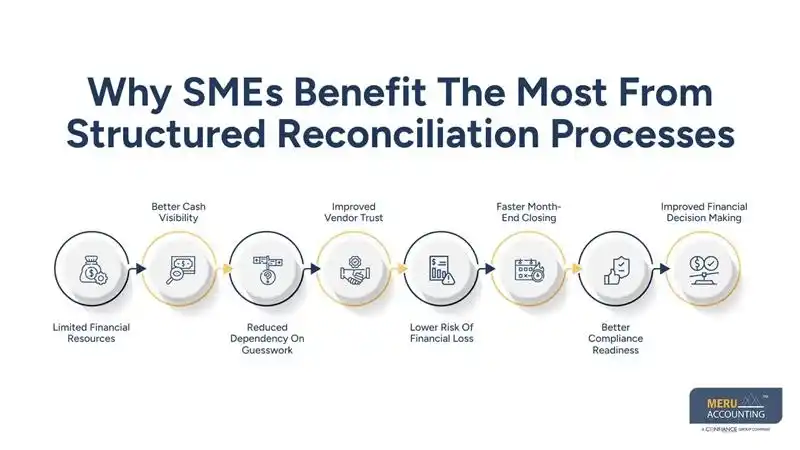
Why SMEs Benefit The Most From Structured Reconciliation Processes
Limited Financial Resources
SMEs often do not have large finance teams. Account Reconciliation Bookkeeping Services reduce workload and improve efficiency.
This allows small teams to manage more transactions without increasing staffing pressure.
Better Cash Visibility
Clear reconciliation provides real-time understanding of available cash. It helps business owners see exactly how much money is free for daily use or upcoming payments.
Reduced Dependency On Guesswork
Instead of assumptions, account reconciliation bookkeeping services offer real data for decision-making. This improves planning accuracy for expenses, hiring, and investments.
Improved Vendor Trust
When payments are tracked properly, vendor relationships improve. Regular and correct reconciliation also helps avoid disputes and late payment confusion with suppliers.
Lower Risk Of Financial Loss
Small errors can lead to big losses. Structured reconciliation reduces this risk. It also helps detect fraud, duplicate payments, or missing invoices at an early stage. Early detection helps SMEs avoid unnecessary financial leakage.
Faster Month-End Closing
Structured reconciliation helps speed up monthly closing of accounts. It reduces last-minute corrections and improves reporting accuracy for management decisions.
Better Compliance Readiness
Clean reconciled records make tax filing and audits easier. It ensures businesses can quickly present accurate financial data when required.
Improved Financial Decision Making
Accurate books support better pricing, budgeting, and investment decisions. This helps SMEs grow with more confidence and fewer financial errors.
Understanding Vendor Account Reconciliation In Day-To-Day Bookkeeping
Meaning Of Vendor Matching
Vendor account reconciliation matches supplier invoices with purchase records and payments.
This ensures every transaction has proper supporting documents for verification.
Importance In Daily Operations
SMEs deal with multiple vendors across different business activities regularly.
Account reconciliation bookkeeping solutions ensure vendor balances remain accurate and updated.
Avoiding Payment Conflicts
Errors in vendor records often lead to payment disputes and confusion. Proper vendor account reconciliation reduces conflicts between businesses and suppliers effectively.
Ensuring Correct Billing
Sometimes vendors may overcharge or include incorrect billing amounts unknowingly. Regular checks under account reconciliation bookkeeping services help identify such errors.
Supporting Smooth Supply Chain
Clear vendor records help maintain steady and uninterrupted business operations. It reduces delays in procurement and ensures timely delivery of goods.
Strengthening Financial Accuracy
Vendor reconciliation improves overall accuracy in business financial reporting systems. It ensures all recorded expenses match actual business transactions properly.
Enhancing Payment Discipline
Structured reconciliation helps SMEs follow timely and organized payment cycles. This improves financial discipline and reduces unnecessary late payment charges.
How Vendor Account Reconciliation Improves Cash Flow Management
Better Payment Planning
With vendor account reconciliation, businesses know what is due and when to pay. This helps SMEs schedule payments without affecting daily operational needs.
Avoiding Late Fees
Timely tracking reduces penalties and extra charges. It ensures vendors receive payments within agreed timelines consistently.
Improving Budget Control
Clear vendor data helps SMEs plan monthly spending better. It allows businesses to allocate funds more accurately across departments.
Strengthening Cash Flow Accuracy
Account reconciliation bookkeeping services ensure cash reports match real transactions. This gives a clearer picture of available working capital at any time.
Reducing Financial Surprises
Unexpected vendor bills are reduced with proper reconciliation. It helps businesses prepare in advance for all upcoming financial obligations.
Key Cost-Saving Advantages Of Account Reconciliation Bookkeeping Services
Reducing Financial Errors
Mistakes often lead to financial loss in business operations. Account reconciliation bookkeeping services reduce such risks effectively. This ensures every transaction is verified and recorded accurately in the books.
Lower Operational Costs
Businesses save time and effort by avoiding manual corrections repeatedly. It reduces dependency on repeated review work and extra accounting effort.
Better Resource Use
Staff can focus on core tasks instead of fixing accounting records. This improves overall productivity within small finance teams across departments.
Avoiding Penalties
Late payments and tax errors can be costly for SMEs. Proper reconciliation prevents this. It also helps SMEs stay compliant with financial reporting deadlines easily.
Improving Profit Tracking
Correct numbers help SMEs understand true profit levels more clearly. It supports better evaluation of business performance across each reporting period.
How Outsourced Account Reconciliation Bookkeeping Services Add Value
Access To Skilled Professionals
Outsourcing provides access to trained experts in account reconciliation bookkeeping services. These professionals bring experience from handling multiple industries and business types.
Use Of Modern Tools
Advanced accounting tools improve accuracy and speed. These tools help reduce manual errors and improve transaction matching efficiency.
Scalable Support
As business grows, account reconciliation bookkeeping services can expand easily. This flexibility helps SMEs handle increasing transaction volumes without disruption.
Reduced Internal Workload
Internal teams can focus on operations instead of reconciliation tasks. This improves productivity and allows better use of limited staff resources.
Better Financial Reporting
Outsourced teams ensure clean and structured reports. This supports better decision-making with accurate and timely financial information.
How Meru Accounting Supports SMEs With Account Reconciliation
Meru Accounting provides structured financial support for SMEs through reliable account reconciliation bookkeeping services. Our team works with global clients and ensures accurate financial tracking across bank, vendor, and internal records.
We also specialize in vendor account reconciliation, helping businesses manage supplier payments without confusion. With experience across multiple industries, we support SMEs in improving cash flow clarity and reducing accounting errors.
Our experts use modern accounting systems to deliver accurate and timely account reconciliation bookkeeping solutions, ensuring businesses stay financially organized and audit-ready.
Our Experts Perspective
From our experience working with SMEs across different industries, small mismatches in records often create larger financial confusion over time. Businesses using account reconciliation bookkeeping services usually gain better control over cash flow within a few months of structured implementation. Regular vendor account reconciliation also helps reduce payment disputes and builds stronger trust with suppliers. In many cases, consistent review of accounts proves more effective than large corrective actions taken later.
Key Takeaways
- Account reconciliation improves financial accuracy for SMEs
- It helps reduce errors in daily bookkeeping
- Vendor tracking improves payment clarity
- Cash flow becomes more stable and predictable
- Outsourcing saves time and reduces cost
- Structured processes improve long-term financial control
FAQs
These services match financial records with bank and vendor statements to ensure accuracy in business accounts.
SMEs need these services to reduce errors, manage cash flow, and maintain correct financial records.
It is the process of checking supplier invoices and payments to ensure all vendor records are correct.
They provide clear data on income and expenses, helping businesses plan payments better.
Yes, outsourcing reduces internal workload and avoids costly financial errors.