Many real estate investors judge success by a single factor: how much a property rises in value over time. While the growth matters, it does not always show the full financial picture. A property may gain value on paper while still creating weak cash flow, high debt pressure, rising tax costs, or low long-term profit. This is why smart investors rely on proper real estate investment accounting to understand the true results of their assets. Real estate investing involves many factors such as rent income, operating costs, loan payments, repair bills, taxes, depreciation, vacancy rates, insurance, and major upgrades that all affect actual returns. Without clear financial tracking, investors may think they are earning strong profits when their real gains are much lower.
Proper accounting systems help investors measure net income, track cash flow, review portfolio health, and make fact-based choices. They also help investors compare the real estate investment pros and cons tied to different property types, markets, and growth plans. Rather than focusing only on appreciation, investors can study the true return produced by each property.
In today’s market, where interest rates, repair costs, and operating expenses keep changing, clarity matters more than ever. Investors who use organized accounting methods can better guard profits, lower risk, and build steady long-term wealth.
What You Will Learn From This Blog
In this blog, you will learn:
- What real estate investment accounting means and why it matters
- The difference between property value growth and true returns
- The key financial metrics investors should track
- How accounting improves financial choices
- Why knowing the real estate investment pros and cons is key before growing a portfolio
- How expert accounting support helps real estate investors manage finances with more accuracy
Understanding the Basics of Real Estate Investment Accounting
Real estate investment accounting is the process of tracking, sorting, and studying all financial activity tied to investment properties. It gives investors a full view of property income, expenses, debt, taxes, and profit.
Unlike basic bookkeeping, real estate investment accounting focuses on investment results and long-term financial gains. It helps investors learn whether a property is truly making healthy returns or simply going up in market value.
This type of accounting often includes:
- Rent income tracking
- Mortgage and loan records
- Property tax reports
- Repair and upkeep costs
- Utility and insurance bills
- Depreciation schedules
- Major upgrade tracking
- Cash flow review
- Profit and loss reports
- Tax planning and filing support
For example, a property may rise in value by $80,000 over five years. However, if the investor faced high repair bills, long vacancy periods, rising loan interest, and weak rent margins during that time, the true return could be far lower than expected.
With organized financial reports, investors gain a clearer picture of both short-term results and long-term wealth growth.
Real estate investment accounting also becomes more important as investors grow portfolios. Managing one rental home may be simple with spreadsheets, but handling many buildings, tenants, lenders, and expense groups needs structured accounting systems.
Strong accounting methods also support lenders, tax filings, audits, partner reports, and investment planning.
The Difference Between Property Value Growth and Real Financial Returns
Many investors mix up appreciation with profit. Appreciation means the rise in a property’s market value over time. True return measures the actual income earned after all costs, risks, and duties are counted.
A property can appreciate while still making poor real returns.
For example, look at two investors:
- Investor A owns a property that rises fast in value but makes low monthly cash flow and high repair costs.
- Investor B owns a property with slower appreciation but strong rent income, low vacancy, and controlled costs.
In many cases, Investor B may earn stronger total returns even with slower property value growth.
This is where real estate investment accounting becomes very important. Proper accounting separates emotional guesses from real financial facts.
True returns often include:
- Net operating income
- Positive cash flow
- Equity growth
- Tax savings
- Debt payoff growth
- Return on investment
- Long-term wealth growth
Investors who focus only on appreciation often miss hidden financial pressure. Large repair jobs, legal fees, property management costs, insurance hikes, and loan expenses can cut actual profit in a major way.
Accounting reports help investors learn whether appreciation is creating true financial gain or simply raising paper value without healthy cash results.
This difference became very clear during times of market slowdown. Some properties that once showed strong appreciation later struggled with vacancies, falling rents, or refinance problems. Investors with detailed accounting records were better ready to handle those risks.
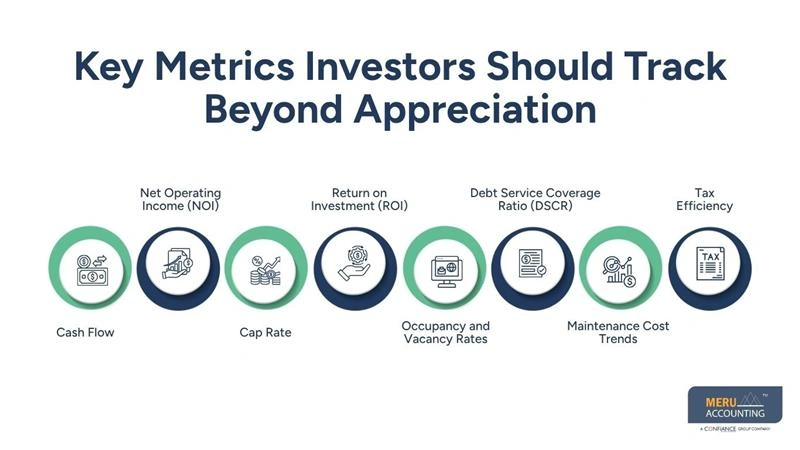
Key Metrics Investors Should Track Beyond Appreciation
Strong investors track more than rising property prices. Real estate investment accounting helps measure key signs that show actual investment strength.
Cash Flow
Cash flow measures the money left after all running costs and debt payments are covered. Positive cash flow supports portfolio growth and financial stability.
Strong cash flow helps investors:
- Cover surprise repairs
- Handle vacancy periods
- Lower stress
- Reinvest into new deals
Net Operating Income (NOI)
NOI measures property income after running costs but before taxes and loan costs.
This metric helps investors compare property results more fairly across markets and property types.
Cap Rate
Capitalization rate shows how well a property creates income compared to its value.
Investors often use cap rate to compare different deals before buying.
Return on Investment (ROI)
ROI measures total profit compared to the first investment amount.
Real estate investment accounting helps calculate ROI with greater accuracy by including:
- Loan costs
- Running expenses
- Tax impact
- Upgrade costs
- Rent income
Occupancy and Vacancy Rates
Vacancy periods directly affect profit. Tracking occupancy trends helps investors forecast income and spot running issues early.
Debt Service Coverage Ratio (DSCR)
DSCR measures whether property income can easily cover debt payments. Lenders often review this ratio before approving loans.
Maintenance Cost Trends
Accounting records help investors track repeat repair costs. High upkeep costs may lower long-term profit even when appreciation stays strong.
Tax Efficiency
Proper accounting also tracks depreciation, deductible costs, and tax plans that improve total investment returns.
Without organized records, investors may lose key deductions or face filing mistakes.
How Real Estate Investment Accounting Improves Financial Decision-Making
Good investment choices depend on accurate financial data. Real estate investment accounting gives investors reliable facts that support smarter planning and risk control.
Better Property Review
Before buying new property, investors can review expected cash flow, likely expenses, loan costs, and expected return levels.
Accounting data cuts guesswork and improves investment choices.
Smarter Budget Planning
Properties often face surprise costs such as roof repairs, plumbing problems, HVAC replacement, or legal bills.
Detailed accounting records help investors build realistic reserve budgets.
Improved Tax Planning
Real estate taxes can become hard to manage, especially for investors with many properties.
Accurate accounting helps investors:
- Track deductible costs
- Manage depreciation schedules
- Prepare clean tax filings
- Lower filing mistakes
- Support audit records
Portfolio Performance Review
As portfolios grow, investors need to compare property results across locations and property types.
Accounting systems help spot:
- High-performing assets
- Weak properties
- Rising expense trends
- Income patterns
- Long-term profit levels
Easier Financing and Lending Support
Lenders often ask for organized reports before approving loans or refinancing.
Expert accounting records improve lender trust and speed up loan reviews.
Better Exit Planning
Some investors hold properties for many years, while others plan to sell and reinvest.
Real estate investment accounting helps investors decide:
- Best time to sell
- Expected gains
- Tax exposure
- Reinvestment plans
- Total investment results
Accurate reports also help investors avoid emotional choices driven only by market hype or short-term appreciation trends.
Understanding the Real Estate Investment Pros and Cons Before Scaling a Portfolio
Every investment plan brings both rewards and risks. Understanding the real estate investment pros and cons helps investors build more stable portfolios with clear goals.
Pros of Real Estate Investing
Long-Term Wealth Growth
Real estate can create long-term wealth through appreciation, rent income, and equity growth.
Cash Flow Opportunities
Rental properties may provide steady monthly income when managed the right way.
Tax Benefits
Investors may gain from deductions tied to depreciation, mortgage interest, repairs, and running expenses.
Inflation Protection
Property values and rents often rise over time, helping investors manage inflation pressure.
Portfolio Diversification
Real estate adds diversification beyond stocks and other common investments.
Cons of Real Estate Investing
High Running Costs
Repairs, taxes, insurance, and upkeep can become costly.
Vacancy Risk
Empty units lower income and raise pressure.
Market Changes
Property values and rent demand can shift due to economic conditions.
Loan Pressure
Interest rate hikes may affect profit and refinancing choices.
Time and Management Needs
Managing tenants, repairs, legal rules, and operations takes ongoing work.
This is why real estate investment accounting matters so much. Investors who fully understand the real estate investment pros and cons can make choices using real numbers instead of guesses.
Accounting systems help investors measure risk, control costs, and keep financial discipline during both strong and weak market periods.
How Meru Accounting Supports Real Estate Investors
Meru Accounting provides expert accounting support built for modern real estate investors and property firms.
The team at Meru Accounting helps investors organize records, track portfolio results, manage tax filings, and improve financial visibility across properties.
Their real estate investment accounting services support:
- Rent income tracking
- Expense management
- Cash flow reports
- Property-wise profit review
- Tax-ready statements
- Depreciation tracking
- Budget planning
- Financial reports for lenders and investors
As portfolios grow, accounting work also becomes more complex. Expert accounting support helps investors cut filing mistakes, keep better control, and spend more time on investment plans and portfolio growth.
By using clear accounting systems, real estate investors gain a better view of true returns beyond basic property value growth.
Key Takeaways
- Property appreciation alone does not show full investment results.
- Real estate investment accounting helps investors measure true profit.
- Cash flow, NOI, ROI, vacancy rates, and tax efficiency are key performance metrics.
- Organized accounting supports smarter choices and risk control.
- Understanding the real estate investment pros and cons helps investors grow portfolios more carefully.
- Expert accounting support improves financial visibility, filing accuracy, and long-term planning.
FAQs
Real estate investment accounting is the process of tracking and managing all activity tied to investment properties, including income, costs, taxes, depreciation, and profit checks.
A property may rise in value while making weak cash flow or high upkeep costs. True returns depend on total profit after costs, taxes, loans, and repair bills are counted.
Key metrics include cash flow, net operating income, return on investment, occupancy rates, debt service coverage ratio, and repair cost trends.
Accurate accounting helps investors track costs, spot weak assets, improve budgeting, manage taxes, and make fact-based choices.
Understanding the real estate investment pros and cons helps investors prepare for market risks, loan pressure, upkeep costs, and management needs before growing a portfolio.