
Accountants for advertising agencies play a key role in handling complex billing systems that include retainers, project work, and mixed pricing models. In most creative firms, income does not come in a simple monthly format.
Instead, it is split across ongoing retainers, campaign billing, and short-term project work. This makes the role of accountants for advertising agencies very important for stable financial control and clear reporting.
Accountants for marketing agencies often face similar challenges, but advertising firms usually deal with faster billing cycles, multiple clients, and layered service contracts. In this blog, you will understand how these accounting professionals manage retainers and project billing with accuracy and structure.
What You Will Learn From This Blog
- How retainers and project billing work in advertising firms
- How accountants for advertising agencies handle monthly retainer tracking
- Key billing problems faced by creative and media firms
- How accountants for marketing agencies support cash flow stability
- Ways accountants reduce billing errors and delays
- How automation helps improve billing accuracy and speed
- Practical insights from real agency accounting systems
Understanding The Role Of Accountants For Advertising Agencies In Modern Billing Models
Managing Mixed Revenue Structures
Accountants for advertising agencies manage income that comes from retainers, hourly billing, and project-based work. Each model needs separate tracking to avoid confusion in billing cycles. Clear classification helps in better reporting.
Aligning With Client Contracts
Every agency contract is different. Accountants for advertising agencies review contract terms carefully to match billing with agreed service levels. This reduces disputes and improves trust.
Tracking Multi-Campaign Revenue
Many agencies run several campaigns for one client. Accountants for marketing agencies often support this process by tracking income per campaign. This ensures accurate revenue recognition.
Supporting Revenue Recognition Standards
Accountants follow standards like ASC 606 guidance from AICPA, which explains when revenue should be recorded. This is important for agencies with long-term contracts.
Improving Financial Visibility
Accurate tracking helps agency owners see real profit per client. Accountants for advertising agencies prepare reports that show clear income patterns across services.
Key Differences Between Retainer Billing And Project-Based Billing
Fixed Monthly Retainers
Retainers are fixed monthly payments for ongoing services. Accountants for advertising agencies ensure these are billed on time and matched with service delivery.
One-Time Project Billing
Project billing is based on specific campaign work. Accountants for marketing agencies often track milestones before issuing invoices.
Timing Of Revenue Entry
Retainers are recorded monthly, while project billing depends on completion stages. This timing difference affects cash flow reports.
Cost Allocation Methods
Retainers usually spread costs evenly, while projects need detailed cost tracking. Accountants for advertising agencies manage both methods carefully.
Client Communication Needs
A clear billing explanation is important. Accountants prepare breakdowns so clients understand both retainer and project charges.
How Accountants For Advertising Agencies Structure Retainer Management Efficiently
Monthly Billing Cycles
Accountants for advertising agencies set fixed monthly billing dates for retainers. This creates a stable and predictable income flow for agencies.
Service Level Tracking
Each retainer includes specific, defined services. Accountants ensure that services delivered match contract terms before billing clients.
Unused Service Adjustments
Some clients do not fully use their retainer hours. Accountants for marketing agencies help adjust or roll over unused time when contractually allowed.
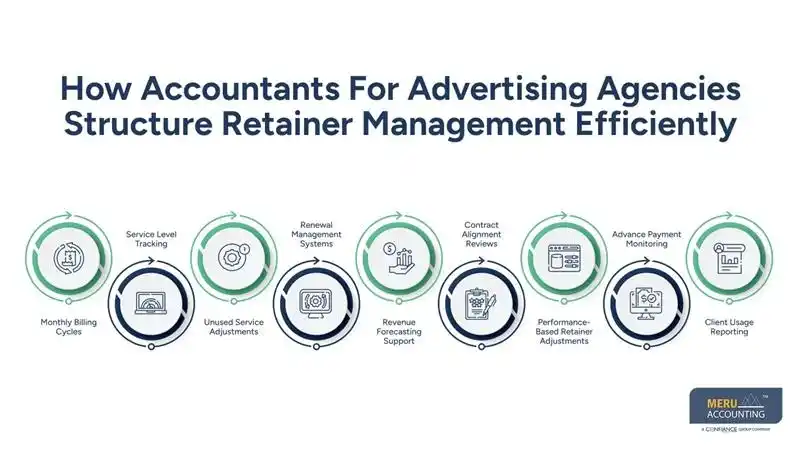
Renewal Management Systems
Retainers must be renewed on a regular schedule. Accountants track expiry dates carefully to avoid service interruptions or gaps.
Revenue Forecasting Support
Predictable retainer income helps forecast future revenue. Accountants for advertising agencies use this data for planning upcoming expenses and budgets.
Contract Alignment Reviews
Accountants regularly review retainer contracts to ensure billing matches agreed terms. This helps prevent misinterpretation of services and keeps financial records aligned with client expectations.
Performance-Based Retainer Adjustments
Some agencies adjust retainers based on campaign performance or workload changes. Accountants for marketing agencies document these changes clearly to maintain transparency in billing.
Advance Payment Monitoring
Many retainers involve advance payments or deposits. Accountants track these carefully to ensure correct adjustment against monthly invoices and avoid double-billing issues.
Client Usage Reporting
Accountants prepare usage summaries for clients to show how retainer hours or deliverables are used. This improves trust and makes renewal discussions more data-driven.
Common Billing Challenges Faced By Advertising And Marketing Firms
Delayed Client Approvals
Invoices often wait for client approval for long periods. Accountants for advertising agencies follow up regularly with clients to reduce delays and keep billing cycles active.
Scope Changes During Projects
Campaign scope may change mid-work due to new client requirements. Accountants for marketing agencies adjust billing records carefully to reflect these updates in a correct way.
Missing Time Tracking Data
If teams do not record hours properly, billing becomes inaccurate and incomplete. Accountants help set structured time tracking systems to improve consistency and reporting accuracy.
Disputes On Deliverables
Clients may question billed work or service output. Accountants for advertising agencies maintain clear records, proof of work, and approvals to support every invoice raised.
Multiple Billing Formats
Different clients prefer different invoice formats and breakdown styles. This increases complexity in billing preparation and requires careful customization for each account.
How Accountants For Marketing Agencies Improve Cash Flow And Revenue Predictability
Structured Invoicing Schedules
Accountants for marketing agencies set clear and well-planned invoice timelines for every client. This reduces gaps in cash inflow and ensures payments are received in a more regular and predictable manner.
Retainer Stability Planning
Retainers give fixed and recurring income to agencies. Accountants for advertising agencies use this stable income base to balance unpredictable project-based revenue and maintain financial consistency.
Expense Matching Systems
Matching costs with related revenue helps show the true profit of each campaign. This approach is important for accurate financial planning and helps agencies understand real performance.
Aging Report Monitoring
Accountants track unpaid invoices through detailed aging reports on a regular basis. This helps reduce overdue payments and improves follow-up actions with clients.
Client Payment Behavior Analysis
Understanding how and when clients usually pay helps predict cash flow more accurately. Accountants for marketing agencies use this insight to plan future expenses and manage liquidity better.
How Accountants Reduce Billing Errors And Payment Delays
Invoice Verification Checks
Accountants for advertising agencies verify each invoice before sending. This reduces errors and ensures all billable items are correctly included and approved.
Standard Billing Templates
Using fixed templates ensures consistency in billing formats. It also makes invoices easier for clients to read and reduces confusion during approval.
Cross-Checking Time Logs
Time entries are checked against project work to avoid mismatches. This helps ensure that only valid and approved hours are billed to clients.
Automated Reminder Systems
Reminders help clients pay on time and reduce delays. These systems send follow-ups at regular intervals without manual effort from the finance team.
Error Reporting Reviews
Regular reviews help identify recurring billing mistakes. This allows accountants for marketing agencies to fix root causes and improve future billing accuracy.
The Role Of Automation In Agency Accounting And Billing Management
Automated Invoice Creation
Accountants for advertising agencies use software to generate invoices quickly and reduce manual work. This helps ensure faster billing cycles and fewer delays in sending invoices to clients.
Integrated Time Tracking Tools
Time tracking systems connect directly with billing tools for accuracy. This ensures all billable hours are captured correctly without missing entries or duplication.
Real-Time Revenue Reporting
Automation gives instant updates on income and expenses. It helps accountants for marketing agencies monitor financial performance without waiting for manual reports.
Payment Tracking Systems
These systems help accountants for marketing agencies monitor payments in real time. They also highlight overdue invoices so follow-ups can be done quickly.
Reduced Manual Errors
Automation reduces human error in billing and record-keeping. This improves accuracy in invoices, reduces disputes, and builds stronger client trust.
How Meru Accounting Supports Advertising Agencies
Meru Accounting provides structured support to agencies that deal with complex billing systems. Our team works closely with clients to manage retainers, project billing, and revenue tracking in a clear and organized way.
Retainer Billing Support
We help agencies set up clear monthly retainer billing systems. Accountants for advertising agencies ensure every contract is tracked properly and billed on time without missing details.
Project Billing Management
Our team manages milestone-based and project-based billing for accuracy and clarity. This helps agencies reduce confusion in complex campaign billing structures and improve transparency.
Cash Flow Monitoring
We help agencies maintain stable cash flow using detailed reporting methods. This allows better planning of expenses and reduces stress during uneven payment cycles.
Software Integration Support
We work with tools like QuickBooks, Xero, and Odoo to improve billing control. Proper integration ensures all financial data stays updated and easy to access in one place.
Error-Free Reporting
Our review process reduces billing mistakes and improves financial accuracy. This helps agencies avoid disputes and maintain stronger client relationships over time.
Our Expert Perspective
From real agency accounting experience, one common pattern is that billing issues rarely come from pricing itself. They usually come from missing data, unclear service records, and delayed invoice cycles that slow down the entire process.
When accountants for advertising agencies set clear systems for retainers and project billing, financial stress reduces and planning becomes more stable and predictable. Accountants for marketing agencies often observe the same improvement once structured billing rules are properly applied across teams and clients.
In most cases, the biggest change is not in how much an agency earns, but in how clearly that income is tracked and billed on time.
Key Takeaways
- Accountants for advertising agencies manage both retainers and project billing systems
- Clear contract tracking improves billing accuracy
- Retainers provide a stable income while project billing needs detailed tracking
- Accountants for marketing agencies support better cash flow control
- Automation reduces errors and speeds up billing cycles
- Proper systems reduce payment delays and disputes
FAQs
They manage billing, retainers, project income, and financial reports for advertising firms in a structured way.
Retainers are fixed monthly payments for ongoing services, tracked and billed by accountants for advertising agencies.
Project billing depends on milestones, scope changes, and time tracking, making it more detailed than retainers.
They manage invoicing schedules and monitor payments to keep cash flow stable and predictable.
Yes, automation reduces manual errors, speeds up invoicing, and improves tracking accuracy.