
The legal industry has experienced a major shift toward remote and virtual operations. Many lawyers now work from home offices or operate fully virtual firms that serve clients online. While this approach reduces overhead costs and offers flexibility, it also creates new financial management challenges. This is where accountants for law firms become essential.
When legal professionals operate remotely, tracking income, expenses, trust accounts, and tax obligations becomes more complex. Law firms must maintain accurate financial records while also following strict compliance requirements. Accountants for law firms help ensure that financial systems remain organized and compliant even when teams are working remotely.
Many firms also rely on accounting services for law firms to maintain consistent financial records and manage billing processes efficiently. These services allow lawyers to focus on serving clients while professionals handle the financial side of the practice.
In this blog, we will explore how accountants for law firms support remote legal practices, the financial challenges faced by virtual firms, and how professional accounting solutions help maintain stability and growth.
What You Will Learn From This Blog
- Remote law practices operate differently from traditional offices. This blog explains how accountants for law firms help maintain financial clarity when lawyers work from multiple locations.
- Virtual law firms must still follow strict legal accounting rules. You will learn how professionals ensure compliance and proper management of client trust accounts.
- Delayed payments and poor billing systems can affect remote law firms. This blog explains how structured financial processes improve revenue collection.
- Modern accounting tools help remote firms manage financial records online. We will discuss how cloud-based systems support virtual legal operations.
- Readers will understand why hiring accountants for law firms helps reduce errors, save time, and improve financial decision-making.
Why Virtual Law Firms Need Accountants For Law Firms
Handling Remote Financial Transactions
Virtual firms process payments through digital platforms and online banking. Accountants for law firms ensure these transactions are recorded properly and categorized correctly.
Maintaining Financial Transparency
Remote teams require clear financial reporting to monitor revenue and expenses. Accountants prepare detailed reports that help partners understand the firm’s financial position.
Ensuring Regulatory Compliance
Law firms must follow strict financial regulations. Accountants for law firms help maintain compliance with trust account rules, tax laws, and reporting requirements.
Supporting Remote Decision Making
Partners in virtual firms rely on financial data to make business decisions. Accurate financial insights help determine pricing strategies and expansion plans.
Reducing Administrative Burden
Lawyers already handle demanding workloads. By outsourcing accounting services for law firms, attorneys can focus on clients instead of financial paperwork.
Key Financial Challenges Faced By Remote Law Practices
Managing Distributed Financial Data
When lawyers work remotely, financial records may be stored across different systems. Accountants for law firms organize these records and maintain consistency.
Monitoring Client Trust Accounts
Trust accounts require careful monitoring to avoid compliance violations. Without professional support, virtual firms may struggle to track these accounts accurately.
Tracking Expenses Across Locations
Remote teams often incur expenses in different locations. Proper accounting ensures that these costs are recorded and categorized correctly.
Maintaining Accurate Billing Records
Remote legal work can make time tracking and billing difficult. Accountants for law firms help maintain structured billing systems.
Ensuring Consistent Financial Reporting
Virtual firms still require monthly financial reports. Reliable reporting helps firm owners track growth and financial performance.
How Accountants For Law Firms Manage Remote Financial Operations
Centralized Financial Systems
Professionals create centralized accounting systems where all financial data is stored and managed in one location. This helps remote teams access accurate financial information whenever needed.
Remote Bookkeeping Management
Bookkeeping tasks such as recording income, tracking expenses, and reconciling accounts are handled by experienced accountants. This ensures that financial records remain updated and well-organized.
Financial Reporting And Analysis
Accountants prepare regular reports, including profit and loss statements and cash flow summaries. These reports help law firm owners understand financial performance and make informed decisions.
Monitoring Revenue Streams
Virtual law firms often have multiple revenue sources. Accountants for law firms track these streams and ensure accurate recording. This helps firms clearly see where their income is coming from.
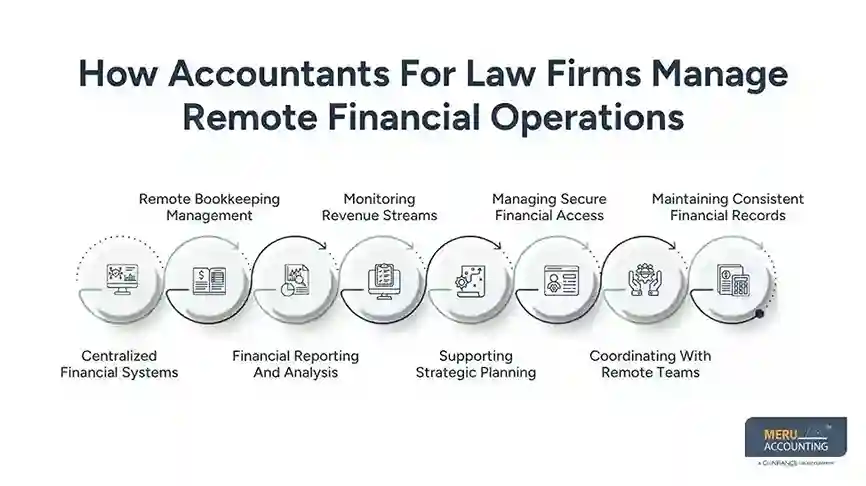
Supporting Strategic Planning
Accurate financial data helps law firms plan budgets and evaluate future investments. Proper planning supports steady growth and financial stability.
Managing Secure Financial Access
Remote firms need secure access to financial data. Accountants for law firms set up controlled access so authorized team members can view financial records safely. This reduces the risk of financial data misuse.
Coordinating With Remote Teams
Law firms often have lawyers and staff working from different locations. Accountants ensure financial information is shared properly among team members. Clear communication helps maintain consistency in financial processes.
Maintaining Consistent Financial Records
Consistency is important for remote accounting operations. Accountants review financial entries regularly to keep records accurate and organized. This also helps prepare the firm for audits and financial reviews.
Role Of Accounting Services For Law Firms In Cloud-Based Bookkeeping
Real-Time Financial Access
Cloud accounting systems allow lawyers to access financial data from anywhere. Accounting services for law firms ensure these systems are maintained properly.
Secure Financial Record Storage
Cloud platforms store financial records safely and allow authorized users to access them when needed. This reduces the risk of data loss and keeps sensitive financial information protected.
Simplifying Bookkeeping Tasks
Automated systems reduce manual bookkeeping work and improve accuracy. This helps law firms save time and maintain organized financial records.
Supporting Remote Collaboration
Cloud tools allow accountants and lawyers to work together even when they are in different locations. This makes it easier to review financial data and resolve issues quickly.
Improving Data Accuracy
Professional accounting services for law firms ensure financial records remain accurate and updated regularly. Regular monitoring helps prevent mistakes and keeps financial reports reliable.
Managing Client Trust Accounts In Virtual Law Firms
Understanding Trust Accounting Rules
Legal professionals must follow strict guidelines when handling client funds. Accountants for law firms ensure these rules are followed.
Preventing Trust Account Errors
Even small errors in trust accounts can cause compliance issues. Professional monitoring helps avoid mistakes. Regular reviews ensure that all transactions are recorded correctly.
Reconciling Trust Accounts Regularly
Accountants perform regular reconciliations to ensure that balances match financial records. This process helps detect discrepancies early and maintain accurate trust account balances.
Maintaining Proper Documentation
Accurate records help law firms demonstrate compliance during audits or reviews. Proper documentation also makes it easier to track client fund transactions.
Ensuring Client Fund Transparency
Proper trust account management builds trust between lawyers and their clients. Clear records help clients understand how their funds are being handled.
How Accounting Services For Law Firms Improve Billing And Invoicing
Structured Time Tracking
Accurate time tracking ensures clients are billed correctly for legal services. It also helps law firms maintain transparency in billing and avoid disputes with clients.
Automated Invoice Generation
Many firms use automated invoicing systems managed by accounting services for law firms. This helps generate invoices quickly and reduces the chances of manual errors.
Monitoring Outstanding Payments
Accountants track unpaid invoices and help firms follow up on delayed payments. Regular monitoring improves collection rates and keeps revenue consistent.
Improving Cash Flow Management
Timely billing and payment collection support steady cash flow for remote law practices. Proper financial tracking also helps firms plan their expenses more effectively.
Maintaining Billing Accuracy
Professional accounting services for law firms help reduce billing errors and disputes. Accurate billing records also improve client trust and satisfaction.
Tax Planning And Compliance For Virtual Law Practices
Managing Tax Obligations
Virtual law firms must comply with tax regulations regardless of their operating model. Accountants for law firms ensure that all taxes are calculated accurately and filed on time.
Tracking Deductible Expenses
Remote practices often have unique expenses such as home office costs. Accountants for law firms ensure these are recorded properly. Proper tracking helps firms maximize deductions and reduce taxable income.
Preparing Accurate Tax Returns
Proper financial records simplify the tax filing process. Accurate preparation also minimizes errors that could trigger audits or penalties.
Avoiding Tax Penalties
Professional tax planning reduces the risk of compliance issues. Accountants help law firms stay updated on changing tax laws to avoid fines.
Supporting Long-Term Tax Strategy
Experienced accountants for law firms help law firms plan their tax obligations efficiently. This allows firms to make informed decisions for long-term financial growth.
Using Technology And Automation In Modern Law Firm Accounting
Digital Accounting Platforms
Modern accounting systems allow firms to manage finances online. These platforms also enable secure access to data from any location.
Automated Data Entry
Automation reduces manual work and improves accuracy in financial records. This ensures timely updates and minimizes human errors.
Financial Dashboards
Law firm partners can view real-time financial summaries using digital dashboards. Dashboards also provide insights for strategic planning and budget adjustments.
Integration With Legal Software
Accounting tools can connect with legal management software for improved workflow. This integration helps synchronize client data with financial records efficiently.
Enhancing Financial Monitoring
Technology allows accountants for law firms to monitor financial data efficiently. Continuous monitoring helps detect irregularities early and maintain accurate records.
Benefits Of Hiring Professional Accountants For Law Firms
Improved Financial Accuracy
Professional accountants ensure that all financial records are accurate and organized. Accurate records help prevent errors and support informed business decisions.
Better Compliance Management
Law firms must follow strict financial rules, and professionals help maintain compliance. This reduces the risk of legal or regulatory issues.
Time Savings For Lawyers
Lawyers can focus on client work while accountants handle financial management. Delegating these tasks frees up valuable time for billable activities.
Stronger Financial Insights
Detailed reports help law firm owners understand their financial performance. These insights support planning, budgeting, and strategic decision-making.
Reduced Financial Risk
Hiring accountants for law firms helps prevent costly financial errors. Professional oversight safeguards the firm against mistakes that could affect cash flow or compliance.
How Meru Accounting Supports Virtual Law Firms
- Meru Accounting offers experienced accountants for law firms who understand the unique financial structure of legal practices, ensuring accurate and compliant financial management.
- Our team provides full remote accounting support, delivering financial management services that fit perfectly with virtual law firm operations.
- We offer comprehensive accounting services for law firms, including bookkeeping, financial reporting, tax planning, and compliance assistance, tailored to the needs of remote legal practices.
- Meru Accounting uses advanced accounting technology, allowing firms to monitor financial data online and access real-time insights for better decision-making.
- Our cost-effective solutions help law firms maintain financial accuracy and compliance without the expense of a full in-house accounting team.
Key Takeaways
- Virtual law firms require structured financial management systems to operate effectively.
- Accountants for law firms help manage financial records, compliance, and reporting.
- Remote legal practices face challenges such as trust account management and billing accuracy.
- Accounting services for law firms help improve bookkeeping, invoicing, and financial reporting.
- Cloud accounting and automation allow virtual law firms to manage finances efficiently.
- Professional accounting support helps law firms focus on legal services while maintaining financial stability.
FAQs
Virtual law firms handle financial transactions online and must follow strict legal accounting rules. Accountants for law firms help maintain accurate records and ensure compliance.
They manage bookkeeping, financial reporting, billing systems, tax preparation, and trust account reconciliation.
They monitor trust accounts, perform regular reconciliations, and ensure funds are handled according to legal guidelines.
Yes, accounting services for law firms help implement proper invoicing systems and track outstanding payments.
Yes. Outsourcing allows smaller firms to access professional financial support without hiring full-time staff.