
CPA firms are dealing with rising workloads, tighter reporting timelines, and growing client expectations. In this environment, accounting and payroll services have become an important support option for firms that want to expand client capacity without increasing internal hiring at the same pace.
Instead of building large in-house teams, many CPA firms now rely on structured external support for routine finance tasks. This shift allows better focus on review work, advisory tasks, and compliance decisions.
At the same time, firms are also adopting payroll services for accountants to manage employee salary processing and tax-related work with greater consistency. This model is changing how CPA firms structure their operations and handle growth.
What You Will Learn From This Blog
- Why CPA firms are shifting toward external finance support
- How workload capacity is improved without expanding internal teams
- Role of payroll in CPA firm operations
- Impact on turnaround time and accuracy
- Benefits of outsourcing routine finance work
- How firms like Meru Accounting support CPA scaling
What are Accounting and Payroll Services?
Accounting and payroll services refer to external financial support provided by specialized firms. These services include bookkeeping, payroll processing, tax handling, and financial reporting. They are commonly used by CPA firms to manage routine financial work in a structured and organized way.
These services cover key tasks such as invoice tracking, ledger updates, salary calculations, tax deductions, and preparation of financial reports. Many CPA firms rely on accounting and payroll services to handle repetitive financial activities so that internal teams can focus more on audits, compliance checks, and advisory work.
In addition, providers follow structured review systems to reduce errors in financial records through multi-step validation processes. Since tax rules and payroll regulations change frequently, these services also help CPA firms stay aligned with updated compliance requirements while maintaining accuracy and consistency in reporting.
Why CPA Firms Partner With Accounting and Payroll Services Providers to Efficiently Scale Capacity
Handling Rising Workload
As client numbers increase, internal teams often reach capacity limits. Accounting and payroll services allow firms to manage higher volume without immediate hiring. Deadline pressure reduces during peak reporting seasons, allowing smoother completion of financial cycles even with growing client bases.
Reducing Internal Pressure
Routine accounting work consumes significant staff time. Using external support reduces workload pressure on internal teams. Senior professionals gain additional bandwidth to focus on financial reviews, client strategy discussions, and advisory responsibilities.
Supporting Multi-Client Operations
CPA firms handle multiple industries and reporting structures. External providers help maintain organized financial processing across clients. Consistency improves across different accounting systems, reporting formats, and industry-specific compliance requirements.
Managing Cost Structure
Instead of fixed-salary expansion, firms can use flexible service models that scale with demand. Financial planning becomes more predictable as variable service costs replace long-term hiring commitments and infrastructure expenses.
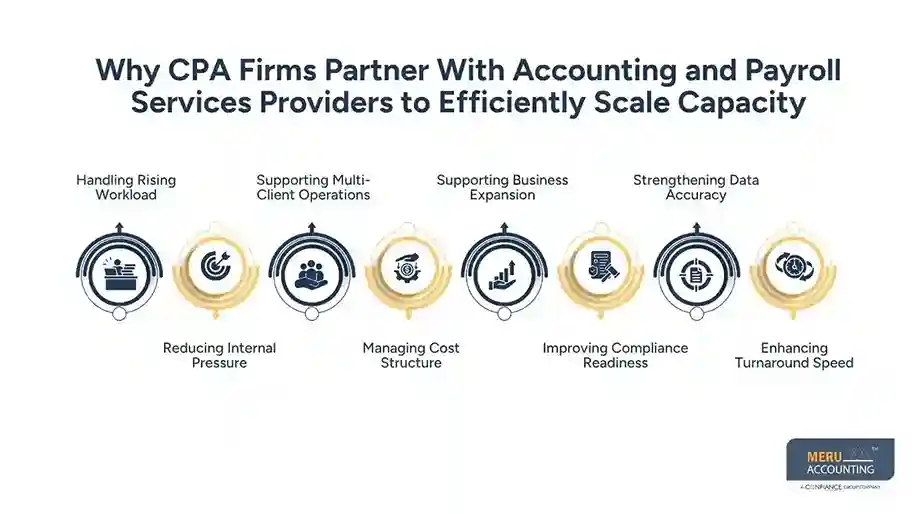
Supporting Business Expansion
When entering new regions or adding new clients, external support reduces setup time and operational delays. Faster onboarding becomes possible without waiting for recruitment cycles, training periods, or internal resource reallocation.
Improving Compliance Readiness
Regulatory requirements across tax and payroll continue to change frequently. External providers maintain updated knowledge of compliance rules and apply them consistently across client accounts. Audit readiness improves due to structured documentation and standardized reporting practices.
Strengthening Data Accuracy
Financial accuracy becomes more stable when structured validation processes are applied before final reporting. Error rates are reduced in reconciliations, payroll entries, and ledger updates, improving confidence in financial statements prepared for clients.
Enhancing Turnaround Speed
Reporting cycles become faster when repetitive tasks are handled externally through accounting and payroll services. Internal teams receive processed data earlier, allowing quicker review and final submission without delays caused by manual workload bottlenecks.
The Role of Payroll Services For Accountants in Modern CPA Practices
Accurate Salary Processing
Payroll accuracy is critical for client trust. Payroll services for accountants ensure salary calculations are handled correctly and on time. Regular validation checks reduce the chances of underpayment or overpayment across employee payroll cycles.
Tax And Deduction Management
Payroll includes tax deductions, benefits, and compliance reporting. These services help maintain accuracy in all calculations. Proper classification of deductions ensures alignment with statutory rules and reduces compliance risks.
Employee Record Handling
Maintaining structured employee data is essential for audits and reporting requirements, which is simplified with integrated accounting and payroll services. Organized records also simplify verification during internal reviews and external audits.
System Integration
Payroll data must align with accounting systems to avoid mismatches in reporting. Consistent synchronization between systems reduces reconciliation issues during financial closing periods.
Reporting Support
Clean payroll data improves month-end and year-end financial reporting quality. Accurate payroll inputs strengthen overall financial statements and support better decision-making.
Key Benefits of Partnering With Accounting and Payroll Services Providers
Higher Work Capacity
CPA firms can manage more clients without expanding internal teams significantly. Work distribution becomes more balanced during peak filing and reporting periods.
Better Time Allocation
Internal teams can focus on advisory and review work instead of routine processing. More time becomes available for client communication and strategic financial planning.
Improved Accuracy
Structured workflows reduce manual errors in accounting and payroll tasks. Regular validation steps ensure consistency in financial records across reporting cycles.
Strong Compliance Control
Providers help track regulatory changes and apply them correctly. Updated compliance practices reduce the risk of filing errors and penalties.
Flexible Scaling
Services can increase or decrease based on client demand. Operational capacity adjusts smoothly during seasonal workload changes or rapid growth phases.
How Payroll Services For Accountants Help Reduce Turnaround Time
Faster Processing Cycles
Payroll tasks are completed more quickly through structured accounting and payroll services workflows. Standardized steps ensure smooth movement of data from input to final output without interruptions.
Reduced Manual Workload
Automation and system-based processes reduce manual effort. Reduced dependency on manual entry lowers delays caused by repetitive data handling tasks.
Early Error Detection
Mistakes are identified before final payroll processing. Pre-check systems help prevent rework and avoid delays during final approval stages.
Clear Workflow Structure
Defined steps reduce confusion and delays. Each stage of payroll processing follows a set order, improving clarity and execution speed.
Better Coordination
Improved communication between CPA firms and service providers reduces delays. Shared platforms and structured updates ensure faster resolution of queries during processing cycles.
How Outsourced Payroll Services Support Advisory-Focused CPA Models
Shift To Advisory Work
CPA firms are focusing more on advisory services while outsourcing routine tasks. Routine payroll and bookkeeping work shifts away from senior teams, creating space for higher-value client discussions.
Better Use Of Expertise
Senior professionals spend more time on analysis and planning. Skill utilization improves as experienced staff focus on financial insights instead of repetitive processing work.
Cleaner Financial Data
Structured processing improves the accuracy of financial inputs. Standardized checks reduce inconsistencies before data reaches reporting and review stages.
Improved Decision Support
Reliable payroll and accounting data generated through accounting and payroll services support better financial decisions. Consistent financial records strengthen forecasting and planning accuracy for clients.
Balanced Work Distribution
Tasks are divided based on complexity and skill level. Operational workload becomes more evenly spread across internal teams and external service partners.
How Meru Accounting Supports CPA Firms in Scaling Operations
Meru Accounting provides structured financial support to CPA firms managing growing client workloads. We deliver reliable accounting and payroll services designed to handle routine finance tasks such as bookkeeping, reporting, and payroll processing. This support allows CPA firms to maintain operational stability even when client volume increases.
We work across multiple accounting platforms, including Xero, QuickBooks, and NetSuite, ensuring smooth data flow and accurate financial handling.
Our strong expertise in payroll operations makes our payroll services for accountants suitable for firms that require consistent salary processing, compliance accuracy, and timely reporting across multiple clients.
A flexible capacity model allows CPA firms to scale services based on workload requirements without operational disruption. Our experience across multiple industries ensures consistent financial processing quality, even when dealing with different compliance rules and reporting structures.
Our Expert Perspective
CPA firms today are not limited by technical accounting work but by time spent on routine processing tasks. In many cases, payroll and bookkeeping consume more operational time than advisory work.
When structured properly, accounting and payroll services reduce this pressure and allow firms to manage more clients without sacrificing accuracy. Similarly, payroll services for accountants reduce delays in salary processing and lower correction cycles during reporting periods.
A model where CPA firms focus on review and advisory while outsourcing routine financial execution is becoming more practical for long-term stability and controlled growth.
Key Takeaways
- CPA firms use external support to handle workload growth
- Accounting and payroll services improve operational capacity
- Payroll accuracy is critical for financial reporting
- Payroll services for accountants reduce processing delays
- Outsourcing supports advisory-focused CPA models
- Structured workflows improve compliance and accuracy
FAQs
CPA firms use these services to manage higher client volumes without expanding internal teams.
Routine financial work is streamlined, improving speed and operational efficiency.
Salary processing, tax deductions, compliance filings, and employee record management are included.
CPA firms always review and approve final outputs before reporting.
Timely payroll processing is ensured with better accuracy and compliance control.