
An accounting firm for real estate can bring structure to tax work that often involves rental income, repairs, loans, closing costs, and property records. Effective tax planning starts with accurate accounting records, complete asset schedules, and a careful review of how each cost was incurred and used.
Real estate owners may miss tax savings when a repair is recorded incorrectly, an improvement is treated as a current expense, or depreciation begins on the wrong date. Real estate accounting classifies each item correctly, while tax review determines whether the cost is deductible now or must be capitalized and depreciated over time.
The IRS says most business and investment property placed in service after 1986 uses MACRS. Under the general system, residential rental property is often recovered over 27.5 years, while nonresidential real property is often recovered over 39 years.
What You Will Learn From This Blog
- How depreciation works for rental and business property.
- How an accounting firm for real estate can sort costs by tax treatment.
- Which common real estate tax deductions need regular tracking.
- How repairs differ from improvements and capital costs.
- Why clear real estate accounting records matter during tax planning.
- How Meru Accounting can manage books and tax records for property owners.
How Real Estate Accounting Handles Property Depreciation
Build a Property Asset List
An accounting firm for real estate should keep a clear asset list showing each property, its cost, date placed in service, and tax basis. Real estate accounting keeps the list tied to tax work papers.
Separate Land From Building
Land is not depreciated under the normal rules for depreciable property. A firm must split the purchase price between land and the building before the depreciation schedule is set.
Track The Placed-In-Service Date
Depreciation depends on when an asset is ready and available for its intended use. The placed-in-service date should match the facts shown by closing and property records.
Use The Right Recovery Period
Residential rental property often has a 27.5-year recovery period under GDS, while nonresidential real property often has a 39-year period. Other assets may have shorter periods, so each item needs a proper class.
Record Improvements Separately
A new roof, major system, or other qualifying improvement may need its own asset record. An accounting firm for real estate can help classify these projects and maintain separate records for depreciation. Keeping each project separate makes future depreciation and sale records easier to review.
Review Depreciation Each Year
An annual review can catch missing assets, wrong dates, or changes after a sale or major project. The depreciation schedule should match the general ledger and related invoices.
How An Accounting Firm for Real Estate Handles Tax Deductions And Depreciation
Review Income And Costs
An accounting firm for real estate starts by matching rent, fees, and other income with property costs. Real estate accounting should show which property earned the income and which property paid each cost.
Check The Tax Nature Of Each Cost
Not every payment made for a rental property is a current deduction. A tax review can sort repairs, supplies, interest, taxes, insurance, and capital costs before the return is prepared.
Match Costs To Property Records
Invoices should show what was bought, where it was used, and when the work was done. Costs can be tied to bank entries and property files for better recordkeeping.
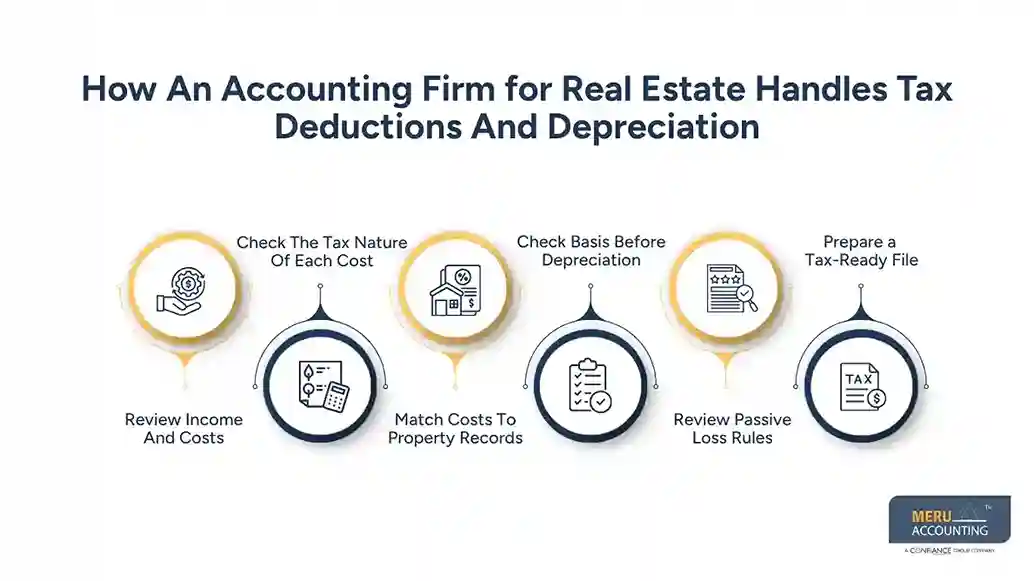
Check Basis Before Depreciation
Tax basis is not always the same as the cash paid at closing. Some closing costs may be capitalized, while other costs may be deductible, so the file needs a careful review. Certain settlement costs may become part of property basis rather than a current deduction.
Review Passive Loss Rules
Rental losses may face passive activity and at-risk limits. These limits should be reviewed carefully instead of assuming every loss is fully usable.
Prepare a Tax-Ready File
An accounting firm for real estate should keep income reports, expense detail, asset schedules, loan records, and support for large costs. Real estate accounting makes the tax review faster when records are clear.
optional anymore
on running the business
Common Real Estate Tax Deductions To Track
Mortgage Interest
Interest on a rental property loan may be deductible under the applicable rules. Real estate tax deductions should be tracked from lender statements rather than estimated from loan payments.
Property Taxes
Property tax may be deductible when the cost meets the applicable rules. Local charges for specific improvements may need different treatment, so each bill deserves review.
Insurance Costs
Qualifying insurance costs tied to rental use may be deductible. An accounting firm for real estate can maintain insurance documentation to support expense reporting during tax preparation.
Repairs and Maintenance
Repair and maintenance costs depend on the nature of the work and applicable tax rules. Expenses that keep a rental property in normal operating condition may be deductible when the rules allow it.
Management and Advertising
Real estate tax deductions can include certain management fees and advertising costs for rental activity. Clear vendor names and invoices make these costs easier to support.
Utilities and Supplies
Utilities, cleaning costs, small supplies, and similar operating costs can add up over a year. Real estate accounting should code these costs by property so the owner can see the true cost of each asset.
How To Distinguish Repairs, Improvements, And Capital Expenses
Identify A Repair
A repair generally keeps property in its normal working state. Examples can include fixing a leak or replacing a small broken part when the work does not meet the rules for capitalization.
Identify An Improvement
An improvement may better the property, restore it, or adapt it to a new use. The IRS says such costs generally must be capitalized rather than deducted at once.
Review The Whole Project
A project may contain both repair and improvement work. An accounting firm for real estate can review invoices, scopes of work, and payment details rather than judging the full project from one vendor label.
Apply Safe Harbor Rules
Certain tax safe harbors may change how some costs are treated when their requirements are met. An accounting firm for real estate should check the current rule, election needs, and records before using a safe harbor.
Capitalize The Right Costs
Capitalized costs become part of the property’s tax basis and may be recovered through depreciation. Real estate accounting should keep these costs separate from normal operating expenses.
Keep Project Documents
Contracts, invoices, permits, receipts, and payment proof can show what work was done. Strong records also make future sale and basis reviews easier.
How Accurate Real Estate Accounting Supports Tax Planning
Show Property-Level Profit
An accounting firm for real estate can organize these records by property, giving owners a clearer view of taxable income and cash flow. That view gives owners a better base for tax planning and cash decisions.
Flag Large Expense Changes
A sharp rise in repairs or contractor costs may point to a capital project or a coding issue. Real estate accounting can flag the change before year-end tax work begins.
Plan For Depreciation
A current asset schedule shows what is already being depreciated and what may need to be added. That record can support accurate tax estimates and reporting.
Track Basis Changes
Basis data should remain current after each major property event. Capital improvements, depreciation, and certain other events can change the property’s tax basis.
Prepare For Tax Deadlines
Real estate accounting can keep reports ready for estimated taxes, tax return work, lender needs, and owner reviews.
Review With a Tax Professional
Tax planning should reflect the owner’s full tax position, not just property profit. An accounting firm for real estate can organize the records, while a qualified tax professional reviews the tax treatment and filing needs.
How Meru Accounting Handles Real Estate Accounting And Bookkeeping
Maintain Property-Level Records
Meru Accounting can keep separate records for each property, making rent, expenses, loans, and other transactions easier to track. Property-level records also give owners a clear view of each asset’s financial activity.
Categorize Property Expenses
Our bookkeeping team can sort costs into rent, repairs, insurance, utilities, management fees, and other accounts. Proper coding gives tax professionals cleaner records when an accounting firm for real estate reviews deductible property costs.
Reconcile Bank and Credit Accounts
Regular reconciliation checks recorded transactions against bank and credit card statements. Our team can find missing entries, duplicate transactions, and coding errors before monthly reports are closed.
Track Fixed Assets
Meru Accounting can record property assets and major improvement costs in the accounting records. Keeping these items separate from daily expenses gives tax professionals better data for depreciation work.
Record Rental Income
Rental payments, fees, and other property income need consistent recording. Our bookkeeping process can track income by property and keep the monthly records ready for financial reporting.
Prepare Monthly Reports
Our accounting and bookkeeping services can provide monthly profit and loss reports, balance sheets, and other reports based on the client’s needs. These reports give property owners current financial data for review and planning.
Our Expert Insight
Clean and well-organized records help an accounting firm for real estate prepare clearer information for year-end tax work. Property owners should keep each property’s income and costs separate, review large or unusual payments before coding them, and retain invoices, receipts, bank statements, loan records, and closing papers. Monthly bank and credit card reconciliations can catch missing or duplicate entries while records are still fresh. Our bookkeeping team focuses on keeping financial records accurate and current, while the client’s CPA or tax professional can use those records to review tax treatment, deductions, and depreciation.
Key Takeaways
- Keep a separate asset record for each property and major improvement.
- Separate land from the building before calculating depreciation, with support from an accounting firm for real estate when needed.
- Track the date each asset is placed in service.
- Review repairs before treating them as capital improvements.
- An accounting firm for real estate can help organize invoices and project records for major property work.
- Track interest, taxes, insurance, repairs, and other valid rental costs.
- Review passive activity and at-risk limits before using rental losses.
- Reconcile the records with the depreciation schedule each year.
- Keep tax basis records ready for a future property sale.
- Use a qualified tax professional for decisions that depend on specific tax facts.
FAQs
An accounting firm for real estate can review property income, expenses, invoices, and tax records to identify eligible deductions and maintain proper documentation.
Common real estate tax deductions may include mortgage interest, property taxes, insurance, repairs, management fees, advertising, utilities, and other eligible operating costs.
Rental property depreciation allows owners to recover the cost of qualifying property over its assigned tax recovery period, subject to IRS rules.
Real estate accounting organizes property income and expenses, helping identify eligible deductions and maintain accurate tax records.
A repair maintains existing property condition, while an improvement adds value, restores property, or adapts it to a new use and may require capitalization.
optional anymore
on running the business