
A project closes. The client has paid. The books look balanced. Then tax season arrives, and one question can stop the review: Why does the profit in the books not match the profit on the tax return? For an architecture firm, the answer may sit in a depreciation schedule, a meal expense, a mixed-use vehicle, a project cost, or a year-end entry. None of these differences may look large on their own, but several small errors can change the tax result. Good accounting for architects is not about making book profit and taxable profit identical. It is about knowing why they differ and proving that each adjustment is correct.
The IRS requires businesses to keep records that support income, expenses, assets, and other items reported on a tax return.
What You Will Learn From This Blog
- Why book income and taxable income can differ in an architecture firm.
- Where common book-to-tax errors occur.
- How architecture accounting can track differences during the year.
- How an architecture accountant can review areas with higher tax risk.
- Which tax adjustments architects should check before filing.
- How better accounting for architects can make year-end tax review more controlled.
Common Book-to-Tax Reconciliation Errors in Architecture Firms
Mixing Book and Tax Depreciation
Picture a firm that buys new computers and a large-format printer during the year. The equipment appears on the books, but the depreciation used for financial reporting may not match the depreciation allowed for tax.
This is a common source of reconciliation differences. Accounting for architects should keep the book depreciation schedule separate from the tax schedule rather than changing one simply to match the other.
Recording All Meals as Fully Deductible
A lunch with a client may be entered in the books as a normal business expense. That does not mean the full amount will always be deductible for tax.
Many business meals are subject to a 50% federal deduction limit, although exceptions apply. A good review identifies the tax adjustment instead of treating the entire ledger balance as deductible.
Missing Personal Use
An architect may use the same vehicle, phone, laptop, or home space for both business and personal needs. Problems arise when the entire cost is posted as a business expense without considering the personal portion.
Accounting for architects should identify mixed-use costs and apply the relevant tax rules. The business account should not become a place to record every cost simply because the firm paid the bill.
Misclassifying Client Costs
A project may require travel, printing, models, permits, consultants, or other costs that the client later reimburses. If the original expense and reimbursement are posted without a clear method, income and expense figures can become misleading.
Architecture accounting should make it easy to see what the firm paid, what the client reimbursed, and how each amount was recorded.
Carrying Old Adjustments Forward
Last year’s tax adjustment can look like an easy starting point for this year’s reconciliation. But an old adjustment may already have reversed, changed in value, or stopped applying altogether.
Accounting for architects should review each adjustment for the current year instead of copying last year’s schedule without checking the underlying transaction.
Weak Supporting Records
A tax adjustment is much easier to defend when the reason is clear. A journal entry with no note or source can leave the reviewer guessing about why the amount was changed.
The IRS advises businesses to retain records that support reported income and expenses. Accurate accounting for architects connects the adjustment to its source.
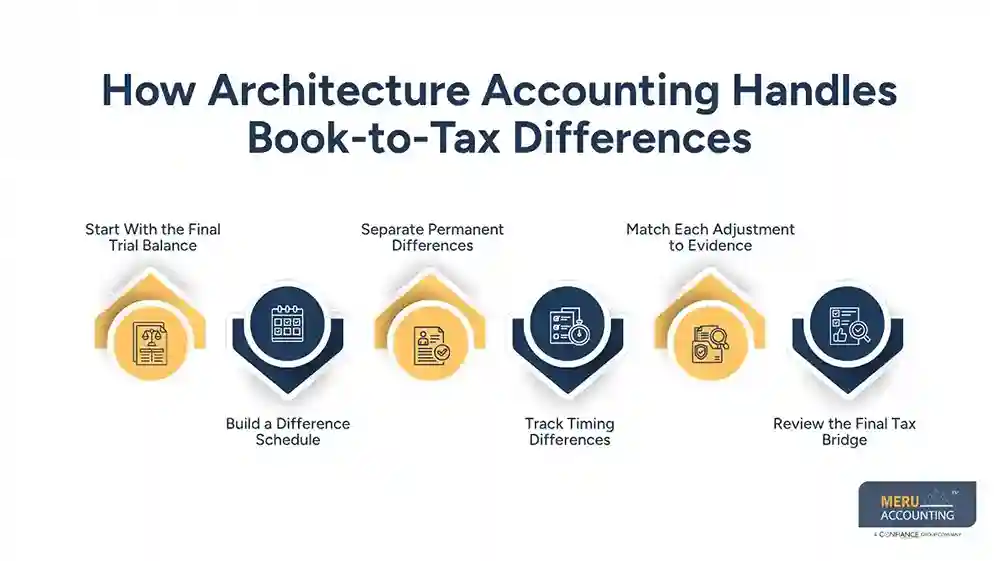
How Architecture Accounting Handles Book-to-Tax Differences
Start With the Final Trial Balance
Tax work should not begin with numbers that are still changing. Architecture accounting should first bring the trial balance through its normal account checks so the tax review starts with reliable book figures.
This also makes it easier to spot unusual balances before they become part of the tax reconciliation.
Build a Difference Schedule
A simple schedule can show the book amount, tax amount, adjustment, reason, and supporting record. That small step can turn a confusing reconciliation into a list of clear items.
For architecture accounting, this schedule becomes the central record for explaining why book income and taxable income are different.
Separate Permanent Differences
Not every book expense will become a tax deduction later. Some items are permanent differences and should be treated that way.
Marking them clearly prevents the same amount from being carried forward as though it were a temporary timing difference. This keeps accounting for architects cleaner from one tax year to the next.
Track Timing Differences
Other differences are about when an item is recognized. A cost may appear in the books in one period but receive tax treatment in another.
Architecture accounting should record these timing differences in a separate schedule, showing the current adjustment and the expected reversal when appropriate.
Match Each Adjustment to Evidence
A good reconciliation should not rely on memory. A depreciation adjustment should connect to the asset schedule. A meal adjustment should connect to the related expense records.
This approach gives accounting for architects a clear trail from the general ledger to the final tax figure.
Review the Final Tax Bridge
At the end of the process, someone should be able to start with book profit and follow each major adjustment until they reach taxable income.
If an amount cannot be explained in simple terms, it deserves another look. Architecture accounting is stronger when the final numbers tell a clear story.
How an Architecture Accountant Can Prevent Reconciliation Errors
Review the Chart of Accounts
An architecture accountant can review whether project costs, payroll, software, travel, meals, equipment, and professional fees are placed in suitable accounts.
When similar costs are spread across unrelated accounts, finding tax differences takes more time and creates more room for missed items.
Check Fixed Asset Schedules
An accountant for architecture can compare purchases in the general ledger with the fixed asset schedule. This can reveal missing assets, duplicate entries, incorrect dates, or items that need a closer look.
The IRS also requires records that can support depreciation and asset-related calculations.
Test High-Risk Accounts
In Accounting for Architects, a useful review does not treat every account in exactly the same way. An accountant for architecture can give extra attention to meals, travel, vehicles, depreciation, owner charges, interest, and unusual year-end entries.
This focused review can bring attention to areas where book and tax treatment often differ.
Review Project Balances
An architecture project can run across several months or even tax years. An architecture accountant can review large open balances, unusual costs, and income entries to see whether the firm’s accounting method has been applied consistently.
That review is especially useful when a project has many vendors or outside consultants.
Check Owner Transactions
Personal spending through a business card can easily end up inside operating expenses. As part of Accounting for Architects, an accounting professional should review owner-related transactions and separate personal amounts from legitimate business costs.
This gives the tax preparer a cleaner expense base and reduces unnecessary adjustments.
Keep a Reconciliation File
A useful reconciliation file should answer three questions: What changed? Why did it change? What proves the change?
An architecture accountant can keep this information together so that the same issue does not need to be researched again during the next review.
optional anymore
on running the business
Tax Adjustments Architects Should Review Before Filing
Depreciation and Asset Basis
Start with equipment and other business assets. Compare the book schedule with the tax schedule and check cost, date placed in service, business use, depreciation, and disposal details.
The IRS provides specific rules for depreciation and recordkeeping, so accounting for architects should not rely on a simple book depreciation figure for tax purposes.
Meals and Entertainment
Look closely at meal accounts before filing. The tax treatment may differ from the amount shown in the books, and entertainment expenses have separate rules.
A detailed review within architecture accounting can prevent a full book expense from being carried into the tax calculation without the required adjustment.
Travel and Vehicle Costs
Travel and vehicle costs deserve attention when business and personal use overlap. Records should show the facts needed to support the business portion.
For accounting for architects, the review should cover both the amount recorded and the reason the cost qualifies as a business expense.
Personal and Business Costs
A business bank account does not turn a personal cost into a business deduction. Review unusual card charges, owner payments, mixed-use costs, and other items that may contain a personal part.
Accounting for architects should classify these costs before the tax return is prepared, rather than fixing them after filing.
Accrued and Prepaid Costs
An expense entered before payment and a payment made before the related service period may not receive the same tax treatment as the book entry.
Architecture accounting should flag these items and check them against the firm’s accounting method and the nature of the expense.
Credits and Special Tax Items
Tax credits and special deductions should be reviewed based on the firm’s entity type and the tax year. A prior-year adjustment should never be treated as an automatic rule for the current year.
An architecture accountant can include these items in the year-end tax checklist and confirm that the related records are available.
Best Practices for Accurate Accounting for Architects
Reconcile Accounts Each Month
Waiting until tax season creates a pile of old transactions to review at once. Accounting for architects works better when bank, card, payroll, receivable, payable, and key project accounts are checked during the year.
Small issues are usually easier to trace while the transaction is still fresh.
Keep Book and Tax Schedules Apart
Book records should represent the firm’s financial reporting. Tax schedules should reflect the applicable tax rules.
Keeping the two views separate allows accounting for architects to explain differences without changing financial records just to make them match the tax return.
Use Project Codes
Project codes can show where income and costs came from. This matters when a firm has several active jobs and needs to trace a vendor bill, consultant fee, travel cost, or client charge.
Clear project data also gives architecture accounting a better base for reviewing unusual costs.
Review Large Changes
A large jump in an account is not automatically an error. A new office, major project, equipment purchase, or staff change can explain it.
Still, accounting for architects should ask why major balances changed before the year is closed. The answer may reveal either a real business event or a posting issue.
Keep Source Documents
Invoices, receipts, contracts, bank statements, card records, and asset documents should be stored in a way that makes them easy to find.
For architecture accounting, organized source records make it easier to confirm an adjustment instead of spending hours searching for proof during tax season.
Make a Year-End Checklist
A checklist can cover depreciation, meals, travel, vehicles, owner transactions, payroll, accruals, prepaid costs, and unusual entries.
Using the same core checklist each year gives accounting for architects a steady process while still leaving room to review items that are unique to the firm.
Partner With Meru Accounting For Architecture Accounting
An architecture firm may have dozens of transactions tied to one project, yet the tax issue may come from one small entry. Meru Accounting provides accounting services that include income tax, payroll, accounts payable and receivable, and financial reporting.
For firms looking for a structured approach to accounting for architects, Meru Accounting can review financial data, organize records, and maintain a clear process for book-to-tax work. The focus is on making figures traceable instead of waiting until filing time to find differences.
An architecture accountant can also review unusual entries during the year, including fixed assets, project costs, owner transactions, and expense classifications. This gives the firm more time to correct issues before the final tax review.
Our Expert Perspective
From our experience reviewing business accounts, the book-to-tax differences that take the most time are not always the largest transactions. A small equipment purchase, a client reimbursement, a mixed-use expense, or an entry posted to the wrong account can create extra work when the tax file is prepared.
For accounting for architects, this is why we pay attention to the transactions behind the final numbers, not only the final profit figure. Architecture accounting should give the reviewer enough detail to understand how a project cost, asset, or expense reached the books and whether its tax treatment needs a separate adjustment.
Key Takeaways
- Accounting for architects should explain, rather than hide, differences between book profit and taxable income.
- Not every book-to-tax difference is an error; some arise from different tax and accounting rules.
- Depreciation, meals, travel, vehicles, project costs, and owner transactions need careful review.
- Architecture accounting should maintain clear book and tax schedules.
- An architecture accountant can review higher-risk accounts before filing.
- Source records should support major income and expense entries.
- Current tax rules should be checked before filing because tax treatment can change.
FAQs
Book-to-tax reconciliation explains the differences between an architecture firm’s book income and taxable income before filing.
Common errors include wrong depreciation, missed tax adjustments, personal expenses, meal costs, and incorrect treatment of project expenses.
Architecture firms can reduce errors by reviewing tax adjustments, reconciling accounts, checking asset schedules, and keeping clear source records.
An architecture accountant reviews book figures, tax adjustments, depreciation, expenses, and supporting records to identify and correct reconciliation errors.
Architecture accounting keeps project income, expenses, assets, and tax adjustments organized so book-to-tax differences can be reviewed before filing.
optional anymore
on running the business