
The hotel sector handles many daily transactions, including room bookings, food sales, events, vendor bills, and staff payments. In this setup, accounting for hotel industry becomes more complex than regular business accounting. Hotels deal with multiple income streams, changing occupancy rates, and seasonal demand shifts that require accurate tracking.
Unlike simple bookkeeping, accounting for hotel industry demands structured methods that match hospitality operations. Errors in financial records can affect pricing, tax reporting, and profit planning. This is why hotels often rely on trained professionals and systems built for hospitality needs.
What You Will Learn From This Blog
- Why accounting for hotel industry is more complex than general accounting
- Key challenges faced in hotel financial tracking
- Role of revenue control and leakage prevention
- Impact of multi-property operations on finance systems
- Benefits of digital tools and cloud systems
- How expert services like Hotel Accounting Services add value
- Real insights into improving hotel financial accuracy
Understanding Accounting For Hotel Industry
Accounting in the hotel sector is closely connected to daily operations and financial movement across multiple services. Hotels generate income from rooms, food and beverage sales, events, travel partnerships, and other add-on services.
Each revenue source must be recorded and analyzed separately to ensure accurate reporting. This separation helps avoid confusion in profit calculation and supports correct tax filing, especially in businesses with high transaction activity.
In this context, accounting for hotel industry plays an important role in maintaining clarity across all income streams. Hotels also handle a large number of financial transactions every day, often running into hundreds or even thousands, depending on size and occupancy.
Recording each transaction promptly is essential for maintaining accurate and reliable financial records in the hotel industry. At the same time, income in the hospitality sector fluctuates seasonally, with peak periods generating higher revenue compared to off-season months.
This requires careful adjustment of forecasts and financial reports to accurately reflect real business conditions. In addition, each department within a hotel operates as a separate cost center, including housekeeping, front office, kitchen, and events. Tracking these costs individually helps measure true performance and control expenses effectively.
What Makes Accounting For Hotel Industry Different
Complex Operational Structure
Hotels run multiple operations at the same time, including front desk services, kitchen management, housekeeping, and event coordination. Financial records must be aligned with each of these functions to ensure accurate reporting and smooth tracking of income and expenses.
High Volume of Micro Transactions
Small daily payments from guests add up quickly and require careful recording to avoid errors. Accounting for hotel industry ensures that every transaction is captured correctly so that no entry is missed or recorded twice, maintaining clean financial data.
Integration With Booking Platforms
Hotels depend heavily on online travel agencies and booking systems for reservations. Financial records must be matched with actual bookings to confirm real revenue and avoid mismatches between expected and received income.
Real-Time Financial Updates
Hotel operations generate continuous financial activity throughout the day. Regular updates in records are needed to reflect current performance and support accurate decision-making based on real-time data.
Compliance and Tax Rules
Hotels must follow strict tax regulations and maintain proper documentation for audits. Accurate record-keeping in Hotel Accounting Services ensures that all financial activities are traceable and aligned with legal requirements.
Why Hotels Need Specialized Accounting Expertise
Handling Hospitality-Specific Processes
Hotels require professionals who understand how room revenue cycles, bookings, cancellations, and seasonal demand patterns work. Financial tracking in this sector is closely linked with day-to-day operations, so accounting must align with hospitality workflows to ensure accuracy in reporting.
Reducing Financial Errors
Errors in billing, invoicing, or revenue recording can directly affect profit visibility. Structured financial systems reduce such risks by ensuring each transaction is recorded correctly and verified against supporting data from different hotel departments.
Better Profit Analysis
Experts in accounting for hotel industry can clearly identify which services generate higher returns, such as rooms, food and beverage, or events.
This approach helps in separating these income sources so management can understand real profit performance and make informed decisions supported by Hotel Accounting Services.
Improved Cost Control
Operational costs in hotels can increase quickly due to staffing, utilities, maintenance, and vendor services. Proper financial tracking allows better monitoring of these expenses and helps maintain balance between income and cost.
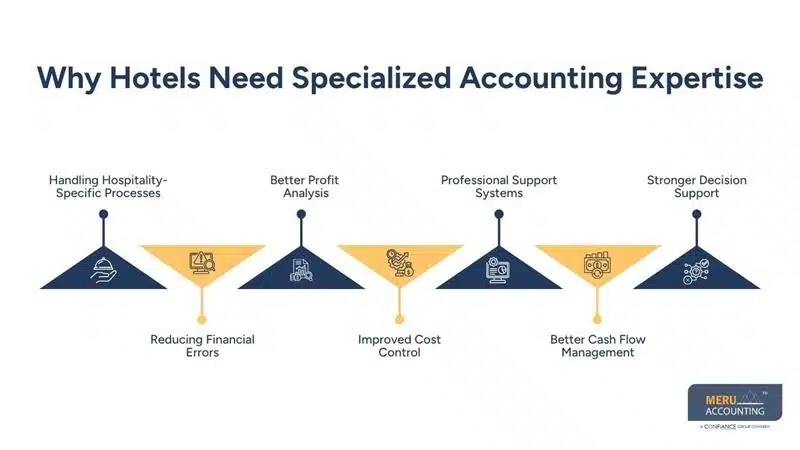
Professional Support Systems
Many hotels rely on hotel accounting services to manage complex financial work. These services bring trained professionals who handle reporting, reconciliation, and compliance tasks with greater accuracy.
Better Cash Flow Management
Hotels often deal with irregular payment cycles from booking platforms and direct guests. Structured accounting helps maintain steady cash flow tracking and avoids liquidity gaps.
Stronger Decision Support
Accurate financial data supports management in pricing decisions, expansion planning, and operational improvements. Reliable reporting ensures decisions are based on real financial conditions rather than estimates.
How Does Multi Property Expansion Affect Accounting For Hotel Industry Businesses
Consolidated Financial Reporting
When a hotel group expands into multiple properties, accounting for hotel industry becomes more complex due to multi-location financial reporting. Each location generates its own income, expenses, and operational data.
All this information must be combined into a single reporting structure to understand overall performance and maintain financial clarity.
Inter Property Transactions
Transfers of goods, services, or funds between branches need proper tracking. These internal movements must be recorded accurately to avoid mismatches in accounts and to ensure each property reflects the correct financial positions.
Centralized Vs Local Control
In multi-property setups, some decisions are managed at the central office while others are handled locally at each hotel. This balance requires a clear financial structure so that reporting remains consistent while still allowing operational flexibility at the property level.
Higher Data Management Needs
As the number of properties increases, so does the volume of financial data. Hotels must adopt strong systems that can handle large-scale reporting, storage, and analysis without losing accuracy or speed.
Standardized Accounting Practices
Consistency across all properties is essential for accurate comparison and reporting. Accounting For Hotel Industry ensures that every branch follows the same financial methods, reporting formats, and record-keeping rules, which helps maintain uniformity across the entire hotel group.
How do Hotels Manage Revenue Leakage in the Hospitality Industry
Tracking Every Booking Source
In accounting for hotel industry, hotels receive bookings from multiple channels such as direct websites, travel agents, and online platforms. Each booking source must be recorded properly to ensure that all revenue is captured and no transaction is missed during reporting.
Reconciling OTA Payments
Online travel agencies often process payments on different timelines compared to guest check-ins. Accounting for hotel industry ensures that bookings are matched with actual payments received, reducing gaps between expected and real revenue.
Monitoring Discounts And Offers
Promotional pricing, seasonal discounts, and package deals can affect total revenue if not tracked carefully. Proper monitoring ensures that discounts are recorded correctly and do not distort financial performance reports.
Preventing Manual Entry Errors
Manual data entry can lead to duplication, missed entries, or incorrect amounts. Reducing dependency on manual processes helps maintain cleaner financial records and improves overall accuracy.
Regular Audit Checks
Frequent internal audits help identify inconsistencies in financial records at an early stage. This allows hotels to correct errors quickly and maintain reliable accounting data for reporting and compliance.
What Benefits Do Cloud-Based Systems Bring to Accounting For Hotel Industry
Real-Time Data Access
Cloud systems update financial data instantly as transactions occur. This allows hotel teams to view current performance without waiting for manual updates or end-of-day reports, improving financial clarity across operations.
Multi-Location Access
Managers and finance teams can access financial records from any location with internet connectivity. This is especially useful for hotel groups operating across different cities or countries, as it allows consistent monitoring of performance.
Reduced Paperwork
Digital systems reduce the need for manual registers, printed invoices, and physical record keeping. This shift helps reduce errors linked to manual entry and keeps financial documentation more organized and easier to retrieve.
Better Data Security
Cloud platforms provide secure storage with controlled access, encryption, and backup systems. Accounting for Hotel Industry benefits from these security features by reducing risks of data loss, theft, or unauthorized changes in financial records.
Integration With Hotel Software
Cloud accounting tools can connect directly with property management systems, booking engines, and payment gateways. This ensures that financial data flows smoothly between systems without manual syncing, improving overall accuracy and consistency.
Why Choose Meru Accounting?
Meru Accounting provides specialized financial support for hospitality businesses through expertise in accounting for hotel industry and complex, high-volume transactions. Our team manages daily entries, revenue tracking, and cost classification in a structured way aligned with hotel operations.
This ensures financial records remain clear, accurate, and easy to understand even when multiple income sources like rooms, food, and events are involved. With strong industry experience, Meru Accounting delivers customized accounting processes that match real hotel workflows.
Through Hotel Accounting Services, we also support integration with modern tools and systems, ensuring smooth data flow across departments and properties. Hotels benefit from better expense control, improved reporting accuracy, and reduced workload on internal teams while maintaining strong compliance and financial clarity.
Our Expert Perspective
With years of experience in hospitality financial systems, we have observed that hotels often face challenges not due to a lack of effort, but because of the complexity involved in daily operations. Accounting for hotel industry requires structured discipline and a system-based approach rather than basic bookkeeping methods. The flow of transactions from rooms, food services, events, and partner channels makes financial tracking highly detailed and sensitive.
In many cases, we have seen that hotels achieve better financial clarity only after adopting expert-led systems and structured support like Hotel Accounting Services. Our experience with real operational data shows that hotels using organized accounting systems reduce reporting errors, improve consistency in financial records, and make more confident business decisions based on accurate numbers.
Key Takeaways
- Accounting for hotel industry is more complex than general accounting
- Hotels manage multiple income streams and high transaction volumes
- Revenue leakage is a common challenge without proper systems
- Multi-property operations need centralized financial control
- Cloud tools improve the speed and accuracy of reporting
- Expert support like Hotel Accounting Services reduces financial risks
- Structured accounting improves decision-making and cost control
FAQs
Hotels need specialized expertise because they handle multiple income sources like rooms, food, and events with different billing timings and complex tax rules in daily operations.
The main challenges include handling high transaction volume, managing OTA bookings, and ensuring accurate guest billing without errors or missing entries.
Hotel accounting services help by maintaining accurate records, organizing revenue data from all departments, and reducing mistakes in financial reporting.
Hotels track revenue by matching front desk bookings, online travel agency payments, and direct sales with actual bank receipts for correct reporting.
Cloud-based accounting systems integrated with hotel management software are the most effective because they provide real-time financial updates, reduce manual workload, and improve overall accuracy in reporting.