
Accounting for Wholesale & Distribution is a key part of managing cost control, pricing accuracy, and profit planning in large supply-based businesses. Wholesale & Distribution Accounting helps businesses track goods movement, manage stock value, and maintain clear financial records across multiple sales channels. Without proper systems, profit loss and stock errors can grow quickly.
In the modern trading environment, companies also depend on structured financial systems and accounting services for wholesale businesses to manage high-volume transactions, supplier billing, and credit cycles. Wholesale & Distribution Accounting ensures that every unit of product is tracked from purchase to final sale, giving owners a clear view of real profit.
This guide explains how Accounting for Wholesale & Distribution works, its importance, key issues, and how it improves profit outcomes in simple and practical terms.
What You Will Learn From This Blog
- How Accounting for Wholesale & Distribution works in real business operations
- Main financial challenges faced by wholesale companies
- Key parts of stock, cost, and revenue tracking systems
- Ways Accounting for Wholesale & Distribution improves profit control
- Best practices used by successful wholesale firms
- Role of accounting services for wholesale businesses in reducing errors
- How to choose the right accounting support for growth
- Practical methods to improve financial clarity and control
Understanding Accounting For Wholesale & Distribution
Understanding accounting in wholesale and distribution starts with how financial records are managed for bulk buying, storage, and resale activities. Each cost stage, such as purchase price, transport charges, storage expenses, and final sale value, is recorded to show true profit. This helps businesses track money flow and reduces confusion in stock and billing cycles when large orders are handled.
In wholesale operations, inventory and financial records are closely connected. Stock data links with accounts to show which products generate profit and which create loss. Even small errors can create gaps in financial reporting.
Accurate invoice entry and stock tracking become important for correct account balances and clear business insights. This is where accounting for wholesale & distribution becomes important for structured financial control.
Many businesses also rely on accounting services for wholesale businesses to handle complex records. Professional support reduces manual errors and improves reporting accuracy. It also ensures better tracking of inventory and financial data across all transactions.
Importance of Accounting For Wholesale & Distribution In Business Growth
Strong Financial Control
Accounting for Wholesale & Distribution gives businesses a unified view of income, costs, and stock movement, helping owners understand overall financial health instead of isolated numbers.
Better Pricing Decisions
Accurate cost tracking ensures pricing is based on complete product cost structure, including purchase, logistics, storage, and handling. This helps businesses maintain healthier margins and avoid underpricing.
Improved Cash Flow Management
Instead of only tracking payments, structured accounting connects receivables, payables, and inventory cycles together. This improves working capital planning and reduces cash flow pressure caused by delayed customer payments.
Reduced Financial Errors
Manual work often leads to errors in billing and stock data. Structured record systems reduce these issues. This leads to more accurate reporting and fewer mismatches during financial checks.
Support From Expert Services
Many companies depend on accounting services for wholesale businesses to maintain clean records and avoid compliance problems. These services also help in handling high transaction volumes with better accuracy and speed.
Core Challenges in Wholesale Financial Management
Complex Inventory Movement
Goods move across warehouses, suppliers, and buyers. Tracking every movement becomes difficult when systems are not in place. This often leads to confusion in stock records and delays in financial updates.
Credit And Payment Gaps
High-volume credit sales combined with multiple invoices make tracking customer balances difficult. When records are not centralized, it becomes harder to monitor overdue payments, increasing cash flow risks and reconciliation workload.
Stock Value Errors
Wrong stock valuation can affect profit reports. Incorrect methods lead to a mismatch between real stock value and the recorded figures. This creates confusion during financial review and planning.
High Transaction Volume
A large number of invoices makes manual tracking difficult. Accounting for Wholesale & Distribution helps manage this high volume with proper structure. It also reduces errors by keeping all transactions organized in a single system.
Dependence On Manual Systems
Many small firms still use manual records. This increases mistakes and delays, making accounting services for wholesale businesses important.
Key Components of Accounting For Wholesale & Distribution
Purchase and Supplier Records
Every purchase must be recorded with full cost details and clear payment terms. Supplier details must stay updated regularly to avoid mismatches in payments and purchase orders. Strong records support smooth tracking of all buying activities across multiple suppliers and locations.
Inventory Tracking System
Stock tracking is a key part of accounting for wholesale & distribution. It shows available stock, sold units, and damaged goods in detail. Strong stock visibility also reduces shortages and overstock issues and improves planning accuracy.
Sales and Revenue Recording
All sales must be recorded properly to measure profit in a structured way. Sales data must connect with cost and stock records for complete accuracy. Better linkage between records leads to clearer revenue tracking and improved financial understanding.
Cost Of Goods Sold (COGS)
COGS shows the real cost of products sold after including all direct expenses. It helps calculate true profit margins with better accuracy and clarity. Accurate costing supports stronger product-level profit analysis and better pricing decisions.
Financial Reporting Structure
Reports like profit and loss statements form an important part of financial records. These reports help in better decision-making and financial control. Strong reporting structure supports better financial planning, review, and long-term business stability.
How Accounting For Wholesale & Distribution Improves Profitability
Clear Profit Tracking
Accounting for Wholesale & Distribution shows the exact profit from each product line. This helps remove low-profit items from the business focus. Better visibility of margins supports stronger product selection and planning.
Better Cost Control
Hidden costs like transport and storage become easier to identify with proper tracking. Financial monitoring improves cost awareness and control. Stronger cost visibility supports healthier profit margins over time.
Reduced Stock Loss
Proper tracking reduces loss from theft or damage. Accounting for wholesale & distribution gives clear visibility into stock flow. Better stock monitoring also reduces errors in physical inventory counts and reporting gaps.
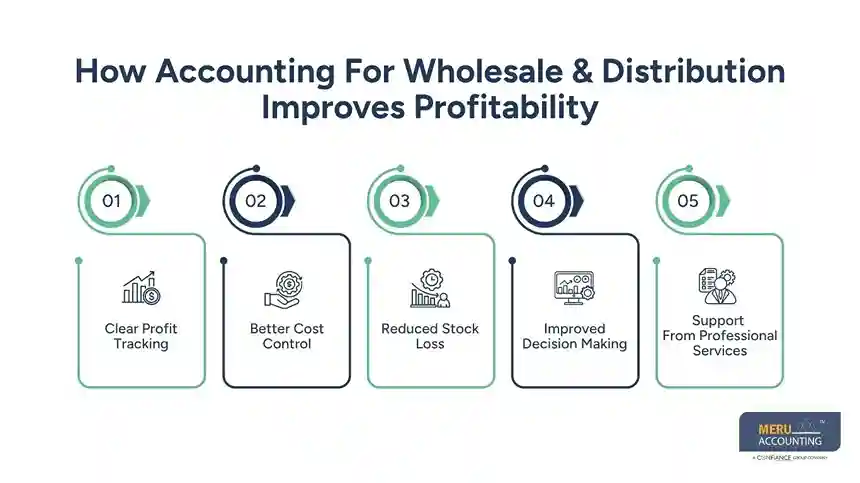
Improved Decision Making
Business owners can make faster decisions based on real data. Financial insights reduce guesswork in planning. Clear data access supports quicker response to market changes and demand shifts.
Support From Professional Services
Using accounting services for wholesale businesses improves accuracy in reporting and reduces financial risk. Expert support also helps maintain consistency in records during high transaction periods.
Best Practices For Efficient Wholesale Accounting
Regular Record Updates
Daily updates keep data accurate and reduce errors in reporting. Timely entry of transactions helps maintain clean financial records. Consistent updates also make it easier to track performance without confusion.
Use Of Digital Systems
Digital tools reduce manual errors and improve processing speed. Automated systems help in handling large volumes of transactions with better accuracy. Modern tools also support better storage and quick access to financial data.
Strong Stock Monitoring
Regular stock checks help avoid a mismatch between records and actual inventory. Accurate stock tracking supports better planning and control. Frequent monitoring also reduces losses caused by errors or miscounts.
Proper Cost Allocation
All costs must be assigned correctly to products for accurate reporting. Proper allocation ensures no expense is left unrecorded in pricing. Clear cost structure supports better profit understanding for each product line.
Periodic Financial Review
Regular reviews help identify issues early and improve decision-making. Financial analysis highlights gaps in performance and record-keeping. Continuous monitoring supports stronger financial control and stability.
How to Choose the Right Accounting Services for Wholesale Businesses
Industry Experience
Choose firms with strong wholesale experience and proven handling of large transaction volumes. Industry knowledge helps reduce errors in financial records and improves accuracy in reporting.
Practical exposure to wholesale operations also supports better handling of inventory and supplier complexities.
Software Knowledge
Service providers must understand modern tools used for financial tracking and reporting. Familiarity with accounting software ensures faster processing and fewer manual errors. Strong software skills also help in managing large datasets without delays.
Reporting Quality
Clear reports play an important role in better decision making for business owners. Structured reporting systems make profit tracking and cost analysis easier. Well-prepared reports also help in identifying gaps in performance quickly.
Cost Efficiency
Service cost should match the scale and requirements of the business. Balanced pricing ensures financial services remain sustainable in the long term. Careful cost planning also prevents unnecessary pressure on business cash flow.
Support Availability
Quick support is important for resolving issues and maintaining smooth operations. Accounting for Wholesale & Distribution requires timely updates and consistent communication. Reliable support also helps in handling urgent financial queries without disruption.
How Meru Accounting Supports Wholesale Businesses
Meru Accounting provides structured financial support for companies handling large product volumes. Our team focuses on clean record-keeping, stock tracking, and accurate reporting for trading firms.
With strong experience in Accounting for Wholesale & Distribution, we help businesses manage inventory, supplier records, and sales data in a simple and clear way. Our approach reduces manual errors and improves financial clarity.
We also provide accounting services for wholesale businesses that include bookkeeping, reconciliation, and reporting support. These services help companies improve profit tracking and reduce financial gaps.
By using modern tools and trained professionals, Meru Accounting ensures that wholesale and distribution accounting becomes more organized and reliable for growing firms.
Our Expert Perspective
From our experience working with wholesale businesses, the biggest issue is not just record-keeping but linking inventory data with real financial outcomes. Accounting for Wholesale & Distribution becomes most effective when every purchase, sale, and stock movement is recorded in a consistent way, allowing clear visibility of actual profit. In many cases, even small improvements in structure and reporting through accounting services for wholesale businesses can reduce confusion and improve financial control within a short period.
Key Takeaways
- Accounting for Wholesale & Distribution helps control cost and profit
- Strong inventory tracking improves financial accuracy
- Proper systems reduce stock and billing errors
- Professional support improves reporting quality
- Accounting services for wholesale businesses help manage complex operations
- Better financial data leads to improved business decisions
FAQs
A structured financial framework that records all transactions in wholesale trade, including purchase activity, inventory movement, and sales tracking, ensuring complete visibility of business operations.
Clear understanding of real profit, cost control, and reduced stock errors becomes possible in daily operations.
They manage complex records, reduce manual mistakes, and improve financial reporting accuracy.
Common issues include stock errors, credit sales tracking, and high transaction volume.
Yes, even small firms can benefit by improving stock control and profit tracking.