In manufacturing, getting paid does not always mean the AR work is done. A customer may send one payment for several invoices, take a deduction, or leave out the details needed to apply the cash. Accounts receivable automation for manufacturing helps handle this work by matching payments with open invoices and flagging items that need a closer look.
For an AR team, that can mean less time digging through bank records, remittance emails, and invoice lists just to figure out where a payment belongs. Instead, clear matches can be handled faster while exceptions are sent to the right person for review.
The goal is not to take people out of the AR process. It is to cut down on repetitive work, reduce unapplied cash, and give the team more time to focus on collections, deductions, disputes, and customer accounts.
What You Will Learn From This Blog
- What accounts receivable automation for manufacturing means
- Why manufacturing AR can be hard to manage by hand
- How automated payment matching can reduce unapplied cash
- Which features matter in an AR automation system
- How automation can help with speed, control, and cash flow
- What to look for in manufacturing accounts receivable solutions
What Is Accounts Receivable Automation for Manufacturing?
Accounts receivable automation uses software to handle parts of the AR process that are often done by hand. This may include payment entry, cash application, invoice matching, account checks, and alerts for open items.
In a manufacturing firm, the process may start when a customer payment reaches the bank. The system can pull in the payment data and look for a match based on the customer, invoice number, amount, purchase order, or remittance note.
If the data lines up, the payment can be matched to the right invoice or group of invoices. If it does not, the item can be sent to an AR team member for review.
This is the core goal of accounts receivable automation for manufacturing: let software handle repeat work while people focus on items that need review, follow-up, or a clear business decision.
Automation does not mean that every AR task should run with no human input. Good control still matters. The system should show what was matched, what rule was used, and which items need review.
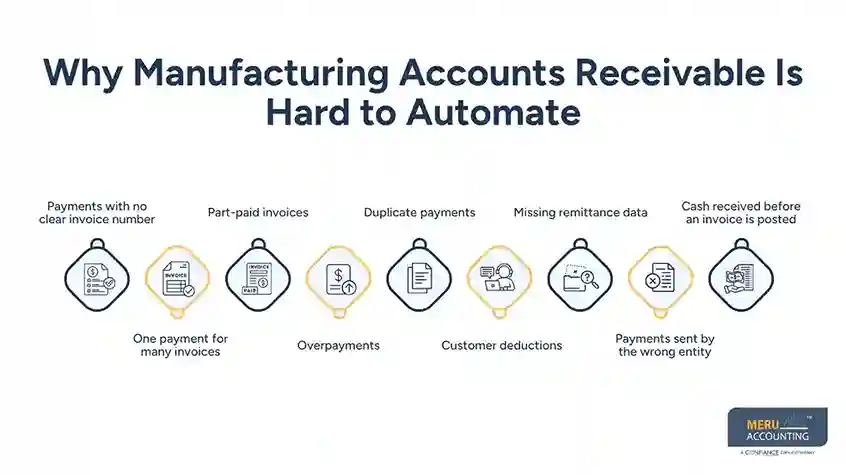
Why Manufacturing Accounts Receivable Is Hard to Automate
Manufacturing AR has its own set of issues. A firm may sell to many buyers, work with large accounts, ship from more than one site, and use many terms and payment methods.
A single customer may pay several invoices in one lump sum. The payment may also include a short pay due to a freight charge, price claim, credit, or other deduction. In some cases, the bank record may show only a short note, while the full remittance comes in a separate file or email.
This can make cash matching hard to do by hand.
Common issues include:
- Payments with no clear invoice number
- One payment for many invoices
- Part-paid invoices
- Overpayments
- Duplicate payments
- Customer deductions
- Missing remittance data
- Payments sent by the wrong entity
- Cash received before an invoice is posted
These issues create more than extra work. They can also make AR reports less clear. Cash may sit in an unapplied account while invoices still show as open. That can make it harder to see the true state of customer balances.
This is where manufacturing accounts receivable solutions can help. The right setup can bring payment data, invoice data, and remittance data into one process.
From Unapplied Cash to Automated Payment Matching
Unapplied cash is not just a bookkeeping task. It can be a sign that the cash application process is too slow or lacks the data needed to make a match.
Suppose a customer sends $50,000 to pay ten invoices. The bank shows the payment, but the remittance file arrives later. An AR worker may need to find the customer, check open invoices, read the remittance, and post each payment by hand.
With accounts receivable automation for manufacturing, much of this work can be done by rules and data checks.
The system can look at:
- Customer name or account ID
- Invoice number
- Payment amount
- Purchase order number
- Remittance details
- Bank reference data
- Open invoice balance
If the data supports a clear match, the system can apply the cash. If there is a gap, it can flag the item instead of making a weak match.
This approach is useful for partial payments as well. For example, if a $10,000 invoice gets a $9,500 payment, the system can apply the cash and flag the $500 gap for review.
The goal is not to force every payment into a match. The goal is to make clear matches fast and send unclear items to the right person.
Key Features of Accounts Receivable Automation for Manufacturing
The best accounts receivable automation for manufacturing setup should fit the way the company gets paid and how its AR team works.
Automated Payment and Invoice Matching
A strong system can compare payment data with open invoices and use set rules to find a match. Rules may use invoice numbers, customer IDs, amounts, or other data.
Remittance Data Capture
Payment data is only useful if the system can read the data that comes with it. Remittance capture can help bring key payment details into the cash application process.
Cash Application Automation
Once a match is found, the system can help post cash to the right customer and invoice. This can cut down on manual entry and speed up the close.
Exception Management
Not every payment will match. A good system should flag unclear items and show why they need review. This gives the AR team a clear work queue.
Customer Account Reconciliation
Automation can help compare payments, invoices, credits, and open balances. This can make it easier to spot items that need action.
Audit Trails and Controls
AR teams still need control over the process. A good tool should keep a record of matches, changes, approvals, and exceptions.
optional anymore
on running the business
Benefits of Automating Accounts Receivable in Manufacturing
The main value of automation is not just fewer clicks. It is a cleaner AR process.
Faster Cash Application
When clear payments can be matched with less manual work, cash can move from the bank record to the right customer account faster.
Less Unapplied Cash
Better matching can reduce the time that cash sits without a clear invoice link. This gives the AR team a better view of what has been paid and what is still due.
Fewer Manual Errors
Manual data entry can lead to wrong invoice numbers, amounts, or customer accounts. Automation can reduce this risk by using data and set rules.
Better AR Visibility
When cash is applied on time, open invoice data is more useful. Managers can get a clearer view of aging, past-due balances, and customer payment trends.
More Time for High-Value Work
AR staff can spend less time searching for invoice numbers and more time on disputes, customer follow-up, deductions, and cash collection.
Better Support for Growth
As invoice and payment volume grows, manual AR work can become harder to scale. Manufacturing accounts receivable solutions can help firms handle more activity without adding the same level of manual work.
Meru Accounting’s Manufacturing Accounts Receivable Solutions
Manufacturing AR works best when the process is built around the way the business bills, collects, and tracks cash. At Meru Accounting, we support businesses with day-to-day AR work that helps keep customer balances clear and records up to date.
Our manufacturing accounts receivable solutions include:
- Customer invoice and payment tracking
- Cash application support
- Accounts receivable reconciliation
- Payment and invoice matching
- Aging report review
- Overdue balance follow-up
- Customer balance checks
- Support for short pays and payment issues
- Monthly AR reporting
- Catch-up and cleanup work
For businesses looking to use accounts receivable automation for manufacturing, strong bookkeeping and AR support still matter. Automation works best when customer data, invoice records, payment details, and account balances are kept clean.
Our Expert Insight
Automation should not be used to hide AR problems. It should make them easier to see and fix.
A useful AR process should tell the team three things: what matched, what did not match, and why. If a system applies cash fast but leaves unclear rules or poor audit trails, the speed may create new risk.
Our view is that manufacturers should start with the items that take the most time. Look at unapplied cash, payment matching, short pays, and manual account checks. Then set clear rules for what the system can handle on its own and what must go to a person.
The best result is not zero human work. It is less low-value work, better control, and a clear path for every exception.
Key Takeaways
- Accounts receivable automation for manufacturing can reduce manual cash application work.
- Automated matching can link customer payments to open invoices faster.
- Unapplied cash often needs better payment and remittance data, not just more staff time.
- Exceptions such as short pays, overpayments, and missing remittance still need review.
- Good controls and audit trails are key to safe AR automation.
- The right manufacturing accounts receivable solutions should fit the firm’s ERP, payment flow, and AR process.
- Clean customer and invoice data makes automation more useful.
FAQs
Common causes include missing remittance details, one payment covering several invoices, short pays, customer deductions, and payments made under the wrong account or entity.
The system compares payment data with open invoices using details such as customer account, invoice number, amount, purchase order, and remittance information. Clear matches can be applied automatically, while exceptions are sent for review.
Yes, depending on the system and its rules. A payment can be matched to the invoice while the difference is flagged as a deduction or short pay for the AR team to investigate.
No. Accounts receivable automation for manufacturing is mainly used to reduce repetitive work. Staff still need to review disputes, unclear deductions, unusual payments, and other items that require a business decision.
Integration depends on the solution. Before choosing one, manufacturers should check whether it connects with their ERP or accounting system and can sync customer, invoice, payment, and remittance data without creating duplicate records.
optional anymore
on running the business