Your ecommerce business may have a strong sales year, but that does not mean your books are ready for tax season. Marketplace fees, refunds, chargebacks, inventory, and payment deposits can all affect your numbers. A CPA for ecommerce should be able to look beyond your bank balance and see whether your books tell the full story.
Before tax preparation begins, take a few minutes to check how your books are being handled. Are sales and payouts reconciled? Is your inventory up to date? Are fees and refunds recorded correctly? A quick review can uncover issues early and give your CPA cleaner records to work with when it is time to prepare your return.
What You Will Learn From This Blog
- What an ecommerce CPA needs from your books
- Why a bookkeeping review should happen before tax season
- How to check your sales, fees, inventory, and account records
- Red flags that may point to weak bookkeeping
- Questions to ask an ecommerce CPA before tax preparation
- How to choose an ecommerce CPA for your business needs
What Does a CPA for Ecommerce Need From Your Books?
Ecommerce books have more moving parts than a basic service business. Your CPA for ecommerce may need to review sales from more than one store or sales channel, along with payment fees, refunds, shipping costs, inventory, and other costs tied to each sale.
Sales and payment data
Your books should show sales in a clear way. This means your CPA should be able to trace sales from your store or marketplace to the related payment account and then to your bank.
Payment deposits do not always equal gross sales. Fees, refunds, chargebacks, and other items may be taken out before money reaches your bank. Your books should show those items instead of treating each deposit as sales income.
Inventory and cost of goods sold
Inventory is a key part of ecommerce accounting. Your books should track what you buy, what you sell, and what remains on hand. Your CPA for ecommerce also needs a clear view of cost of goods sold (COGS), so profit is not overstated or understated.
Fees, refunds, and chargebacks
Marketplace fees, payment fees, refunds, and chargebacks can add up fast. These items should be recorded in the right accounts and tied back to your sales data when needed.
Sales tax records
If you collect sales tax, your records should make it easy to see tax collected, tax paid or remitted, and any tax liability still due. Your CPA may need these records to check that tax-related accounts are handled correctly.
Bank and credit card activity
All business bank and credit card accounts should be reconciled on a regular basis. Old unreconciled items can make year-end reports hard to trust and may lead to extra work during tax preparation.
Why Review Your CPA’s Bookkeeping Process Before Tax Season?
A tax return is only as useful as the records behind it. If your books have missing sales, wrong expense accounts, or old unreconciled items, your CPA may need to spend tax season fixing records instead of focusing on tax work.
A review also gives you time to fix issues before year-end numbers are used for tax filing. For example, an inventory balance that does not match your records may need more than a quick journal entry. The cause needs to be found first.
Your CPA for ecommerce should also have a clear process for reviewing unusual items. This may include large expense changes, negative inventory, old receivables, unpaid bills, or balance sheet accounts that have not changed for a long time.
If you are learning how to choose an ecommerce CPA, ask how the firm checks books before tax preparation. A good fit should understand the link between bookkeeping, ecommerce sales data, inventory, and tax work.
You do not need to be an accountant to do a basic review. Start with these areas.
1. Check how sales are recorded
Compare your store or marketplace sales reports with the sales shown in your accounting system. Look for major gaps between the two.
Also check whether gross sales, refunds, discounts, and chargebacks are shown in a clear way. Your books should not hide all of these items inside one net deposit number.
2. Review payment processor reconciliations
Check accounts linked to Stripe, PayPal, Shopify Payments, Amazon, or other payment tools. The ending balance in the books should make sense when compared with the related account records.
Ask your CPA for ecommerce how often these accounts are reconciled and how unmatched payments are handled.
3. Verify ecommerce fees and refunds
Look at your fee reports and refund records. Make sure these costs are not being missed or placed in the wrong account.
Small errors may seem harmless, but they can grow as sales volume rises.
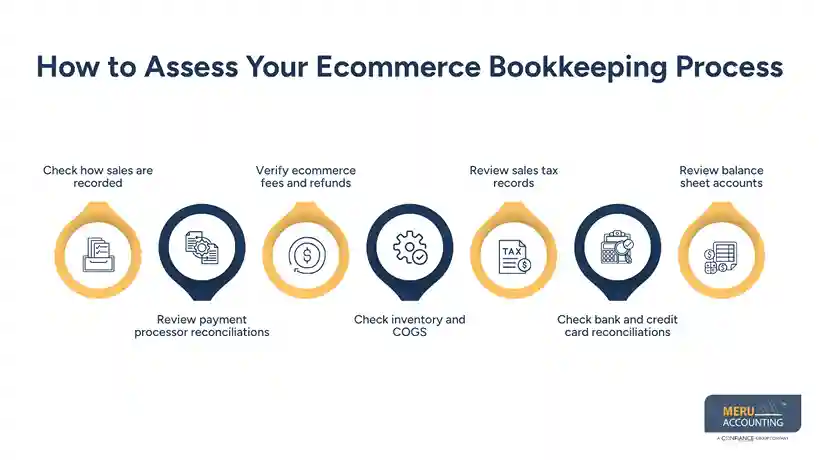
4. Check inventory and COGS
Review your inventory report and compare it with your actual records. If you use more than one warehouse or sales channel, check whether inventory is tracked across each location.
Your CPA should also be able to explain how COGS is calculated and how inventory changes are reflected in the books.
5. Review sales tax records
Check sales tax payable accounts and compare them with your tax reports. If you sell across states, make sure your records support the work your tax team needs to do.
Sales tax rules can vary by state and by the type of sale, so your bookkeeping process should keep the needed data in order.
6. Check bank and credit card reconciliations
Look for old unreconciled transactions. Review any large or unusual items that have been sitting in the books for months.
If your accounts are not reconciled each month, ask why. Regular reconciliation is one of the basic checks that helps keep financial reports reliable.
7. Review balance sheet accounts
Do not focus only on the profit and loss statement. Review inventory, loans, accounts payable, sales tax payable, payment processor accounts, and other balance sheet accounts.
A CPA for ecommerce should be able to explain what these balances mean and why they are still open.

optional anymore
on running the business
Ecommerce Bookkeeping Red Flags to Look for Before Tax Season
Some issues deserve a closer look before you send your books for tax preparation.
- Sales are recorded only when cash reaches the bank.
- Payment fees are missing or lumped into broad expense accounts.
- Payment processor accounts have old, unreconciled balances.
- Inventory has not been updated for a long time.
- COGS does not match your inventory activity.
- Refunds and chargebacks are not recorded clearly.
- Personal charges are mixed with business costs.
- Large amounts sit in uncategorized or suspense accounts.
- Bank accounts have not been reconciled each month.
- Balance sheet accounts have old items with no clear reason.
None of these items alone proves that your books are wrong. But they are good reasons to ask questions before tax preparation begins.
When learning how to choose an ecommerce CPA, ask what the firm does when it finds these issues. A clear process for review, cleanup, and follow-up can make tax season much smoother.
Questions to Ask an Ecommerce CPA Before Tax Season
Before tax work starts, ask direct questions about the bookkeeping and review process.
How do you review ecommerce sales?
Ask whether the CPA checks sales reports against payment processor data and accounting records.
How do you handle inventory and COGS?
Find out how inventory is tracked and how COGS is reviewed before tax numbers are finalized.
How do you check payment processor balances?
Ask whether Stripe, PayPal, Amazon, Shopify Payments, or other accounts are reconciled and how unmatched items are handled.
What reports do you need from me?
A clear answer can help you avoid a last-minute request for sales reports, inventory data, fee reports, or other records.
What happens when you find bookkeeping errors?
Ask whether the CPA fixes the issue, works with your bookkeeper, or sends the issue back to you. You should know who owns each step.
How do you keep books tax-ready during the year?
This is an important question when deciding how to choose an ecommerce CPA. A year-round process can help reduce the need for a large cleanup right before filing.
CPA for Ecommerce Businesses: How Meru Accounting Can Help
Meru Accounting provides CPA for ecommerce businesses, with accounting, bookkeeping, and tax support built around the needs of online sellers. Ecommerce businesses deal with sales from multiple channels, payment fees, refunds, inventory, COGS, and other transactions that need to be recorded and reviewed correctly throughout the year.
Our ecommerce CPA support can include:
- Ecommerce bookkeeping and monthly account reconciliation
- Sales and payment processor reconciliation
- Inventory and COGS accounting
- Accounts payable and accounts receivable
- Bank and credit card reconciliation
- Monthly financial statements and reports
- Catch-up and cleanup bookkeeping
- Tax-ready financial records
- Tax preparation and related accounting support
We work with your existing systems and processes to keep your financial records organized and ready for review. Whether you need ongoing accounting support, help cleaning up past records, or a CPA who understands ecommerce transactions, our team can support your business through the year—not just at tax time.
When considering how to choose an ecommerce CPA, look beyond tax filing alone. The right CPA should understand how your sales channels, payment systems, inventory, expenses, and financial records connect. That broader view can make it easier to keep your books accurate and prepare for tax season with fewer surprises.
Our Expert Insight
A clean-looking P&L does not always mean your ecommerce books are in good shape. We look closely at how the numbers got there. If sales increase but margins change sharply, for example, your CPA should be able to explain whether the difference came from product costs, discounts, shipping, marketplace fees, or another factor.
The same applies to inventory, payment processors, and sales tax balances. These accounts should be reviewed when the numbers change, not simply carried forward each month. When evaluating a CPA for ecommerce, ask whether they can explain unusual changes and what they do when the numbers do not add up.
Key Takeaways
- Ecommerce books need to cover more than bank deposits and basic expenses.
- Sales, fees, refunds, payment accounts, inventory, COGS, and sales tax records all need review.
- Reconciliations should be done before tax preparation, not during a last-minute cleanup.
- Old or unclear balance sheet items deserve attention.
- Ask your CPA how errors are found and fixed before tax filing.
- When deciding how to choose an ecommerce CPA, look at both tax knowledge and the CPA’s bookkeeping review process.
- Clean, current books give your CPA a better base for tax work.
FAQs
Consider hiring a CPA for ecommerce when your sales, inventory, sales channels, or tax needs become more complex.
Yes. An ecommerce CPA can work with sales and payout data from platforms such as Shopify and Amazon, along with your accounting software and payment processors.
A bookkeeper maintains financial records, while a CPA can also provide tax, accounting, and financial review services.
Fees vary based on your sales volume, inventory, number of sales channels, and the services you need.
When considering how to choose an ecommerce CPA, look for experience with ecommerce sales, inventory, COGS, payment processors, and tax work.
optional anymore
on running the business