
Growth is the ultimate goal for almost every marketing agency. More clients often mean more projects, higher sales, and larger teams. On the surface, growth looks simple. Sign more clients, hire more staff, and increase revenue. In real business operations, though, growth creates new money challenges that many agency owners do not expect. A small agency with five clients may handle financial work with spreadsheets and basic software. Once that same agency reaches twenty or thirty clients, things become harder. Team payroll grows, ad spend tracking becomes more complex, monthly retainers, one-time projects, software costs, contractor payments, and tax needs all begin to pile up. That is why many growing firms bring in an agency bookkeeper before taking on a large number of new clients.
Many agency owners focus heavily on sales and client work. Financial records often become a task pushed to the end of the week or month. Over time, small mistakes can turn into larger issues that affect cash flow and profit. Strong bookkeeping creates a clean financial base that supports stable growth instead of stressful growth. Let’s see in detail why every growing marketing agency needs an agency bookkeeper before scaling clients.
What You Will Learn From This Blog
In this blog, you will learn:
- What an agency bookkeeper does
- Signs that your agency has outgrown simple financial tracking
- Why agencies need stronger bookkeeping before adding more clients
- The difference between in-house bookkeeping and outsourced bookkeeping firms
- How bookkeeping support can help agencies scale with less risk
Understanding the Role of an Agency Bookkeeper
An agency bookkeeper manages and organizes the financial side of a marketing agency. Their work goes far beyond entering numbers into accounting software.
Marketing agencies have unique financial activity. They may manage monthly retainers, project fees, media buying costs, freelancer payments, commissions, and software subscriptions at the same time. All these items require accurate records.
An agency bookkeeper often handles:
- Recording daily financial transactions
- Tracking income and expenses
- Reconciling bank and credit card accounts
- Managing invoices
- Monitoring cash flow
- Creating financial reports
- Tracking client payments
- Preparing financial data for tax work
Good bookkeeping gives agency owners a clear view of business performance.
Instead of guessing whether the agency is making money, leaders can review real numbers and make decisions with confidence.
Signs Your Marketing Agency Has Outgrown Basic Financial Tracking
Many agency owners start with simple systems. They may use spreadsheets, accounting software, or handle bookkeeping on their own. These methods may work at the beginning, but growth often creates warning signs.
Revenue is increasing but profits seem unclear
Many agencies celebrate higher sales numbers. Then they discover that profits are not growing at the same pace. Without proper records, it becomes hard to understand where money is going.
Client payments become harder to track
As client counts increase, invoice management can become messy. Late payments, missing invoices, and unpaid balances may start affecting cash flow.
Expenses continue to rise
Software tools, contractor fees, ad costs, and payroll expenses can grow fast. Without detailed tracking, owners may not notice unnecessary spending.
Financial reports take too long
If preparing reports takes several days each month, your current system may no longer fit your business size.
Tax season becomes stressful
Many agencies struggle during tax preparation because records are incomplete or disorganized.
These signs often show that a business needs more structured financial support.
Know Why Every Growing Agency Needs an Agency Bookkeeper Before Scaling Clients
Growth creates pressure on every part of an agency. Financial operations are no exception. Adding clients without strong bookkeeping systems can create major issues later.
Better cash flow management
Cash flow is one of the biggest concerns for agencies. An agency may have strong sales numbers but still struggle to pay bills if incoming and outgoing money is not tracked well. An agency bookkeeper helps monitor cash flow and identifies problems before they become serious.
Clear visibility into profit margins
Many agency owners know their total revenue but do not know their actual profit margins. Some clients may generate high revenue but low profit because of labor costs, ad expenses, or project scope changes. Bookkeeping records help agency owners see which work creates strong returns.
Easier hiring decisions
Scaling often means hiring new team members. Hiring too quickly can create financial pressure. Hiring too slowly can hurt client service quality. Financial reporting helps owners understand when the business can support new payroll costs.
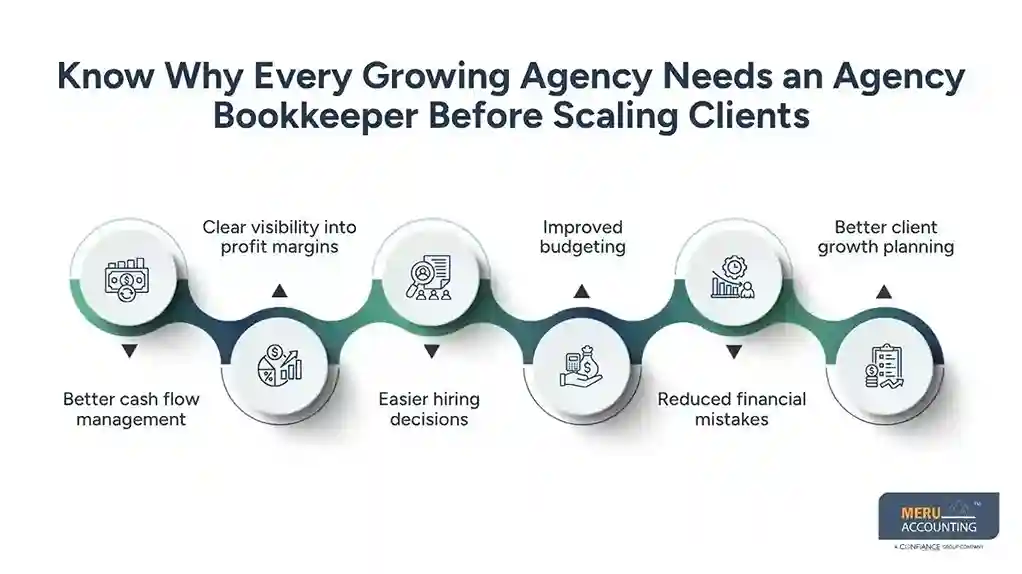
Improved budgeting
Growth usually requires investment. Agencies may spend more on software, marketing, hiring, or systems. Budget planning becomes easier when financial records remain organized.
Reduced financial mistakes
Simple errors can become expensive problems. Duplicate payments, missed invoices, incorrect expense entries, and tax issues may hurt agency performance. Strong bookkeeping processes lower these risks.
Better client growth planning
Adding ten new clients may sound exciting, but growth without planning can damage operations. An agency bookkeeper helps owners understand if the business has enough financial strength to support expansion.
Comparing In-House Bookkeeping vs Outsourced Bookkeeping Firms
Growing agencies often choose between hiring an internal employee and working with outsourced bookkeeping firms.
Both options have strengths and weaknesses.
In-house bookkeeping
Advantages:
- Direct communication with internal staff
- Immediate access to bookkeeping support
- Strong understanding of daily operations
Challenges:
- Higher salary costs
- Benefits and training expenses
- Limited experience in some cases
- Harder to scale quickly
Outsourced bookkeeping firms
Advantages:
- Lower operating costs
- Access to experienced professionals
- Flexible support levels
- Ability to scale services as the agency grows
Challenges:
- Less direct physical access
- Requires a structured communication process
Many agencies prefer outsourced bookkeeping firms because they can gain skilled financial support without adding full-time overhead costs.
For agencies in growth mode, flexibility often becomes a major advantage.
How Poor Bookkeeping Can Slow Agency Growth
Many agency owners do not notice bookkeeping problems until growth starts creating stress. Here’s how poor bookkeeping can slow agency growth:
- Poor financial systems can affect several areas of business performance.
- Cash shortages may appear without warning.
- Profit margins can become difficult to understand.
- Business owners may make hiring choices based on assumptions instead of data.
- Tax preparation can take extra time and create added costs.
- Lenders and investors often want accurate financial reports. Missing data can make funding harder to secure.
As agencies become larger, these issues can grow quickly.
How Meru Accounting Supports Marketing Agencies
Growing agencies need financial systems that support long-term success.
At Meru Accounting, we understand that marketing agencies operate differently from many other businesses. Agency owners often manage retainers, project work, contractors, software tools, ad spend, and shifting revenue cycles.
Our bookkeeping services for agencies are built to help simplify these financial tasks.
Meru Accounting provides:
- Daily bookkeeping support
- Income and expense tracking
- Bank and credit card reconciliation
- Financial reporting
- Cash flow visibility
- Accounts receivable support
- Scalable bookkeeping systems
Our team works to give agency owners clear financial data so they can focus more time on client growth and business strategy.
Whether your agency is preparing to add new clients or improve internal processes, Meru Accounting can help build a stronger financial foundation.
Our Expert Insight
Many marketing agencies put a strong focus on growth numbers such as client count, monthly sales, and campaign wins. While these numbers matter, they do not always show the full story. We often see agencies reach a stage where revenue grows fast, but owners still feel unsure about the financial side of the business. In many cases, the problem is not a lack of clients. The problem is limited insight into cash flow, costs, and real profit.
At Meru Accounting, we believe agencies should build strong financial systems before major growth starts. Bringing in an agency bookkeeper early can help build a solid base for growth. When agency owners understand their numbers, they can make better hiring choices, set clear budgets, improve pricing, and grow their client base with more confidence and lower financial risk.
Key Takeaways
- Growth creates more financial complexity for marketing agencies.
- An agency bookkeeper helps organize and manage financial records.
- Weak bookkeeping systems can create cash flow and profit problems.
- Strong financial reporting supports smarter business decisions.
- Outsourced bookkeeping firms can provide flexible and cost-effective support.
- Accurate bookkeeping helps agencies scale clients with greater confidence.
- Strong financial systems create a stable path for long-term growth.
FAQs
An agency bookkeeper records sales, tracks costs, manages bills, checks cash flow, and creates reports for a marketing agency.
Many agencies should hire an agency bookkeeper when client growth starts causing issues with bills, costs, reports, or cash flow.
Yes. Many outsourced bookkeeping firms give flexible help, lower costs, and skilled bookkeeping support that fits growing agencies.
Good bookkeeping helps spot spending trends, profit levels, and cash flow patterns that help support better business choices.
Better bookkeeping before growth helps cut mistakes, improve plans, and build a strong base for long-term growth.