
Airlines operate in a highly regulated and cost-sensitive environment where financial accuracy is critical for long-term stability. Airline Accounting plays a central role in managing revenue, expenses, compliance, and operational costs across multiple routes, aircraft, and jurisdictions.
However, many airlines now rely on external experts to manage these complex financial tasks. This shift allows internal teams to focus more on safety, service quality, and operational efficiency while experts handle financial precision.
In this blog, we explore how Airline Accounting, when outsourced, can reshape financial control, reduce workload pressure, and allow airlines to concentrate on their core operations. We also examine the role of Aviation Accounting in managing industry-specific financial complexity.
What You Will Learn From This Blog
- Why airlines are moving toward outsourced financial support
- How Airline Accounting reduces internal workload
- The role of Aviation Accounting in managing complex revenue systems
- Key benefits of outsourcing financial functions
- How to choose the right financial partner
- Real operational advantages for airlines
Introduction to Airline Accounting
Airline Accounting plays a key role in managing the financial structure of airlines that operate across multiple routes, countries, and service systems. It helps track income, control costs, and maintain accurate financial records across all flight operations.
Revenue tracking across routes is one of the most important parts of airline financial management. Airlines earn money from ticket sales, cargo services, baggage fees, seat upgrades, and loyalty programs. Each route may follow different pricing rules and demand patterns, which makes financial tracking more complex.
Cost structure management is another major area. Expenses such as fuel, aircraft maintenance, airport charges, and staff salaries vary across flights. Proper financial control ensures that every cost is recorded under the correct flight or route to understand true profitability.
Airlines also operate under strict regulatory requirements. Aviation Accounting ensures that financial records follow global aviation standards, tax rules, and audit guidelines across different regions. This helps avoid compliance issues and financial risks.
Accurate financial reporting is essential for investor trust and business planning. Monthly and quarterly reports reflect the real performance of airline operations.
Finally, airlines use multiple systems for bookings, operations, and finance. The financial process connects these systems and ensures all financial data remains accurate, consistent, and easy to access for decision-making.
Why Airlines are Shifting Toward Outsourced Airline Accounting Services
Rising Operational Complexity
Modern airlines operate across countries, currencies, and tax systems. Managing Airline Accounting in-house requires large, skilled teams.
Internal Cost Pressures
Maintaining full-time finance departments increases fixed costs. Outsourcing reduces overhead while maintaining accuracy in Airline bookkeeping and accounting tasks.
Need for Specialized Expertise
As airlines expand globally, financial complexity increases across multiple jurisdictions and tax systems. Aviation Accounting helps standardize reporting across different countries while ensuring consistency in financial records and compliance with local regulations.
Technology Integration Requirements
Technology integration requires continuous updates and technical handling. External finance teams already use advanced systems for managing airline financial processes.
Faster Financial Close Cycles
External teams streamline month-end and year-end closing processes, making financial accounting more timely and reliable. This also reduces delays in reporting and gives management quicker access to accurate financial results.
Key Benefits Of Outsourced Aviation Accounting For Airlines
- External experts reduce manual errors in billing, reconciliation, and reporting, which improves overall financial accuracy and strengthens operational financial quality across airline processes.
- Internal teams can focus more on route planning, safety, and service delivery instead of repetitive financial tasks tied to Airline accounting, reducing administrative pressure within airline operations.
- Clear breakdowns of fuel, crew, and maintenance expenses improve visibility into spending patterns, helping management make more informed financial decisions.
- As airlines expand to new routes and markets, external financial services can scale quickly without delays in hiring or restructuring internal teams.
- External teams stay updated with global aviation rules and reporting standards, which reduces compliance risks and ensures better financial control.
- Accurate forecasting of inflows and outflows improves cash flow planning and gives airlines a clearer view of short-term and long-term financial stability.
How Airline Accounting Supports Core Operational Focus
Focus On Flight Operations
When Airline Accounting is handled externally, internal teams focus on scheduling, safety, and route efficiency. Operational teams gain more time to manage flight performance and improve turnaround speed.
Improved Customer Service
Reduced financial workload allows staff to prioritize passenger experience rather than accounting tasks. Passenger handling becomes smoother with quicker response times and better service coordination.
Strategic Decision Support
Clean financial reports from Aviation Accounting help management make better route and pricing decisions. Leadership gains clearer insight into route profitability and demand trends across markets.
Reduced Internal Work Pressure
Finance teams are relieved from routine tasks, improving productivity across departments. More focus shifts toward analysis, forecasting, and financial planning activities.
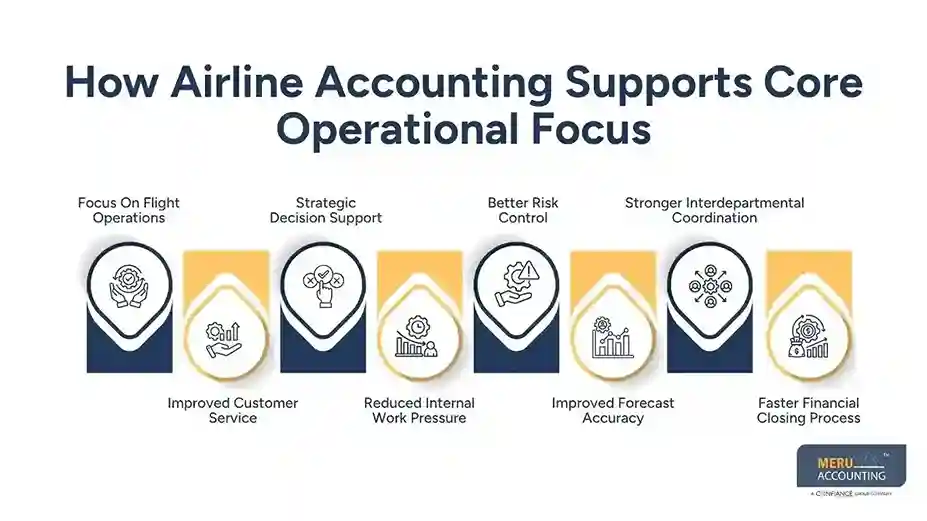
Better Risk Control
Financial experts in accounting identify risks early, reducing operational disruptions. Early detection of financial inconsistencies helps avoid unexpected cost issues and compliance gaps.
Improved Forecast Accuracy
Accurate financial inputs lead to stronger forecasting of revenue and expenses across routes. Better projections allow airlines to plan capacity and pricing with more confidence.
Stronger Interdepartmental Coordination
Finance, operations, and sales teams align better when financial data is clear and updated. Smooth coordination reduces delays in decision-making and improves overall efficiency.
Faster Financial Closing Process
Monthly and yearly closing cycles become quicker with structured accounting processes. Management receives timely reports that support faster business decisions.
Role of Aviation Accounting in Managing Complex Revenue Streams
Multi-Currency Transactions
Airlines operate in multiple countries, requiring accurate currency handling and reporting. Aviation Accounting ensures proper conversion, reconciliation, and consistent financial reporting across global operations.
Ancillary Revenue Tracking
Income from baggage, meals, and upgrades is tracked separately in Airline Accounting systems. Each revenue stream is categorized to understand true performance beyond ticket sales.
Loyalty Program Accounting
Frequent flyer programs require complex valuation methods handled through accounting systems. Points and rewards are recorded as liabilities until redemption occurs.
Interline Billing Management
Revenue sharing between airlines is reconciled through structured accounting processes. Accurate settlement between partner airlines reduces disputes and delays.
Seasonal Revenue Adjustments
Airline demand fluctuates seasonally, requiring careful financial adjustments. Revenue forecasts are adjusted to reflect peak and off-peak travel periods.
How to Choose the Right Aviation Accounting Partner
Industry Experience Matters
Select providers with proven Airline Accounting experience in aviation-specific environments. Strong industry exposure helps reduce errors linked to complex airline operations and reporting needs.
Technology Capability
Ensure the partner uses modern systems that integrate with airline booking and ERP tools for Aviation Accounting. Advanced tools improve data accuracy and reduce manual processing delays.
Compliance Knowledge
The partner must understand global aviation tax and regulatory frameworks. Proper compliance handling reduces audit risks and supports smooth international operations.
Scalability Options
As airlines grow, Airline Accounting needs to expand, so scalable services are essential. Flexible service models support expansion into new routes and markets without disruption.
Data Security Standards
Financial data protection is critical in accounting due to sensitive operational information. Strong security protocols help prevent data leaks and unauthorized access.
Transparent Reporting Structure
Clear dashboards and reports ensure airlines always understand their financial position. Real-time visibility supports faster and more confident decision-making.
How Meru Accounting Strengthens Airline Financial Operations
Industry-Focused Financial Expertise
Meru Accounting works with aviation clients that manage high transaction volumes and complex reporting needs. Our Airline Accounting approach is built around real airline workflows, including ticket revenue tracking, cargo billing, and operational cost mapping.
Structured Reporting Systems
We design clear reporting formats that make accounting easier to interpret for management teams. This includes route-wise profitability, expense classification, and monthly performance summaries that support better planning.
Accurate Revenue And Cost Control
Airlines often deal with scattered financial data from multiple systems. Our process consolidates this information into structured records, reducing confusion and improving financial clarity.
Compliance And Audit Readiness
We ensure airline records are maintained in line with global compliance standards. This reduces audit pressure and keeps Aviation Accounting documentation ready for regulatory checks at any time.
Support For Scalable Growth
As airlines expand into new routes or regions, financial systems must adapt quickly. Meru Accounting provides scalable support that grows with operational needs without disrupting existing workflows.
Practical Insight From Our Team
Our experience shows that airlines gain better control over costs when financial data is simplified and centralized. By refining financial processes, airlines can make faster decisions without waiting for delayed or unclear reports.
Our Expert Perspective
Outsourcing Airline Accounting allows airlines to streamline financial operations by reducing the burden of routine accounting tasks and improving overall reporting accuracy. From our experience, centralized and well-structured financial data leads to faster decision-making and better cost control across routes and operations. It also helps airlines stay compliant with evolving aviation regulations while maintaining financial transparency. Ultimately, this shift enables internal teams to focus more on operational performance and passenger experience.
Key Takeaways
- Airline Accounting is complex due to multi-route and multi-currency operations
- Outsourcing reduces internal workload and improves financial accuracy
- Aviation Accounting plays a key role in managing compliance and revenue streams
- Airlines gain better focus on core operations like safety and customer service
- Choosing the right partner ensures scalability and long-term financial control
FAQs
Airline Accounting is the process of managing financial records, revenue, and expenses in airline operations, including ticket sales, fuel costs, and maintenance expenses.
Airlines outsource to reduce workload, improve accuracy, and gain access to specialized financial expertise in aviation operations.
It tracks multiple income sources like tickets, cargo, baggage fees, and loyalty programs while ensuring proper reconciliation.
Yes, it reduces fixed staffing costs and improves financial efficiency without compromising accuracy or compliance.
Yes, even small airlines benefit by accessing expert financial systems without maintaining large internal accounting teams.