Modern consulting firms increasingly rely on the best AI accounting software to manage financial work with accuracy and control. In consulting-led businesses, where billing, projects, and client reporting happen at the same time, traditional accounting methods often fail to keep pace. This is why many firms are shifting toward smarter systems built for accounting for consultants, where automation reduces manual effort and improves financial clarity.
The best AI accounting software is not just a bookkeeping tool. It acts as a financial system that connects invoices, expenses, payroll, reporting, and forecasting in one place.
For consulting businesses handling multiple clients and project structures, this creates more reliable financial visibility and reduces delays in decision-making.
What You Will Learn From This Blog
- Why consulting firms need AI-based accounting systems
- How the best AI accounting software changes financial operations
- Role of automation in accounting for consultants
- Key integration features required in accounting tools
- Common mistakes firms make while selecting software
- How AI reduces manual accounting work
- Practical insights from consulting finance operations
- How Meru Accounting supports consulting businesses
Why Modern Consulting Firms Need Smarter Financial Tools
Rising Complexity in Billing Structures
Consulting firms often deal with hourly billing, fixed contracts, and recurring retainers. Managing these manually creates confusion in revenue tracking. Modern systems organize billing rules and reduce invoice errors across different projects.
Need for Real-Time Financial Visibility
Consulting decisions depend on up-to-date financial data. Delayed reports can lead to poor cash planning. AI accounting tools provide dashboards that update financial data in real time.
Multi-Client Project Management Challenges
Firms handle multiple clients and projects simultaneously. Without structured systems, it becomes difficult to track income and expenses per project. This is where accounting for consultants becomes more structured through automation.
Remote Team Operations
Many consulting firms operate with distributed teams. Cloud-based accounting systems allow secure access to financial data from anywhere, improving coordination between teams.
Compliance and Tax Pressure
Tax reporting and compliance requirements vary across regions. The best AI accounting software organizes financial records in a structured format that simplifies tax filing and audits.
Cash Flow Monitoring Issues
Consulting firms often face delays in client payments. AI systems track receivables, send reminders, and highlight overdue invoices to improve cash flow visibility.
Role of AI in Transforming Accounting Workflows
Automated Data Entry
AI systems pull financial data directly from bank feeds, invoices, and receipts. Manual entry tasks are eliminated, reducing human error and saving significant processing time. Continuous syncing ensures accounting records remain updated without delays.
Smart Expense Categorization
The best AI accounting software automatically categorizes expenses based on patterns and rules, making bookkeeping more consistent. Accurate classification improves financial reporting and supports better cost control across projects.
Faster Reconciliation Process
Bank statements are matched with accounting records automatically. Any mismatch is flagged for review, saving time during month-end closing. Finance teams gain more bandwidth for analysis instead of repetitive verification work.
Automated Invoice Handling
Recurring invoices and billing cycles are generated automatically. Accounting for consultants working with retainer-based clients becomes more efficient. Timely billing cycles reduce revenue leakage and improve collection consistency.
Financial Forecasting
AI tools analyze past data to predict future income and expenses. Consulting firms gain stronger visibility for budgeting and planning decisions. Better forecasting supports scalable growth and resource optimization.
Error Detection in Real Time
Duplicate entries, missing data, and unusual transactions are detected early, reducing correction work later. Clean financial records improve audit readiness and strengthen overall financial control.
Growing Complexity in Accounting for Consultants
Multiple revenue streams
Consulting firms combine project-based billing, hourly charges, and retainers. Managing these revenue streams manually becomes difficult without structured systems.
Time tracking integration
Accurate time tracking is essential for billing clients. The best ai accounting software integrates with time tracking tools to ensure accurate billing.
Global client payments
International clients often pay in different currencies. This adds complexity in conversion, reporting, and tax handling.
Contractor and freelancer payments
Consulting firms frequently work with freelancers. Accounting for consultants includes tracking contractor payments and maintaining compliance records.
Project profitability tracking
Understanding which projects generate profit is critical. AI systems provide project-level reports that highlight profitability clearly.
Data security needs
Client financial data must be stored securely. Modern accounting systems include encryption and access control features to protect sensitive information.
How the Best AI Accounting Software Supports Consulting-Led Businesses
Faster Invoice Creation
Invoices are generated automatically based on project data and billing rules. Manual delays in billing cycles are significantly reduced, improving cash flow timing.
Centralized Financial Records
The best AI accounting software stores all client-related financial data in one place, including invoices, payments, and tax records. Easy access to unified data improves financial control and decision-making.
Cost Tracking Across Projects
Firms can track employee costs, vendor expenses, and project spending with more accuracy. Better visibility into cost distribution helps improve project profitability analysis.
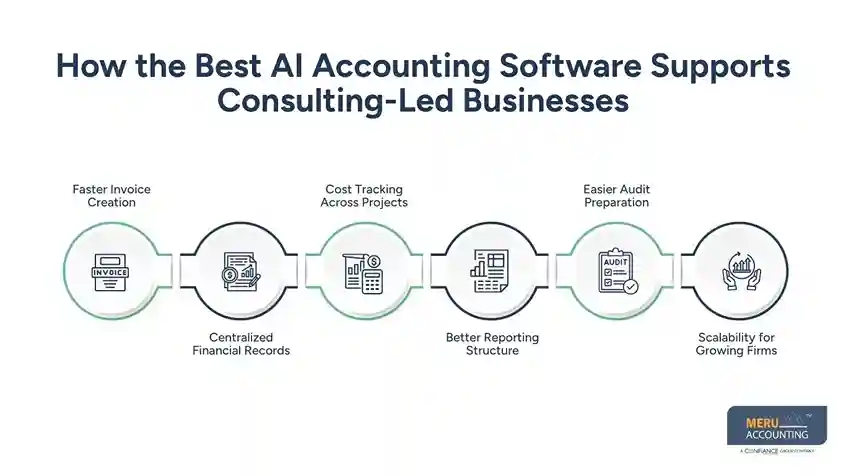
Better Reporting Structure
Financial reports become more reliable because data is collected and processed automatically. Consistent reporting formats support clearer business insights and performance tracking.
Easier Audit Preparation
Supporting documents are linked with transactions, making audits and financial reviews simpler. Organized records reduce preparation time and minimize compliance risks.
Scalability for Growing Firms
As consulting firms expand, AI systems handle increasing transaction volumes without major structural changes. Scalable infrastructure supports business growth without adding operational complexity.
Integration Capabilities of the Best AI Accounting Software
Payroll and Tax System Connectivity
The best ai accounting software connects payroll and tax systems, reducing duplication of data entry. Automated syncing ensures salary processing and tax calculations remain accurate and consistent.
CRM and Project Management Integration
Consulting firms often use CRM tools to manage clients. Integration allows financial data to sync with client activity and project updates. Seamless data flow improves alignment between sales, delivery, and finance teams.
Cloud Access for Teams
Cloud-based systems allow secure access to financial records from multiple locations, supporting remote teams. Real-time updates ensure all stakeholders work with the latest financial information.
Third-Party Software Compatibility
Consulting firms use multiple tools, and integration ensures all systems communicate without manual work. Better connectivity reduces data silos and improves operational efficiency.
Banking Integration
Bank accounts can be connected directly for automatic transaction updates and reconciliation. The best AI accounting software ensures continuous syncing, reduces manual entry, and improves financial accuracy.
Cross-Department Data Flow
Finance, HR, and operations teams can work with updated financial data at the same time. Unified access improves collaboration and supports faster business decisions.
How to Choose the Best AI Accounting Software for Your Consulting Business
Check Automation Features
Look for tools that automate invoicing, reconciliation, and expense tracking. Strong automation reduces manual workload and improves financial accuracy across daily operations.
Evaluate Reporting Quality
Strong reporting features are essential for accounting for consultants, especially for project-based analysis. Clear reports support better decision-making and help track profitability per client.
Review Security Standards
Financial data protection should include encryption, access control, and secure backups. Strong security measures reduce risks related to data breaches and unauthorized access.
Focus on Usability
A simple interface reduces training time and improves adoption across teams. Easy navigation ensures faster onboarding for employees with different technical skills.
Confirm Integration Support
The software should connect easily with CRM, payroll, and project tools. Seamless integration improves data flow and reduces duplication of work across systems.
Consider Scalability
The best ai accounting software should support business growth without requiring system replacement. Scalable systems handle increasing transactions and expanding teams efficiently.
Common Mistakes Consulting Firms Make When Choosing Accounting Software
Choosing Based Only on Price
Low-cost tools often lack advanced reporting and automation features required for consulting firms. The best AI accounting software should balance cost with functionality, scalability, and long-term efficiency. Prioritizing price over capability can limit financial accuracy and growth potential.
Ignoring Future Expansion
Many firms select software based on current needs only, which creates issues during scaling. Planning for growth ensures smoother transitions as business volume increases.
Poor Onboarding Planning
Without proper training, teams fail to use the system effectively. Structured onboarding improves adoption rates and reduces operational disruption.
Overlooking Security Features
Client data protection is often ignored during selection, which can create risks later. Strong security frameworks are essential to maintain trust and compliance.
Lack of Integration Planning
Disconnected systems increase manual work and reduce accuracy. Proper integration planning ensures seamless data flow across finance and operational tools.
Using Generic Accounting Systems
Consulting firms need specialized accounting for consultants, not general-purpose systems. Industry-specific solutions handle project billing, client tracking, and reporting more effectively.
How AI Accounting Software Reduces Manual Workload in Consulting Operations
Automated Transaction Processing
Bank transactions and invoices are recorded automatically without manual entry. Continuous syncing reduces delays in financial updates and improves accuracy across accounting records.
Faster Accounts Payable Management
Vendor payments, due dates, and approvals are tracked in one system. Centralized control helps consulting firms avoid missed payments and maintain better vendor relationships.
Simplified Expense Handling
Employees can upload receipts digitally, and the best AI accounting software categorizes expenses automatically based on predefined rules. Streamlined expense processing reduces manual intervention and improves consistency in financial records.
Reduced Reporting Effort
Financial reports are generated quickly with updated data. Real-time reporting enables faster decision-making and better financial visibility for consulting leaders.
Automated Tax Calculations
Tax-related entries are processed using built-in rules, reducing manual calculation errors. Automation ensures compliance accuracy and minimizes last-minute filing pressure.
Improved Workflow Efficiency
Accounting teams spend less time fixing errors and more time reviewing financial insights. Operational efficiency improves as repetitive tasks are replaced with automated processes.
How Meru Accounting Supports Consulting Businesses
Meru Accounting works with consulting-led businesses that require structured financial systems and reliable reporting. We provide end-to-end support in selecting and managing the best AI accounting software based on business size, project structure, and reporting needs.
Our team at Meru Accounting assists in setting up accounting systems that support accounting for consultants, including invoice management, expense tracking, payroll handling, and project-level reporting. Businesses also receive help with cloud accounting setup, software integration, and financial reporting.
With experience across global consulting firms, Meru Accounting ensures that financial systems are aligned with business operations and compliance requirements. This allows consulting businesses to focus more on client work while maintaining accurate financial records.
Key Takeaways
- The best AI accounting software reduces manual accounting work in consulting firms
- Consulting businesses need structured systems for project-based financial tracking
- AI improves accuracy in invoicing, reporting, and reconciliation
- Integration with CRM and payroll systems is essential
- Accounting for consultants requires better control over projects and billing models
- Cloud systems support remote and global consulting teams
- Software selection should focus on automation, security, and scalability
- Meru Accounting provides setup and support for consulting-focused accounting systems
FAQs
Used to manage invoices, expenses, reporting, and financial tracking with less manual work, while the best AI accounting software improves accuracy and real-time financial visibility.
Consulting firms manage multiple projects, clients, and billing types requiring accurate tracking, and accounting for consultants helps streamline complex financial operations.
Automating data entry, reconciliation, and categorization reduces errors significantly, and the best AI accounting software ensures consistent and reliable financial records.
Small firms can manage finances efficiently without large accounting teams, and financial management becomes more scalable with AI-driven tools.
Focus remains on project billing, time tracking, and client reporting, making it more specialized than traditional accounting models.