A payroll run can look perfect on the payroll screen and still leave a mess in the books. An employee gets paid, but the tax liability is wrong. The bank payment clears, but the payroll clearing account stays open. The journal posts, but one department has the wrong cost. That is why payroll software for accountants should be judged by what happens after payroll is processed. The real test is whether the numbers move correctly from payroll to the ledger, bank, tax records, and reconciliation work.
This blog looks at the features, integrations, and accounting controls that matter when choosing payroll software for accountants.
What You Will Learn From This Blog
- What makes payroll software for accountants useful for daily work.
- Which payroll and tax tools need a close look.
- How software links can shape payroll and bookkeeping work.
- Which checks can spot errors before they grow.
- How to test the software with a real pay run before you buy it.
- Common errors to avoid when you pick payroll software for accounting firms.
Introduction to Payroll Software for Accountants
Think of a payroll run with 25 staff. Gross pay is $60,000, staff cuts are $8,000, tax owed by the firm is $5,000, and the bank pays out $52,000. These sums do not stand on their own. Each one must go to the right place in the books. Payroll software for accountants brings these parts into one flow. It can calculate pay, make payroll reports, track tax due, and send the data to the main ledger.
This is even more key for payroll software for accounting firms. A firm may run pay for many clients, each with its own pay dates, books, teams, and tax needs. The software must keep these gaps clear, not turn them into more work by hand.
Key Features to Look for in Payroll Software for Accountants
Payroll Processing and Tax Calculations
A payroll system should do more than basic hourly or salary pay. Look for tools that can handle overtime, bonuses, cuts, benefits, and tax costs paid by the firm.
Payroll software for accountants should also show how it gets to the final net pay. If gross wages change from one pay period to the next, the team should be able to see why before the journal goes into the books.
General Ledger and Journal Entry Integration
The payroll journal is where payroll turns into an accounting record. Wage costs, tax costs, staff cuts, and payroll debts must go to the right accounts.
Reliable payroll software for accountants should let users check the journal before it is posted. For example, if payroll cost is set to the wrong team, the error should show up before the month-end close.
Payroll Reporting and Recordkeeping
A good report should answer a need, not just show data. Accountants may need to know total wages for a pay period, tax due, sums paid, or payroll costs by team.
Payroll software for accounting firms should also make old records easy to find. This helps when a client asks about an old pay run or when an accountant needs to trace an old entry.
Employee and Contractor Payments
Employee and contractor payments should be kept clear, mainly when both are part of the same workflow. Pay dates, sums, cuts, and pay status should be easy to check.
Payroll software for accountants can also make error checks easier. A failed pay or odd sum should stand out, not get lost in a long list of deals.
Tax Filing and Compliance Features
Tax tools can cover tax math, form prep, and online filing. The key is to know what the software does and what still needs a human check.
For U.S. payroll, federal withholding includes income tax, Social Security, Medicare, and FUTA. Payroll software for accountants should give the team enough detail to check these sums before filing or paying.
optional anymore
on running the business
Payroll Software Integrations for Accounting Workflows
Accounting Software Integration
Payroll and accounting should not feel like two separate jobs. When the systems connect, payroll data can move into the books without staff entering every figure again.
Payroll software for accountants should also keep the link between a payroll run and its journal entry clear. If an amount looks wrong during reconciliation, the accountant should be able to trace it back to the source.
Bank and Payment Integrations
The bank statement tells a different part of the payroll story. Payroll may show that employees were paid, while the bank confirms whether the money actually left the account.
For payroll software for accounting firms, this connection can make payment matching easier. It can also bring failed or reversed payments to the accountant’s attention sooner.
Time Tracking and HR Integrations
A payroll error can start before payroll is even processed. A wrong pay rate, missing hours, or an outdated employee record can flow into the final payroll amount.
Time tracking and HR integrations can reduce repeated entry, but the accounting team still needs a way to review important changes. Payroll software for accountants should make those changes visible and traceable.
Tax and Compliance Integrations
Tax tools can connect payroll data with filing and payment work. But “tax integration” does not always mean the same thing across software plans.
Before choosing payroll software for accounting firms, check which tax forms, states, filing services, and payment tasks are included. A feature that looks complete on a product page may have limits in actual use.
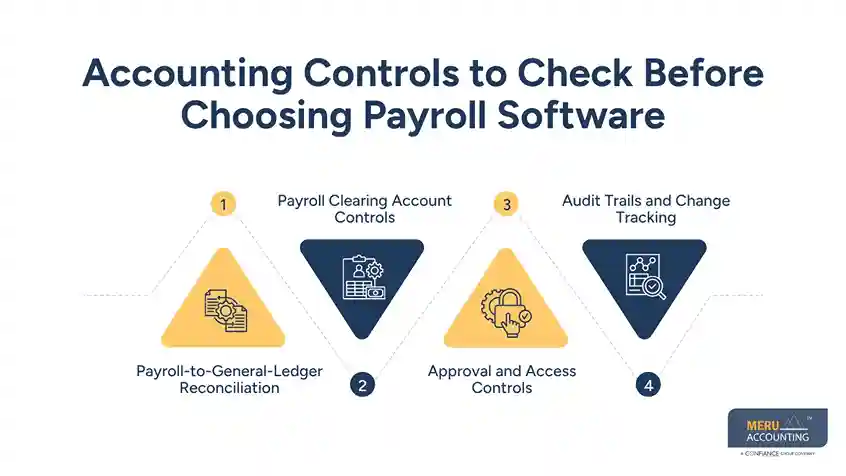
Accounting Controls to Check Before Choosing Payroll Software
Payroll-to-General-Ledger Reconciliation
One of the simplest checks is also one of the most useful: compare the payroll report with the journal posted to the books.
Payroll software for accountants should make this comparison easy. If payroll shows $60,000 in wages but the ledger shows $59,500, the team needs to find the reason before closing the period.
Payroll Clearing Account Controls
A payroll clearing account should not become a place where unexplained amounts sit for months. Each balance should have a reason and a clear path to the related payment.
Payroll software for accountants should make it possible to trace a clearing balance to the payroll run and bank transaction. An old balance may point to a duplicate entry, missing payment, or timing issue.
Approval and Access Controls
Payroll data needs tighter control than many routine accounting entries. A user who can change pay rates or bank details may affect a future payment without changing the current payroll report.
Payroll software for accounting firms should allow access based on job role. One person may enter payroll, another may approve it, while a third reviews the accounting entry.
Audit Trails and Change Tracking
An audit trail becomes valuable when something does not look right. If an employee’s pay rate changed, the accounting team should be able to see when the change happened and who made it.
Payroll software for accountants should retain useful change records for key payroll fields. This makes investigation much easier than relying on memory or email trails.
How to Choose Payroll Software for Accountants
Map the Payroll Process
Start with the current process rather than the software brochure. Follow one payroll run from hours or salary data through approval, payment, journal posting, and reconciliation.
This quickly shows where manual work exists and where the new payroll software for accounting firms needs to fit.
Review the Accounting Setup
Check the chart of accounts, departments, locations, classes, and payroll liability accounts before selecting a system.
A payroll system that cannot match the business’s accounting setup may create extra journal work even if its payroll calculations are accurate.
Test a Full Payroll Run
A demo can make almost any system look simple. A real test is more revealing.
Use sample employees with different pay rates, deductions, taxes, and payment types. Then review the payroll report, journal, bank payment, and liability balances.
Check Reports and Exports
Reports matter when something needs to be checked six months later. Look at filters, date ranges, export formats, and access to older payroll data.
Payroll software for accountants should make it easy to pull the exact information needed for a reconciliation or client question.
Review the Total Cost
The monthly plan is only part of the cost. Check employee charges, extra users, tax filing, payment services, accounting integrations, setup, and add-ons.
For payroll software for accounting firms, also consider whether costs change as the number of clients or employees grows.
Payroll Software for Accountants: Common Mistakes to Avoid
Choosing Features Over Accounting Fit
A system can have dozens of payroll features and still be a poor accounting fit. The key question is whether the payroll data lands correctly in the books.
Ignoring Reconciliation
Do not assume that a successful payroll run means the accounting work is complete. Compare payroll, journals, bank payments, and liabilities before closing the period.
Giving too Much Access
Avoid giving every payroll user full control. Limit access to the tasks each person actually needs and review those rights from time to time.
Not Checking Tax Filing Limits
Tax filing may be included, limited, or sold as an extra service. Check the exact terms before choosing a plan.
Not Testing Corrections
Errors happen. Test voids, corrections, off-cycle payments, refunds, and changes to earlier payroll runs before committing to the software.
Meru Accounting's Payroll And Bookkeeping Services
Meru Accounting provides payroll accounting services that fit into wider bookkeeping and accounting work. Services can include payroll data review, payroll entries, account reconciliation, and related accounting tasks.
For businesses using payroll software for accountants, we provide services that keep payroll records and accounting entries aligned. This can be useful when payroll and accounting are handled in separate systems.
Meru Accounting also provides bookkeeping, payroll, AP-AR, tax, and other accounting services based on the client’s needs and accounting setup.
Our Expert Perspective
Reliable payroll software is not about having every feature on the list. What matters more is whether an accountant can look at a number and quickly find out where it came from.
Before you choose payroll software for accounting firms, run through one full pay cycle. Check the wage entry in payroll, then follow it to the journal and ledger. Do the same with the payment and bank record. If you can follow each amount without having to dig through several screens, the system is easier to check and manage.
Key Takeaways
- Payroll software for accountants should link payroll with the books.
- Check the tax, pay, report, and journal tools before you pick a system.
- Links with bank, HR, time, tax, and book tools can cut extra data entry.
- Match pay totals with the general ledger after each key pay run.
- Check payroll clearing accounts for old or odd balances.
- Use role-based access and audit trails to track key pay changes.
- Test one full pay cycle, not just a live demo.
- Check the full cost and tax filing limits before you pick payroll software for accounting firms.
FAQs
Payroll software for accountants runs staff pay and links payroll data with the books. It can track wages, tax, pay cuts, pay runs, reports, and journal entries.
Accountants should check pay math, tax tools, links to the books, reports, pay logs, user rights, audit logs, and ways to check and match data.
The link cuts repeat data entry and makes payroll journals easy to check. It also makes it easy to match pay totals with the books.
Payroll software for accounting firms may need more client tools, reports, user rights, data export, and links to the books. This is key when a firm runs pay for many firms.
Run a test pay run and match the pay report with the journal, bank pay, tax due, and clear-out account. This shows if the full pay and book flow works as it should.
optional anymore
on running the business