

If you’re setting a bookkeeping budget, the bookkeeper hourly rate is only one part of the cost. The work may take one hour for clean books, but much longer when there are many feeds, cards, bills, or old errors. In 2026, many U.S. freelance and contract bookkeepers charge about $25 to $60 per hour, while skilled work may cost more.
The rate you see on a quote may not tell you what you’ll pay each month. Transaction count, account count, payroll, reports, and the state of your books can all change the total. That’s why it helps to look at both the bookkeeper hourly rate and the work behind it.
What You Will Learn From This Blog
- What affects the bookkeeper hourly rate in 2026
- How bookkeeper rates per hour change with work level
- How transaction volume can raise your cost
- Why cleanup work often costs more
- When hourly or monthly bookkeeping may fit
What Is the Average Bookkeeper Hourly Rate in 2026?
There is no single U.S. rate that fits every bookkeeper. Current 2026 pricing guides place many freelance bookkeepers in the $25 to $60 per hour range, with skilled or niche work often costing more. Employee pay is a different measure because a wage does not cover the full cost of running a service firm.
For that reason, do not treat the average bookkeeper hourly rate as a fixed market price. It is better to use it as a starting point. A basic bookkeeper who handles clean books may charge less than a senior pro who handles month-end close, payroll support, complex accounts, or cleanup work. Your final bookkeeper hourly rate should match the work you need, not just the title of the person doing it.
A low-volume service firm with two bank accounts may need only a few hours each month. An online store with sales, fees, refunds, and payouts can need much more time. The same bookkeeper hourly rate can lead to a very different monthly bill.
Bookkeeper Rates Per Hour by Transaction Volume
Transaction count is one of the best ways to judge the size of a bookkeeping job. One 2026 U.S. benchmark puts monthly bookkeeping at about $150 to $250 for under 50 transactions, $400 to $650 for 100 to 250, and $600 to $1,000 for 250 to 500. Higher volume can push fees much higher.
Here is a simple way to think about bookkeeper rates per hour and work size:
Under 50 transactions per month:
This is often light work if the books are clean. A bookkeeper may only need a few hours for data review, account checks, and reports.
50 to 250 transactions:
This is a common range for small firms. The work can include bank and card feeds, account review, and month-end close.
250 to 500 transactions:
More time may go to sorting, checking, and matching entries. A higher bookkeeper hourly rate may also apply when there are many accounts or manual entries.
500 to 1,000+ transactions:
At this level, volume can become a key cost driver. E-commerce, restaurants, and firms with many sales or payment feeds may need more hours or a higher service tier.
These are guide bands, not fixed quotes.
How Transaction Volume Changes Your Bookkeeping Cost
More transactions usually mean more work, but the link is not one-to-one. Bank feeds and rules can cut time, while manual checks, bills, transfers, refunds, and payment activity can take more time.
The number of accounts also matters. One bank account and one card may be easy to close. Add cards, payment tools, a loan, and payroll, and each account may need its own check.
This is why a quote based only on a bookkeeper hourly rate can miss the real cost. Ask what the rate covers. Does it include bank and card reconciliation? Monthly reports? Bill entry? A/R or A/P work? If those items are extra, the final cost can rise fast.
The state of your books matters too. Clean books follow a set process. Messy books may need research before entries can be placed in the right account. Missing statements, old unreconciled items, duplicates, and mixed personal and business costs can add hours.
optional anymore
on running the business
What Makes a Bookkeeper Charge a Higher Hourly Rate?
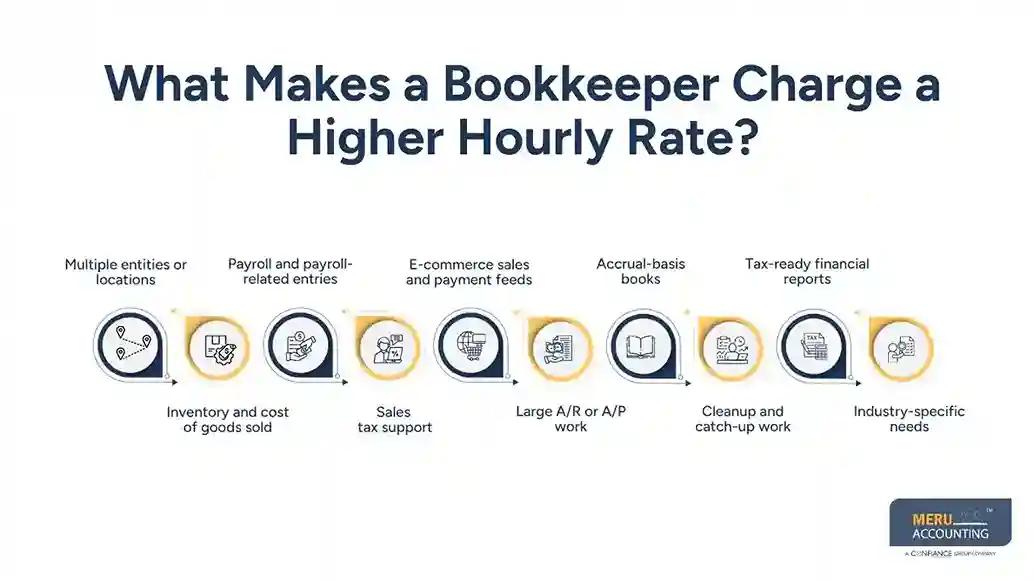
Experience is one factor, but it is not the only one. Complex work may cost more because it calls for more skill and care.
Common reasons include:
- Multiple entities or locations
- Inventory and cost of goods sold
- Payroll and payroll-related entries
- Sales tax support
- E-commerce sales and payment feeds
- Large A/R or A/P work
- Accrual-basis books
- Cleanup and catch-up work
- Tax-ready financial reports
- Industry-specific needs
A senior bookkeeper may also work faster and make fewer errors. So a higher bookkeeper hourly rate does not always mean a higher total cost. If one person needs five hours and another needs eight, the final bills may be close.
Cleanup work is another major factor. Cleanup is not just data entry. It can mean finding old errors, tracing source records, fixing account links, and making sure balances match. 2026 pricing guides show that cleanup can cost two to four times a normal month of bookkeeping for the same client, based on the mess and the time needed.
Hourly Bookkeeping vs. Monthly Bookkeeping Rates
Hourly billing can work for small or one-time needs, such as a new business with few transactions or a short project.
Monthly pricing may be easier when you need steady work. You know the fee before the month starts, and the bookkeeper can use the same process each month. Current 2026 benchmarks put many small-business plans in the few-hundred-dollar range, with cost rising as volume and scope rise.
So which is better? Compare the total work, not just the bookkeeper hourly rate. Ask for a clear list of what is included, how many accounts are covered, how often books are closed, and what happens if your volume rises.
If your books need cleanup, ask for a separate project quote. A cleanup job may be hard to price from a normal monthly rate until the bookkeeper sees the records. One 2026 benchmark estimates cleanup at about $300 to $500 for 1–3 months behind, $500 to $1,500 for 4–6 months, and $1,500 to $3,500 for 7–12 months at typical volume. Complex books can cost more.
Outsourced Bookkeeping Services by Meru Accounting
The right bookkeeping setup starts with the work behind the numbers. At Meru Accounting, we look at factors such as transaction volume, number of accounts, reconciliation needs, and the condition of your existing books before defining the support a business needs. This helps avoid paying for a service that’s too broad—or choosing a low rate that leaves key work out of scope.
Our outsourced bookkeeping support covers:
- Transaction bookkeeping: Categorizing income and expenses and keeping day-to-day records up to date.
- Bank and credit card reconciliation: Matching account activity and finding items that need review.
- A/R and A/P support: Tracking customer balances, bills, payments, and amounts due.
- Month-end bookkeeping: Closing the books and checking key accounts before reports are prepared.
- Financial reporting: Preparing clear P&L, balance sheet, and other reports for business review.
- Cleanup and catch-up bookkeeping: Fixing old entries, unreconciled accounts, missing records, and other issues before moving to regular monthly work.
- Tax-ready bookkeeping: Keeping records organized so your tax professional has cleaner books to work from.
- QuickBooks, Xero, and Zoho Books support: Working within the accounting system your business already uses.
With 12+ years of experience serving businesses across 20+ industries, we understand that bookkeeping time doesn’t depend on transaction count alone. A business with fewer transactions can still need more work if its books have old errors, many accounts, or complex payment flows. Our approach is to match the bookkeeping process to the actual needs of the business, then keep that process consistent as the books move from month to month.
Our Expert Insight
In our experience, the biggest bookkeeping cost isn’t always the hourly rate—it’s the time spent fixing errors, chasing missing records, or reviewing work that wasn’t completed correctly the first time. That’s why we look at the overall effort required to keep the books accurate, not just the quoted rate.
We also find that businesses often need different levels of support at different stages. A new business may need basic monthly bookkeeping, while an established business with old unreconciled accounts may first need cleanup and catch-up work. Understanding that difference helps owners get a more realistic idea of what bookkeeping will actually cost.
Key Takeaways
- The bookkeeper hourly rate in 2026 often falls around $25 to $60 for many freelance and contract bookkeepers, but skilled work can cost more.
- The average bookkeeper hourly rate is only a starting point, not a set price.
- Transaction volume, account count, and book condition can change your total cost.
- Bookkeeper rates per hour may be higher for complex work, but faster work can lower the final bill.
- Cleanup and catch-up work should often be priced as a separate project.
- Monthly pricing can be easier to plan when you need ongoing bookkeeping.
FAQs
In the U.S., bookkeeper hourly rates often fall around $25–$60 per hour, though experienced or specialized bookkeepers may charge more.
Hourly billing can work well for short-term or unpredictable work. A monthly fee is often easier to budget when you need bookkeeping done each month consistently.
It depends on the provider. Ask whether the rate covers transaction entry, account reconciliation, financial reports, month-end close, and routine communication—or if some services are billed separately.
Rates can vary based on experience, accounting software skills, business complexity, location, and the type of work involved. A bookkeeper handling multi-entity accounts or complex reconciliations may charge more than one doing basic data entry.
Don’t compare the hourly rate alone. Look at the total hours, services included, quality of work, and expected monthly cost. A higher rate may be more cost-effective if the work is completed accurately with less oversight.
optional anymore
on running the business