
Many firms today face strong pressure to control costs while still giving clear and correct financial services to clients. From staff pay and software costs to rules, training, and system needs, daily business costs keep rising across the accounting field. For many bookkeeping businesses, keeping profits steady while also growing operations has become a hard task. Many bookkeeping businesses are now looking for cost-saving solutions that also improve daily operations. Outsourced support has become a useful choice for firms that want to improve work flow without raising overhead costs. Instead of building large in-house teams, firms now work with outside experts who can handle daily accounting work, reports, payroll support, bank checks, and other back-office tasks at a lower business cost.
This method is very useful for growing firms, small accounting groups, and bookkeeping businesses that need more room to adjust. Whether the goal is to lower staff costs, improve work speed, or manage busy work periods, outsourcing gives firms a clear way to control business costs without lowering service quality. In this blog, we will explain how outsourced support helps accounting firms lower costs, improve daily work flow, and build long-term growth in a highly active business market.
What You Will Learn From This Blog
After reading this blog, you will understand:
- Why operating costs are rising for bookkeeping businesses
- How outsourcing supports modern bookkeeping work
- Which business tasks can be outsourced in an effective way
- Ways outsourcing lowers hiring and training costs
- How firms can improve output without growing internal staff
- Why outsourcing helps a growing bookkeeping startup
- How Meru Accounting supports firms with skilled bookkeeping services
Why Many Bookkeeping Businesses Struggle with Rising Operating Costs
The accounting field has changed in many ways during the last few years. Businesses now expect fast reports, live financial updates, strong rule checks, and better client support. Meeting these needs often forces firms to spend more on staff, software tools, and daily work systems.
One major issue for bookkeeping businesses is staff-related costs. Hiring trained accounting workers can be costly, mainly when firms must also give training, staff benefits, office space, computer systems, and software access. As firms grow, these costs continue to rise. This is one of the main reasons bookkeeping businesses are turning to outsourced support.
Software and system costs also create financial pressure. Firms must invest in cloud accounting tools, cyber safety systems, payroll software, tax systems, and safe file storage tools. While these systems improve daily work speed, they also raise monthly and yearly business costs.
Another common problem is changing work volume. Many firms face busy work periods during tax season, audits, or year-end reports. Keeping a large in-house team all year can lead to extra payroll costs during slow months.
Small and mid-sized firms often face the biggest pressure because they must compete with large accounting firms while also working with tighter budgets. For a growing bookkeeping startup, balancing business costs with client needs can become difficult without outside support.
Because of this, many firms now use outsourcing as a cost-control method that helps them stay flexible while still giving high-quality service.
Understanding the Role of Outsourced Support in Modern Accounting Operations
Outsourced support means giving selected accounting or bookkeeping tasks to outside experts or service firms instead of handling every task within the company. This business model allows firms to use trained accounting support without keeping a large full-time staff.
Modern outsourcing now covers far more than basic data entry work. Today, outsourced teams can manage many types of financial tasks, including:
- Bookkeeping and bank checks
- Payroll processing
- Financial reports
- Accounts payable and receivable
- Tax support work
- Inventory accounting
- Virtual CFO support
- Rule and report checks
Cloud systems have made outsourced work easier and safer. Firms can now share financial data, reports, and accounting files through safe cloud systems, allowing outsourced teams to work in a smooth and secure way from many places.
This level of flexibility helps bookkeeping businesses manage work flow in a better way while lowering overhead costs. It also allows bookkeeping businesses to respond faster to changing client demands. Instead of hiring many full-time workers, firms can use trained experts only when support is needed.
Outsourcing also helps firms scale in a smooth way. As client demand grows, firms can increase support services fast without spending extra time on hiring or office setup.
For many firms, outsourced support is not only a cost-saving plan. It is also a long-term business method that improves output, flexibility, and steady daily operations.
Key Areas Where Outsourcing Helps Bookkeeping Businesses Save Money
Outsourcing can lower business costs across many key work areas. The savings often come from lower staffing costs, better work speed, fewer mistakes, and stronger use of business resources.
Payroll Processing
Payroll work needs strong accuracy, rule knowledge, and on-time processing. Mistakes in payroll numbers or tax reports can lead to fines and staff concerns.
By outsourcing payroll tasks, firms can lower office work pressure while also avoiding the cost of keeping payroll experts in-house.
Accounts Payable and Receivable
Handling invoices, payment records, vendor files, and collections takes a large amount of time and staff effort. Outsourced teams can manage these tasks in an organized way through automated systems and planned work methods.
This improves cash flow control while lowering manual office work.
Bank Checks and Financial Reports
Regular bank checks and financial reports are very important for correct financial control. Outsourced accounting experts can prepare reports on time while lowering pressure on internal teams.
Correct reports also help firms find financial issues early and improve business planning.
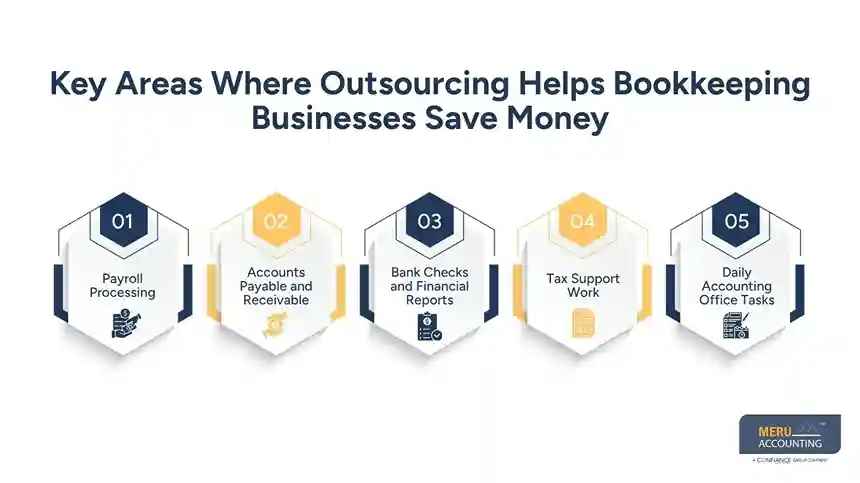
Tax Support Work
Tax periods often create very heavy work pressure for bookkeeping businesses. Hiring short-term in-house workers during busy seasons can become costly and less efficient.
Outsourced support allows bookkeeping businesses to manage tax work loads without raising long-term staffing costs.
Daily Accounting Office Tasks
Many routine accounting tasks take up valuable staff time. Data entry, file handling, invoice sorting, and record updates can all be outsourced in an effective way.
This allows internal teams to focus more on client support and high-value business work.
Reducing Hiring and Training Costs Through Outsourcing
Hiring and staff development are among the biggest business costs for accounting firms. Finding skilled workers takes time, and training new staff members often requires extra spending on teaching and daily guidance.
For bookkeeping businesses, these costs can lower profits, mainly when worker turnover rates remain high.
Outsourcing lowers many of these costs because outside service providers already employ trained accounting experts. Firms do not need to spend extra money on hiring campaigns, interview steps, training plans, or technical learning.
This method also removes many indirect costs, including:
- Staff benefits
- Office setup costs
- Equipment purchases
- Software access for extra workers
- Paid leave expenses
- Long-term salary duties
Another major benefit is faster work readiness. Outsourced experts are usually trained in accounting software, rule checks, and reporting methods. This allows firms to keep work speed high without long training periods.
A bookkeeping startup can gain strong value from this model because it allows the business to grow step by step without carrying large fixed payroll costs during early growth stages.
Instead of spending heavily on full-time hiring, smaller firms can use more resources for client growth, software upgrades, and service expansion.
How Outsourcing Improves Daily Work Efficiency
Lowering costs is only one part of the outsourcing benefit. Many firms also see strong improvements in daily work speed and overall business efficiency.
Outsourced teams often follow clear work systems and planned accounting methods. This improves consistency across daily bookkeeping tasks and lowers delays in reports.
Because outsourcing firms focus mainly on accounting work, they often use advanced automation systems and smooth work methods that improve output. Tasks that may take many hours in-house can often be finished faster by trained outsourced experts.
Efficiency gains also help bookkeeping businesses manage larger client volumes without building larger internal departments. This creates stronger business growth while still keeping service quality high. For bookkeeping businesses, this balance is important for long-term client retention.
Another major benefit is improved time use. Internal teams can focus more on advisory work, client support, and business growth instead of spending too much time on repeated office tasks.
For firms managing many clients, outsourcing can also improve report speed, bank checks, and tax support work.
Risk Control and Rule Support Through Outsourcing
Accounting and bookkeeping work requires strong accuracy and proper rule compliance. Mistakes in financial records, payroll numbers, or tax reports can create fines and damage business trust.
Professional outsourcing providers often stay updated on accounting rules, report standards, and compliance needs. Their knowledge helps lower business risks for accounting firms.
Outsourced teams also follow quality check methods that improve accuracy in bookkeeping tasks. Multiple review steps and planned file systems help lower common accounting mistakes.
Data safety has also improved greatly in modern outsourcing systems. Many providers now use secure cloud systems, encrypted file-sharing tools, limited access controls, and backup systems to protect private financial data.
For bookkeeping businesses handling client financial records, this added safety support can improve business trust and rule management.
Why Outsourcing Is Valuable for a Growing Bookkeeping Startup
A new accounting firm often faces limited resources during the early stages of growth. Hiring trained staff, buying software, and managing rule costs can place heavy financial pressure on the business.
For a bookkeeping startup, outsourcing creates a more flexible work structure that supports growth without creating very high overhead costs.
Instead of building a large internal team right away, bookkeeping businesses and startups can outsource selected accounting tasks while focusing more on client support and market growth.
This method provides many benefits:
- Lower startup business costs
- Access to trained accounting experts
- Better scaling during business growth
- Lower office work pressure
- Faster service delivery
- Greater business flexibility
Outsourcing also helps smaller firms compete more effectively with larger accounting companies by improving service speed without large office investments.
As client demand grows, outsourced support can also expand step by step based on changing work needs.
How Meru Accounting Supports Modern Accounting Firms
At Meru Accounting, we understand the business challenges accounting firms face while managing rising costs and growing client expectations. Our professional bookkeeping services are designed to help firms improve work flow, lower business pressure, and maintain correct financial management processes.
We provide custom support solutions for accounting firms, CPA practices, and growing businesses that need trusted bookkeeping assistance. Our trained experts work with modern accounting platforms and cloud systems to deliver correct and timely financial support.
Our services include:
- Bookkeeping and bank checks
- Payroll processing support
- Accounts payable and receivable management
- Financial reporting support
- Tax preparation support
- Cloud accounting services
- Virtual accounting support
Meru Accounting focuses on helping firms simplify daily work while lowering staffing and office costs. Our flexible service model allows businesses to use skilled accounting support without building large in-house teams.
Whether you are an established accounting firm or a growing bookkeeping startup, our outsourced bookkeeping services can help improve daily work efficiency and support long-term business growth.
Key Takeaways
- Rising business costs continue to affect accounting firms across many markets.
- Outsourced support helps firms lower staffing, training, and office expenses.
- Many bookkeeping businesses use outsourcing to improve scaling and daily work efficiency.
- Payroll, reports, bank checks, and tax support are common outsourced tasks.
- Outsourcing allows firms to manage busy work periods in a better way.
- A bookkeeping startup can grow more efficiently through outsourced business support.
- Professional outsourcing firms help improve accuracy, rule compliance, and work consistency.
- Meru Accounting provides custom bookkeeping support solutions for modern accounting firms.
FAQs
Many firms choose outsourcing to lower business costs, improve work speed, access trained experts, and manage work loads without building larger internal teams.
Outsourcing lowers costs linked to hiring, staff benefits, office setup, software access, and long-term payroll duties.
Yes. Outsourcing helps small firms use skilled support while keeping business costs flexible during growth periods.
Common outsourced tasks include payroll processing, bank checks, accounts payable, accounts receivable, financial reports, and tax support work.
Professional outsourcing providers use secure cloud systems, encrypted platforms, and controlled access methods to protect financial data and maintain privacy.