
A $10,000 commission check can look like a great deal until you see what it took to earn it. Bookkeeping for realtors helps you look past gross commission and see what each deal leaves after lead fees, broker splits, travel, marketing, and other costs.
Some deals bring a good return with little work. Others take weeks of calls, showings, follow-ups, and extra costs for a much smaller gain. If you track these numbers by deal, you can see which transactions pay well, which ones drain your time, and where your costs are too high.
This blog shows how bookkeeping for realtors can help you measure deal profit, track financial KPIs for realtors, and use your books to make better choices about leads, costs, and client work.
What You Will Learn From This Blog
You’ll learn how to:
- Find the true cost of each real estate transaction.
- Separate deal costs from normal business overhead.
- Work out profit beyond the gross commission.
- Track key financial KPIs for realtors.
- Use reports to find weak deals and high-cost lead sources.
- Use realtor bookkeeping to support better business choices.
Why Some Real Estate Transactions Are Less Profitable Than They Appear
A closing may look great when you see the gross commission. But that number does not show the full cost of getting the deal across the line.
Think about a deal with a $12,000 commission. You may have paid for the lead, shared part of the commission with your broker, driven to several showings, paid for photos, and bought a closing gift. You may also have spent many hours on calls, texts, offers, and follow-ups.
After those costs, the amount you keep may be far less than the first number suggests. Bookkeeping for realtors gives you a way to connect those costs with the deal that caused them.
Time is another key factor. A $10,000 deal that takes 20 hours may be more useful than a $15,000 deal that takes 60 hours. Both produce revenue, but they do not give you the same return on your time.
The same issue can happen with lead sources. A paid lead may bring in more clients, yet the cost to win and close those clients may be high. A past client or referral may bring less gross revenue but create a much better profit margin.
What Makes a Real Estate Transaction Unprofitable?
A deal can become unprofitable when its costs rise too far compared with the commission it produces. In some cases, one high cost causes the problem. More often, several small costs add up.
Common costs include:
- Lead and referral fees
- Broker or team splits
- Paid ads and other marketing
- Mileage, parking, and travel
- Client gifts and meals
- Property photos and video
- Staging support
- Printing and signs
- Extra showings and property visits
- Time spent on deals that fail to close
Deal length can also affect profit. A transaction that stays active for months may require far more work than a simple deal.
Failed deals deserve attention too. You may not earn a commission, but you can still spend money on travel, marketing, inspections, photos, and your own time.
This is where realtor bookkeeping becomes more useful than a basic list of income and expenses. Your records should help you see which costs belong to each deal and which costs support your full business.
How Bookkeeping for Realtors Helps Measure Transaction Profitability
To measure deal profit, your books need more detail than total income and expense totals. You need a way to link key costs to the transaction that caused them.
Start by giving each deal a clear name, code, class, or project tag. Use the same method for every transaction. This makes it easier to pull costs for one deal without digging through bank records each time.
Next, track direct costs. These may include lead fees, referral fees, mileage, client gifts, photos, and deal-specific ads. If a cost is tied to one deal, record it in a way that lets you find it later.
You should also keep direct costs separate from general overhead. Office rent, software, insurance, and admin costs support the full business. They should not be treated as a direct cost of one deal unless you have a fair way to assign them.
Bank and credit card accounts should also be checked on a regular basis. Missing or misclassified costs can make a deal look more profitable than it really was.
With clean bookkeeping for realtors, you can review deal results each month instead of waiting until tax time. That gives you a better view of where your money goes and which work brings the best return.
How to Calculate Profit for Each Real Estate Transaction
A simple way to measure transaction profit is:
Transaction Profit = Gross Commission − Direct Deal Costs − Allocated Costs
For example, assume a transaction produces $12,000 in gross commission.
Your costs are:
- Broker split: $1,800
- Lead fee: $700
- Travel and client costs: $300
- Deal-specific marketing: $200
Your estimated profit is:
$12,000 − $1,800 − $700 − $300 − $200 = $9,000
The $9,000 figure gives you a better view than the gross commission alone.
You can also compare profit with time spent. If the deal took 45 hours, the profit was about $200 per hour before broader overhead and taxes.
This does not mean every deal must meet the same target. Some deals may lead to repeat clients or referrals. Still, the number gives you a useful way to compare your work.
optional anymore
on running the business
Key Financial KPIs for Realtors to Track
The right financial KPIs for realtors can show where your income comes from and where profit is lost. Focus on measures that can help you make a clear business choice.
Net Profit Margin
Net profit margin shows how much revenue remains after business costs. If sales rise but your margin falls, your growth may not be as strong as it looks.
Average Commission Per Transaction
This shows the average commission earned per closed deal. Watch the trend over time and compare it with your deal costs.
Cost Per Lead
Cost per lead tells you how much you spend to bring in each lead. Compare this cost with your close rate and profit per deal.
Lead-to-Closing Rate
A low-cost lead source may still be weak if very few leads become clients or closed deals. Track the full path from lead to closing.
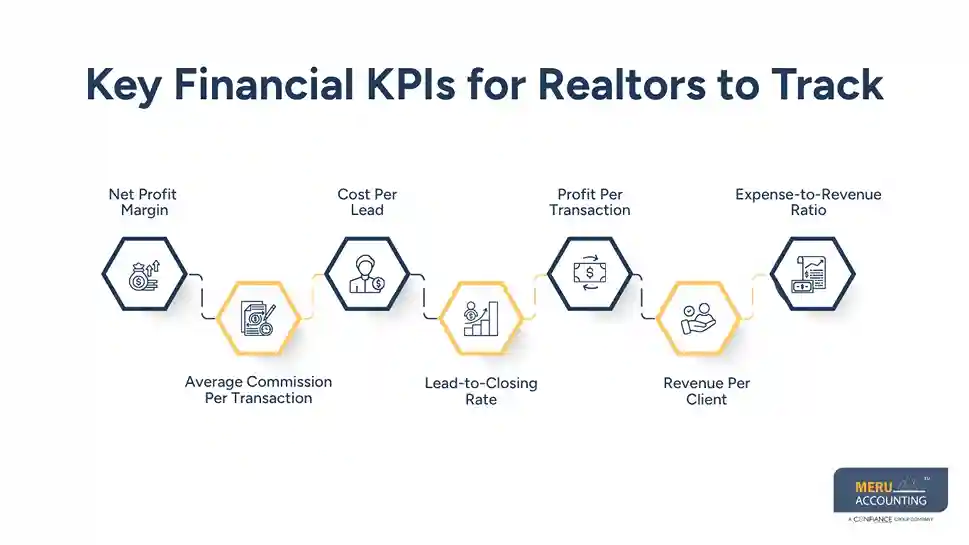
Profit Per Transaction
This KPI shows what remains after the costs tied to a deal. It is one of the best ways to spot deals that look strong but bring a weak return.
Revenue Per Client
Some clients can create more value through repeat deals and referrals. Tracking revenue by client can help you see the long-term value of your client base.
Expense-to-Revenue Ratio
This ratio shows how much of your revenue goes toward business costs. A rising ratio may signal that your expenses are growing too fast.
These financial KPIs for realtors are most useful when you review them as trends. One weak deal does not always mean there is a problem. A pattern across several months deserves a closer look.
How to Use Financial Reports to Improve Realtor Profitability
Your reports can turn raw bookkeeping data into useful business insight. Start with your profit and loss statement. Look at income and expense trends to see where costs are rising.
Then review marketing and lead costs. Compare what you spend on each source with the number of closed deals and profit it brings. A source that gives you many leads may still be a poor choice if few leads close.
You can also review transaction-level results. Compare deal profit, direct costs, and time spent. This can show whether certain deal types or lead sources take too much work for the return they bring.
Cash flow reports provide another view. Real estate income may not arrive at a steady pace, even when your annual revenue is strong. A cash flow review can help you plan for taxes, marketing, software, and other regular costs.
The goal is not to cut every expense. Some costs help you win clients and close more deals. The goal is to know which costs support growth and which ones reduce your return.
How Meru Accounting Supports Bookkeeping for Realtors
Realtor books can get messy when every closing has a different mix of commissions, splits, referrals, lead fees, and other costs. Our team looks at how these transactions flow through the books and sets up the records so income and expenses are coded consistently.
What our bookkeeping for realtors includes:
- Monthly bookkeeping and account reconciliation
- Commission and transaction tracking
- Expense categorization and review
- Bank and credit card reconciliation
- Profit and loss and cash flow reporting
- Year-round bookkeeping support
Our role isn’t limited to entering transactions. We help keep the financial records consistent enough to spot missing expenses, unusual costs, and changes in profitability. This gives Realtors a stronger financial base for reviewing their business and working with their tax professional or financial advisor.
Our Expert Insight
One area Realtors often overlook is timing. A closing may make a month look highly profitable, while commissions from earlier work are recorded at the same time as expenses from deals that have not closed yet. That can make monthly results look better or worse than the business really is.
For this reason, we recommend reviewing the books on both a transaction and monthly basis. Match commission income with the costs and activity that produced it, then use the monthly financial statements to see the broader health of the business.
This distinction matters when making decisions about marketing spend, hiring, lead sources, and cash reserves. Good accounting should help a Realtor understand not only what was earned, but when the money was earned and what financial commitments are still ahead.
Key Takeaways
- Gross commission is not the same as transaction profit.
- Lead fees, broker splits, travel, and client costs can cut into deal profit.
- Track direct costs by transaction when possible.
- Compare deal profit with the time spent on the transaction.
- Use financial KPIs for realtors to spot cost and profit trends.
- Review lead sources based on closed revenue and profit, not lead count alone.
- Strong bookkeeping for realtors gives you better data for business decisions.
- Review transaction results on a regular basis instead of waiting for year-end.
FAQs
There isn’t one fixed margin that works for every Realtor. Compare margins across similar deals and consider the time, lead cost, referral fees, and other costs required to close them.
Yes. Your broker split is a direct cost of earning the commission, so leaving it out can make a transaction look more profitable than it really is.
Compare the cost of acquiring the lead with the revenue and profit generated from the deals it produces. Also consider the number of leads needed to get one closing, not just the total number of leads.
Yes. Strong deal-level profits can be offset by high overhead, slow collections, debt payments, or other business costs. This is why transaction results should also be reviewed against the full business P&L.
First, identify what caused the low return rather than treating every weak deal the same. The issue may be a high lead cost, excessive travel, a large referral fee, low commission, or too much time spent on the transaction.
optional anymore
on running the business