Bookkeeping services for small business can give owners clear financial records, timely reports, and better control over daily money tasks. As a firm grows, its financial work also becomes more detailed. Sales may rise, staff may join, new accounts may open, and tax work may become more complex.
A structured bookkeeping process records income, costs, invoices, payments, payroll, bank activity, and other transactions in an orderly way. The IRS states that businesses should use a recordkeeping system that clearly shows income and expenses and keeps documents that support reported amounts.
The right level of financial support can also change with each stage of growth. A new firm may need basic transaction records, while a larger firm may need regular account reviews, payroll records, cash flow reports, and detailed financial statements.
What You Will Learn From This Blog
- How bookkeeping services for small businesses can change at each stage of growth.
- Why accurate financial records matter for cash flow, tax work, and planning.
- Which financial tasks are common for new and growing firms.
- How small business bookkeeping costs can vary by transaction volume and service scope.
- When in-house work may suit a firm and when outsourcing may be more practical.
- Which financial record errors small firms should watch for.
- How Meru Accounting can manage routine financial tasks for growing firms.
Introduction To Bookkeeping Services For Small Businesses
Bookkeeping services for small businesses cover the regular work needed to record and organize financial activity. Common tasks include recording sales, expenses, invoices, payments, payroll entries, bank transactions, and credit card activity.
The process also includes bank reconciliation, account review, and financial report preparation. Accurate records give owners a clear view of income, costs, profit, cash flow, unpaid invoices, and amounts due to suppliers.
The level of service can change as a firm grows. A new firm may need basic transaction entry and monthly reconciliation, while a larger firm may need payroll records, inventory tracking, accounts receivable, accounts payable, and detailed financial reports.
Why Small Businesses Need Professional Bookkeeping Services
Saving Owner Time
Small business owners often have many duties outside financial administration. Professional financial support can take routine entry, reconciliation, and reporting work away from the owner.
Reducing Record Errors
Wrong account codes, missed transactions, duplicate entries, and unreconciled balances can affect financial reports. A defined review process can identify these issues before they become harder to fix.
Improving Report Quality
Business decisions need current figures. Professional bookkeeping services for small businesses can produce regular reports that show sales, costs, receivables, payables, and profit.
Strengthening Tax Preparation
Tax returns need financial data that can be traced to supporting documents. The IRS states that taxpayers must be able to substantiate certain expenses claimed for tax purposes.
Managing Small Business Bookkeeping Cost
Small business bookkeeping cost can depend on transaction volume, account count, payroll, inventory, reporting needs, and review frequency. Comparing only the monthly fee can give an incomplete view of the service.
Bookkeeping Services For Small Businesses At Different Growth Stages
Startup Stage
A new firm may have limited sales and only a few financial accounts. Bookkeeping services for small businesses at this stage may focus on account setup, transaction entry, bank reconciliation, expense tracking, and basic monthly reports.
Early Growth Stage
Sales growth usually brings more invoices, payments, expenses, and customer activity. Regular reconciliation and accounts receivable tracking become more important as transaction volume rises.
Team Growth Stage
Hiring employees adds payroll, wages, benefits, reimbursements, and related financial entries. The financial process may also need closer coordination between payroll reports, bank activity, and expense records.
Bookkeeping services for small business can support consistent recording across these financial activities.
Multi-Channel Stage
A firm may sell through a website, physical location, online platform, or several sales channels. Each source should be tracked clearly and matched with deposits and related transaction data.
Expansion Stage
A larger firm may operate several locations, service lines, or legal entities. Financial reporting may then need separate views by location, department, product, or entity.
How Bookkeeping Needs Change As Your Business Grows
Higher Transaction Volume
More sales and expenses create more financial entries. Higher volume increases the need for regular review, clear account coding, and timely reconciliation.
More Financial Accounts
Growth may lead to new bank accounts, credit cards, loans, payment gateways, and savings accounts. Each account needs regular checks so financial reports remain accurate, especially when bookkeeping services for small businesses cover multiple bank, credit, and payment accounts.
More Employees
Payroll creates recurring financial entries and tax-related records. Employee costs, reimbursements, benefits, and payroll payments should be recorded in the correct period.
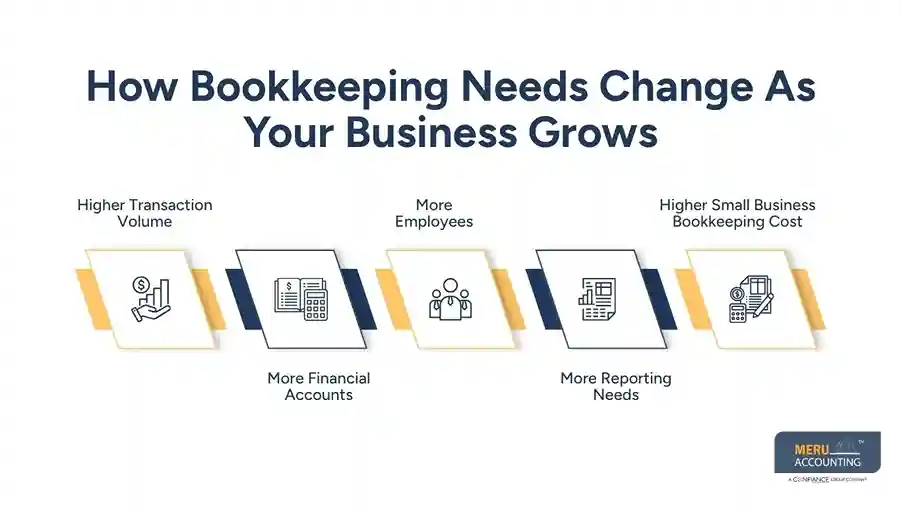
More Reporting Needs
Owners may first need only monthly profit and loss data. Later, they may need cash flow reports, receivables aging, payables aging, department reports, or location-based results.
Higher Small Business Bookkeeping Cost
Small business bookkeeping cost can increase when a firm adds accounts, employees, locations, transactions, or reporting needs. The increase should reflect added work rather than unnecessary services.
optional anymore
on running the business
In-House Vs. Outsourced Bookkeeping Services For Small Business
Comparison Area | In-House Financial Staff | Outsourced Financial Teams |
Work Structure | An in-house employee works within the firm and manages daily financial tasks based on internal needs. | An external team handles agreed financial tasks on a weekly, monthly, or set schedule. |
Staff Skills | The firm depends on the skills and knowledge of its hired employees. | An outsourced firm may provide access to several professionals with different areas of experience, making bookkeeping services for small businesses useful for firms that need broader financial support. |
Daily Availability | Staff members are available during their set working hours and can handle tasks within the office. | External teams work according to agreed schedules, service terms, and communication methods. |
Total Cost | Costs may include salary, hiring, training, leave, software, equipment, and management time. | Fees are usually based on the agreed work scope, transaction volume, reporting needs, and service level. |
Workload Changes | The firm may need to hire more staff when transaction volume or financial tasks increase. | The service scope can be adjusted when accounts, transactions, staff, or reporting needs increase. |
Best For | May suit firms with steady transaction volume and a need for regular internal finance work. | May suit firms that want professional financial work without adding a full-time employee. |
Management | Business owners or managers oversee the employee and review assigned tasks. | The outsourced provider manages its team while the business retains financial oversight. |
Small Business Bookkeeping Cost | The total cost can rise when salary, benefits, software, training, and other staff expenses are included. | Small business bookkeeping cost depends on the agreed services and level of work required. |
Flexibility | Changes in workload may require changes to staff roles or hiring plans. | Services can often be scaled based on changing transaction and reporting needs. |
Right Choice | Suitable when the firm needs an employee focused on internal financial tasks. | Suitable when the firm needs regular financial support with a flexible external setup. |
Common Bookkeeping Mistakes Small Businesses Should Avoid
Mixing Personal And Business Spending
Personal and business spending should remain separate. The IRS notes that personal expenses are generally not deductible as business expenses and recommends separate business and personal accounts for easier record management.
Delaying Reconciliation
Regular reconciliation is often included in bookkeeping services for small businesses to help identify discrepancies before they affect financial reports. Monthly reconciliation gives the finance team a regular point for checking balances.
Missing Supporting Documents
Invoices, receipts, bills, statements, and payment records provide evidence for financial entries. The IRS lists these types of documents among records that may support business transactions.
Using Wrong Account Categories
A transaction can be entered with the wrong account even when the amount is correct. Incorrect categories can affect profit reports, expense totals, tax data, and management decisions.
Ignoring Old Balances
Unpaid customer invoices and supplier balances should be reviewed regularly. Old items may reflect unpaid amounts, duplicate entries, credits, or transactions that need correction.
Bookkeeping Services For Small Business With Meru Accounting
Organized Financial Processing
Meru Accounting can manage transaction entry, bank reconciliation, expense records, invoices, and other routine financial tasks based on the agreed service scope. Our team can maintain records on a regular schedule.
Monthly Financial Reports
We can prepare financial reports that show income, expenses, profit, assets, liabilities, and other key figures. Clear reports give owners a practical basis for monthly review.
Services That Match Growth
Bookkeeping services for small businesses should change when financial needs change. Meru Accounting can adjust the scope as a firm adds employees, accounts, locations, sales channels, or reporting needs.
Tax Ready Financial Records
Our team can organize financial data and supporting records for tax preparation. Tax rules vary by country, state, entity type, and business activity, so tax treatment should always be reviewed according to the firm’s specific situation.
Flexible Service Structure
Small business bookkeeping costs should reflect the actual work required. Meru Accounting can structure financial support around the firm’s transaction volume, reporting needs, account count, and service requirements.
Our Expert Perspective
Our experience shows that financial administration works best when tasks have a clear schedule, assigned responsibility, and a review point. Owners should not wait for year-end to discover missing entries, unpaid invoices, or unusual costs.
Regular reviews through bookkeeping services for small businesses can show cash gaps and rising costs before they affect daily operations. A clear monthly process also gives owners timely figures for planning, spending, and growth decisions.
Key Takeaways
- Match financial support with the firm’s current stage of growth.
- Use bookkeeping services for small businesses to record sales, costs, invoices, payments, payroll, and bank activity on time.
- Reconcile bank and card accounts on a set schedule.
- Keep personal and business spending separate.
- Retain invoices, receipts, bills, statements, and other supporting records.
- Review financial reports each month for changes in sales, costs, profit, and cash.
- Compare small business bookkeeping costs with the full scope of work.
- Consider outsourcing when financial tasks take too much owner time.
- Increase the level of financial review as the firm grows.
FAQs
Small firms may need transaction recording, reconciliation, invoicing, payroll, reporting, and financial review as they grow.
Growing firms often need more accounts, transaction tracking, payroll work, detailed reports, and regular financial reviews.
The cost depends on transaction volume, account numbers, payroll, reporting needs, business size, and the level of service required.
Outsourced bookkeeping can suit firms that need skilled financial work without the full cost of hiring and managing an in-house employee.
A business should consider professional bookkeeping when financial tasks take too much owner time or transaction volume makes record management harder.
optional anymore
on running the business