
Starting a new business takes time, focus, and smart planning. Founders often manage product work, sales, hiring, and day-to-day tasks at the same time. In the middle of all this work, accounting and bookkeeping can become hard to manage. Financial records, payroll, tax filings, expense tracking, and cash flow reports all need close attention from the start. Many startup owners now choose business startup accounting and bookkeeping services to handle these tasks.
Outsourcing can help save time, lower costs, and improve financial accuracy. Still, the wrong outsourcing choice can create problems that hurt growth and lead to costly mistakes. A poor accounting setup can lead to missing reports, tax issues, poor cash control, and bad business decisions. That is why startups should know what mistakes to avoid before choosing a service provider.
What You Will Learn From This Blog
In this blog, you will learn:
- Why startups use outsourced accounting support
- Why outsourcing has become a smart choice for new businesses
- Common mistakes startups make while outsourcing accounting work
- How to select the right service partner
- Ways to avoid risks and support long-term growth
Why Startups Choose Business Startup Accounting and Bookkeeping Services
Many founders launch a business with small teams and limited budgets. Hiring a full in-house finance department during the early stage may not be practical. This is where business startup accounting and bookkeeping services become useful.
Startups choose these services because they help with:
- Daily bookkeeping tasks
- Expense tracking
- Payroll support
- Tax preparation
- Financial reports
- Cash flow management
- Compliance needs
These services give startup owners more time to focus on building products, reaching customers, and growing revenue.
Working with a skilled business start up accountant can also help business owners understand financial data and make better choices.
Why Outsourcing Accounting and Bookkeeping Has Become a Smart Choice for Startups
Outsourcing business startup accounting and bookkeeping services has become more common because businesses want flexible support and lower operating costs.
Startups often gain several benefits through outsourcing:
- Reduced overhead costs
- Access to skilled accounting professionals
- Better use of accounting technology
- Improved financial reporting
- More time for core business work
- Easy access to expert guidance
Many providers of business startup accounting and bookkeeping services also provide cloud-based systems that allow founders to view reports and records in real time.
While these advantages are important, success depends on choosing the right provider and avoiding common errors.
Common Mistakes to Avoid While Outsourcing Business Startup Accounting and Bookkeeping Services
Many startup owners focus only on cost or speed when selecting a service provider. That approach often creates problems later.
Understanding common mistakes can help startups make stronger decisions and avoid financial setbacks.
Mistake #1: Choosing Business Startup Accounting and Bookkeeping Services Based Only on Price
Cost matters for every startup, but choosing the cheapest option may create bigger issues later.
Low-cost providers may have:
- Limited support
- Poor response times
- Inexperienced staff
- Weak reporting systems
- Hidden fees
Low prices may look attractive at first, but mistakes in accounting can cost far more than the savings.
Instead of focusing only on cost, look at service quality, expertise, and long-term value.
Mistake #2: Not Checking Industry Experience and Startup Expertise
Every industry works in a different way. A startup in software may have different accounting needs than a startup in retail or healthcare.
Some providers of business startup accounting and bookkeeping services understand general bookkeeping but lack startup knowledge.
Startup accounting may include:
- Investor reporting
- Funding records
- Revenue tracking
- Growth planning
- Tax credit support
Ask providers about their experience with startups and your specific industry before making a decision.
Mistake #3: Hiring a Business Start Up Accountant Without Reviewing Credentials and Skills
Some business owners hire a business start up accountant without checking experience, certifications, or technical skills.
This mistake can create problems with:
- Financial reports
- Tax filings
- Compliance work
- Budget planning
- Record accuracy
Before hiring, review:
- Professional qualifications
- Industry experience
- Client feedback
- Software knowledge
- Startup expertise
A qualified accountant can help startups avoid many financial issues before they become serious problems.
Mistake #4: Ignoring Technology, Software, and Integration Capabilities
Modern accounting depends heavily on technology.
Some startups select providers without checking whether their systems work with existing tools.
Poor integration can lead to:
- Duplicate records
- Missing data
- Manual work
- Delayed reports
- Tracking errors
Ask whether the provider supports:
- Cloud accounting systems
- Payroll tools
- CRM systems
- Expense management software
- Payment platforms
Strong technology support creates smoother operations and better reporting.
Mistake #5: Failing to Define Scope of Work and Service Expectations
Some businesses assume that all business startup accounting and bookkeeping services providers offer the same services.
That assumption can create confusion and missed tasks.
Before starting work, clearly define:
- Daily bookkeeping tasks
- Tax filing support
- Payroll duties
- Financial reporting frequency
- Advisory services
- Response times
Written agreements help avoid misunderstandings and set clear expectations.
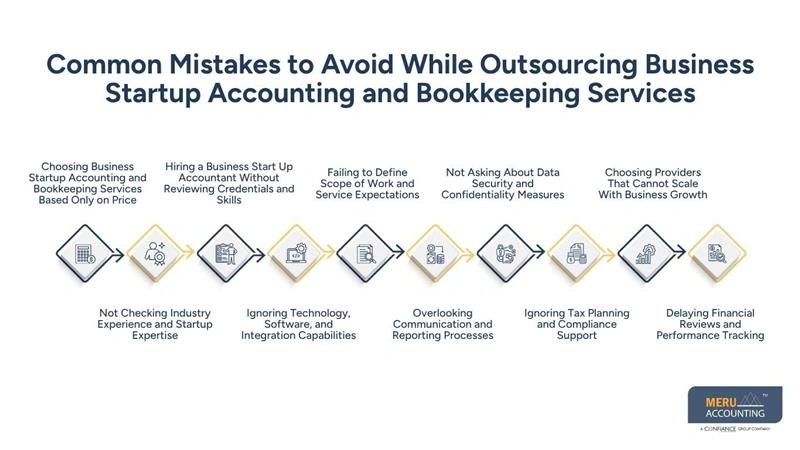
Mistake #6: Overlooking Communication and Reporting Processes
Good communication plays a major role in successful outsourcing relationships.
Some startups choose providers without discussing:
- Meeting schedules
- Reporting timelines
- Response times
- Contact methods
Poor communication may create delays and confusion.
Regular updates help startup owners stay informed about:
- Cash flow
- Expenses
- Revenue trends
- Tax deadlines
- Financial performance
Clear communication builds trust and supports better business decisions.
Mistake #7: Not Asking About Data Security and Confidentiality Measures
Accounting records contain sensitive business data.
This information may include:
- Revenue records
- Payroll data
- tax details
- customer payments
- banking information
If security measures are weak, businesses may face serious risks.
Ask providers about:
- Data encryption
- Secure file sharing
- Access controls
- Backup systems
- Security policies
Protecting financial information should always be a top priority.
Mistake #8: Ignoring Tax Planning and Compliance Support
Many startups think accounting only means recording income and expenses.
Tax planning is also a major part of financial management.
Poor tax support can lead to:
- Filing delays
- Penalties
- Missed deductions
- Compliance problems
Strong accounting support should include tax guidance and planning.
A good business start up accountant can help identify tax needs early and reduce future problems.
Mistake #9: Choosing Providers That Cannot Scale With Business Growth
A startup that has ten clients today may have hundreds next year.
Business needs often change as growth happens.
Some accounting providers work well for small operations but struggle when business activity increases.
As companies grow, they may need:
- More reports
- Payroll expansion
- Multi-state tax support
- Budget forecasting
- Financial planning
Choose business startup accounting and bookkeeping services providers that can grow with your business needs.
Mistake #10: Delaying Financial Reviews and Performance Tracking
Some startup owners assume accounting work only matters during tax season.
This approach can create major problems.
Regular financial reviews help businesses understand:
- Profit trends
- Cash flow status
- Expense patterns
- Revenue growth
- Financial risks
Without frequent reviews, problems may stay hidden for months.
Strong financial monitoring helps business owners make faster and better decisions.
Meru Accounting’s Business Startup Accounting and Bookkeeping Services
Starting a business comes with many financial tasks that need close attention from day one. Founders often spend most of their time on product growth, sales work, hiring, and customer needs. As the business grows, handling bookkeeping, payroll, taxes, and financial records can become harder to manage. At Meru Accounting, we help startups handle these financial tasks with reliable and organized support.
Our business startup accounting and bookkeeping services are built to help startup owners keep accurate records and gain a clear view of their finances. We know that every startup has different goals and financial needs, so our team gives support that fits each stage of business growth.
Our Services Include:
- Daily bookkeeping and transaction tracking
- Bank and account reconciliation
- Payroll processing and support
- Financial reports and statement preparation
- Tax preparation and compliance support
- Cash flow tracking and management
- Accounts payable and accounts receivable support
- Custom accounting solutions for startups
Our team works closely with clients to understand changing business needs and provide practical accounting support at every stage. Whether you need a trusted business start up accountant or a full finance support team, Meru Accounting helps build a strong base for long-term business success.
Our Expert Insight
Many startup owners focus on cost when choosing accounting support, but price should not be the only factor. The right partner should understand startup needs, provide clear reports, use the right tools, and support your business as it grows. Small gaps in financial work can turn into larger issues over time if they are not handled early.
From our experience, startups often get better results when they choose accounting support that fits both current goals and future plans. Strong financial records, steady reporting, and clear communication help business owners make smart choices and reduce risk as the company grows.
Key Takeaways
- Outsourcing accounting can save time and lower operating costs
- Choosing providers only because of low prices may create future risks
- Technology and system integration improve efficiency
- Communication processes should be clear from the start
- Data security should always be reviewed carefully
- Tax planning support helps avoid costly issues
- Scalable accounting services support long-term growth
- Regular financial reviews help improve decision-making
- The right accounting partner can strengthen startup success
FAQs
These services usually include bookkeeping, payroll support, tax preparation, financial reporting, expense tracking, and cash flow management.
A business start up accountant helps startups maintain accurate records, manage taxes, improve financial planning, and support business growth.
Yes. Outsourcing often reduces hiring expenses, training costs, employee benefits, and overhead costs.
Most startups should review financial reports monthly. Fast-growing businesses may need more frequent reviews.
Startups should review experience, industry knowledge, technology tools, security practices, communication methods, and growth support before selecting business startup accounting and bookkeeping services providers.