Construction payroll accounting requires more than paying workers on time. Contractors must record labor costs against the right projects, track overtime, account for payroll taxes, and match payroll records with job-cost reports. Even a small coding error can make one project look costly while another appears more profitable than it is.
A clear construction payroll accounting process links employee hours, pay rates, payroll entries, and project budgets. It also gives project managers and finance teams a sound basis for reviewing labor costs before they close the books each month.
What You Will Learn From This Blog
- Why construction payroll accounting needs accurate job-level records.
- How payroll-to-job-cost reconciliation connects payroll data with project costs.
- Which checks belong on a construction payroll accounting month-end checklist.
- What common errors affect labor costs and financial reports.
- How construction payroll solutions improve cost tracking and monthly close work.
- Which measures show whether payroll reconciliation is working well.
Construction Payroll Accounting Month-End Close Checklist
A set month-end routine keeps construction payroll accounting records complete and ready for review. Use this checklist before closing the ledger.
Verify Employee Hours, Pay Rates, and Overtime Calculations
Compare approved timecards with payroll records, check rate changes, and review overtime calculations. Confirm that each worker’s hours belong to the correct job and pay period.
Reconcile Gross Wages, Payroll Taxes, and Benefit Costs
Match gross wages, employee deductions, employer taxes, and benefit costs with payroll reports. Check that tax liabilities and benefit amounts are posted to the correct ledger accounts.
Review Job-Cost Allocations and General Ledger Entries
Compare project labor reports from construction payroll solutions with payroll totals and ledger entries. Check each cost code, correct misposted amounts, and confirm that total allocations match the costs recorded.
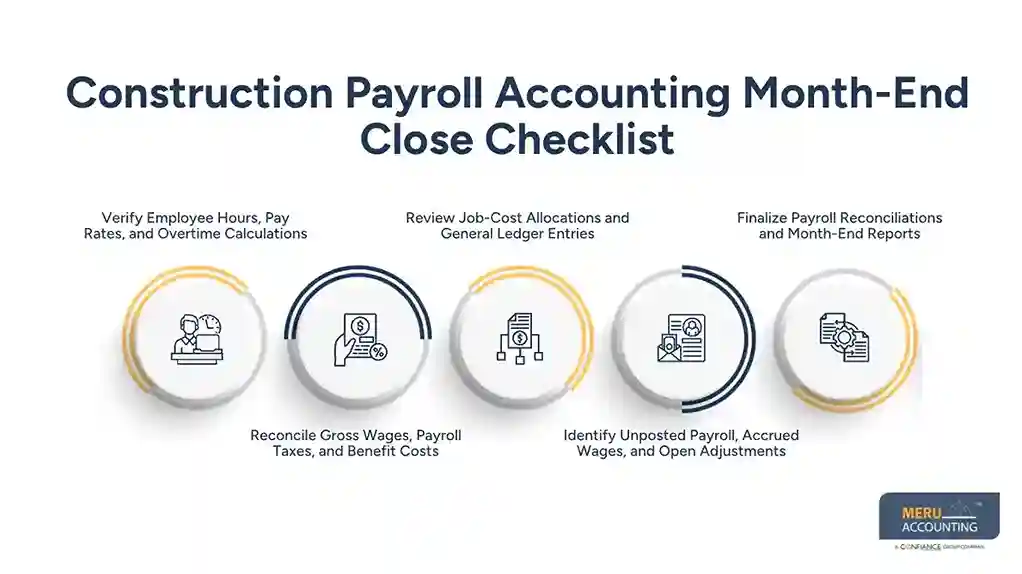
Identify Unposted Payroll, Accrued Wages, and Open Adjustments
Review work completed before month-end but paid in the next period. Record wage accruals when required under the firm’s accounting policy, and track pending corrections until they are approved and posted.
Finalize Payroll Reconciliations and Month-End Reports
Prepare a summary of payroll totals, job-cost differences, accruals, and open items. Have a reviewer approve key balances and retain the reports, time records, and correction notes.
optional anymore
on running the business
Why Construction Payroll Accounting Requires Job-Level Accuracy
Construction firms often run several jobs at once, with workers moving between sites, tasks, and pay rates. Construction payroll accounting must record these changes correctly.
- Workers Split Time Across Jobs: One employee may work on two sites in one week. Each shift needs the right project code to prevent labor costs from landing on the wrong job.
- Overtime Changes Labor Costs: Extra hours can raise payroll costs and may affect job budgets. Teams must check overtime rules and assign the added cost to the right project.
- Pay Rates Vary by Role: Skilled trades, site staff, and laborers may earn different rates. Accurate records keep each job’s labor cost in line with actual work.
- Job Codes Shape Cost Reports: A wrong phase or cost code can distort project reports. Clear coding lets managers compare actual labor costs with estimates.
- Payroll Records Affect Profit: Missing hours or wrong allocations can overstate one job’s profit and understate another’s. Accurate timecards and job-cost records show each project’s actual labor costs.
What is Construction Payroll Accounting and Why Does It Matter?
Construction payroll accounting records wages, overtime, payroll taxes, benefits, and other labor costs, then assigns them to the right projects and accounts. It connects payroll processing with job-cost records and the general ledger.
- Records Direct Labor Costs: The process captures wages for workers who perform site tasks. These costs can be traced to the job, phase, and cost code.
- Tracks Employer Payroll Costs: Employer taxes, benefits, and other labor charges may form part of total project cost. The accounting team must apply the firm’s cost policy consistently.
- Keeps Books Accurate: Payroll entries must match payroll reports and ledger balances. Regular checks reduce errors in monthly financial statements.
- Shows Project Performance: Managers can compare actual labor costs with budgets and spot cost overruns before they grow.
- Creates an Audit Trail: Timecards, payroll registers, approvals, and journal entries show how each labor cost was calculated and recorded.
How Payroll-to-Job-Cost Reconciliation Works in Construction
Payroll-to-job-cost reconciliation compares paid or accrued labor costs with the amounts posted to each project and the general ledger. Construction payroll accounting teams should follow a repeatable process.
- Collect Approved Time Records: Gather timecards, site logs, and supervisor approvals. Check that hours match the employee, work date, and job code.
- Match Hours With Payroll: Compare approved hours with payroll registers, pay rates, overtime, and gross wages. Investigate any difference before posting final costs.
- Assign Costs to Jobs: Split wages and related labor costs across the correct projects, phases, and cost codes. Use approved allocation rules when workers share their time.
- Compare Ledger Entries: Match payroll totals with wage expense, tax liabilities, benefit costs, and cash or payroll clearing accounts. Check that debits and credits balance.
- Resolve Differences: Trace gaps to missed hours, wrong codes, timing issues, or unposted entries. Record approved changes and keep evidence of each correction.
For example, if a worker spends 24 hours on Project A and 16 hours on Project B, the firm must split the worker’s labor cost using approved time records. Posting all 40 hours to Project A would distort both job reports.
Construction Payroll Accounting Month-End Close Checklist
A set month-end routine keeps construction payroll accounting records complete and ready for review. Use this checklist before closing the ledger.
Verify Employee Hours, Pay Rates, and Overtime Calculations
Compare approved timecards with payroll records, check rate changes, and review overtime calculations. Confirm that each worker’s hours belong to the correct job and pay period.
Reconcile Gross Wages, Payroll Taxes, and Benefit Costs
Match gross wages, employee deductions, employer taxes, and benefit costs with payroll reports. Check that tax liabilities and benefit amounts are posted to the correct ledger accounts.
Review Job-Cost Allocations and General Ledger Entries
Compare project labor reports from construction payroll solutions with payroll totals and ledger entries. Check each cost code, correct misposted amounts, and confirm that total allocations match the costs recorded.
Identify Unposted Payroll, Accrued Wages, and Open Adjustments
Review work completed before month-end but paid in the next period. Record wage accruals when required under the firm’s accounting policy, and track pending corrections until they are approved and posted.
Finalize Payroll Reconciliations and Month-End Reports
Prepare a summary of payroll totals, job-cost differences, accruals, and open items. Have a reviewer approve key balances and retain the reports, time records, and correction notes.
Common Construction Payroll Accounting Errors That Affect Job Costs
Errors often arise when payroll and project records use different data or follow different review steps. Construction payroll accounting teams should watch for these issues.
- Wrong Job or Phase Codes: Labor charged to the wrong project can distort budget reports. Review unusual costs and confirm codes with site supervisors.
- Missing or Duplicate Hours: Incomplete timecards and duplicate entries can change wage totals. Compare approved time records with payroll before final posting.
- Incorrect Overtime Costs: Wrong hours or pay rates may lead to incorrect wage expense. Check applicable federal and state rules, along with any relevant contract terms.
- Unrecorded Employer Costs: Missing payroll taxes or benefit costs can make a job appear less costly than it is. Reconcile all relevant labor charges.
- Late Payroll Entries: Entries posted in the wrong period can distort monthly results. Review pay dates, work dates, accruals, and adjustment status before closing.
How Construction Payroll Solutions Improve Job-Cost Tracking and Reconciliation
Construction payroll solutions connect payroll data with timekeeping, job-cost tools, and accounting records. Their value depends on accurate setup, clear review rules, and regular checks.
Integrating Payroll, Timekeeping, and Job-Cost Systems
Connected systems can transfer approved hours and job codes without repeated manual entry. Teams should test data links and review exceptions before relying on automated transfers.
Automating Labor Cost Allocation and Payroll Data Transfers
Construction payroll services can apply set allocation rules and send payroll totals to the ledger. Staff must still review unusual hours, rate changes, and rejected entries.
Tracking Labor Costs by Project, Phase, and Cost Code
Detailed cost tracking shows where labor spending occurs within each job. Managers can compare actual costs with budgets and investigate differences before the next report.
Improving Payroll Reporting and Month-End Accuracy
Consistent reports make it easier to match payroll totals with job costs and ledger balances. Construction payroll solutions can also flag missing codes and unmatched entries, while finance staff review and approve corrections.
How to Measure the Effectiveness of Payroll-to-Job-Cost Reconciliation
Use clear measures to evaluate whether construction payroll accounting and construction payroll solutions deliver accurate, timely, and consistent labor cost records across projects.
- Reconciliation Difference: Track the gap between payroll totals and job-cost postings. The target is zero unexplained difference after approved adjustments.
- Close Completion Time: Measure the number of days needed to finish payroll checks and reports. Compare results each month to find delays.
- Correction Rate: Count job-code changes, missing hours, and other payroll corrections. A falling rate may show that time entry and review steps are working better.
- Unposted Item Count: Track open payroll entries and accruals at close. Each item should have an owner, a reason, and a due date.
- Report Accuracy: Compare final job-cost reports with approved payroll and ledger records. Keep evidence of reviews and investigate repeated differences.
Construction Payroll Accounting Services From Meru Accounting
Meru Accounting provides accounting and bookkeeping services for construction businesses that need accurate labor cost records and reliable month-end reports. Our services focus on payroll entries, job-cost tracking, and account reconciliation.
- Payroll Expense Reconciliation: We review payroll reports against wage expense accounts, payroll tax liabilities, and related ledger entries to identify differences that need correction.
- Project Labor Cost Tracking: Our team reviews labor allocations across projects and cost codes to keep job-cost reports aligned with approved payroll records.
- Month-End Accounting: We prepare and review relevant accounting entries, accrued wage records, and reconciliation reports as part of the client’s month-end close process.
- Financial Record Review: We examine ledger balances and supporting records to identify missing entries, unusual amounts, and unresolved differences before reports are finalized.
- Accounting System Coordination: We work with the client’s existing accounting tools and established procedures to maintain consistent records across payroll, job costs, and financial reports.
Meru Accounting provides construction payroll accounting services based on each client’s business needs, reporting process, and accounting policies. Our focus is on clear records, accurate cost allocation, and timely financial reporting that gives construction businesses a better view of labor spending.
Our Expert Perspective
One common issue in construction payroll accounting is that total payroll may match the books while labor costs remain wrong at the project level. For example, if a worker splits time between two sites but all hours go to one job, the overall wage expense may be correct, yet both project cost reports will be misleading.
The best way to catch this issue is to compare approved timecards, payroll registers, and job-cost reports before month-end close. Review unmatched amounts, check cost codes, and record each correction with a clear reason. This approach gives contractors a more accurate view of labor costs and a sound basis for reviewing project budgets.
Key Takeaways
- Assign every worker’s approved hours to the correct project, phase, and cost code.
- Match payroll registers with job-cost reports and general ledger entries before closing the books.
- Review wages, overtime, employer taxes, benefits, and accrued labor costs each month.
- Record and explain all differences instead of carrying unexplained balances into the next period.
- Use construction payroll solutions with clear review steps and approved allocation rules.
- Track reconciliation gaps, close time, corrections, and open items to measure results.
- Retain timecards, payroll reports, approvals, and journal entries for future review.
FAQs
Reconcile construction payroll with job costs by matching approved work hours, wages, overtime, and labor allocations with project cost reports and general ledger entries.
Construction payroll accounting month-end close includes checking timecards, pay rates, overtime, payroll taxes, benefit costs, job-cost allocations, wage accruals, and ledger balances.
Allocate payroll costs to construction jobs using approved employee hours, pay rates, project codes, work phases, and cost codes recorded in timekeeping and payroll systems.
Differences between construction payroll and job-cost reports often result from incorrect job codes, missing hours, overtime errors, unposted entries, or unrecorded wage accruals.
Construction payroll solutions that connect time tracking, payroll processing, job-cost accounting, and general ledger systems can simplify labor cost allocation and reconciliation.
optional anymore
on running the business