Large companies manage a high volume of financial activities every day. From payroll and invoice tracking to tax reporting and budget planning, enterprise businesses must handle financial data across multiple departments and locations. Even a small error in financial records can affect cash flow, reporting accuracy, tax compliance, and business planning. To reduce these risks, many businesses use corporate bookkeeping software to maintain accurate and organized financial records. Modern software helps companies reduce manual work, minimize data errors, centralize financial information, and generate real-time reports.
Bookkeeping for enterprise companies involves much more than entering financial data. Businesses must monitor transactions across departments, track expenses, comply with tax regulations, and maintain records for audits. This is where advanced bookkeeping systems become important. Companies also use software for bookkeepers to improve coordination between accounting teams, managers, and external financial professionals. With the right system in place, businesses can improve efficiency while maintaining accurate financial records.
This blog explains how enterprise companies use modern bookkeeping systems to improve accuracy, simplify financial operations, and support long-term business growth.
What You Will Learn From This Blog
In this blog, you will learn:
- What corporate bookkeeping software means for enterprise businesses
- Why large companies rely on bookkeeping software for accuracy
- How software for bookkeepers supports large-scale financial operations
- Key benefits of using centralized bookkeeping systems
- Best practices for selecting the right bookkeeping software
- How Meru Accounting supports enterprise bookkeeping management
Understanding Corporate Bookkeeping Software
Corporate bookkeeping software refers to financial management systems designed to help medium and large businesses record, organize, store, and monitor financial transactions.
Unlike simple bookkeeping applications used by small businesses, enterprise systems are built to handle large transaction volumes, multiple users, branch-level financial data, payroll processing, tax reporting, and compliance requirements.
These systems help businesses maintain accurate financial records while reducing dependence on spreadsheets and manual accounting processes.
A modern corporate bookkeeping software system may include:
- General ledger management
- Accounts payable and receivable tracking
- Payroll processing
- Expense management
- Financial reporting dashboards
- Tax reporting support
- Audit trail tracking
- Multi-location financial management
- Data security and user access controls
Large businesses often operate across multiple regions or business divisions. Without organized bookkeeping systems, financial errors can increase quickly. A centralized software system helps businesses maintain consistency across departments while improving reporting accuracy.
Another major benefit is real-time financial visibility. Business leaders can access updated financial information immediately instead of waiting for manually prepared reports from different locations. This helps management teams make faster and better financial decisions.
Many businesses also integrate bookkeeping systems with ERP software, payroll platforms, banking systems, and inventory management tools. These integrations improve workflow efficiency and reduce duplicate data entry.
As financial operations become more complex, businesses need systems that support growth, compliance, and operational accuracy. This is why corporate bookkeeping software has become an important part of enterprise financial management.
Why Enterprise Companies Depend on Corporate Bookkeeping Software
Enterprise companies manage a large amount of financial activity every day. Handling these tasks manually can lead to reporting errors, delayed reconciliations, compliance risks, and operational inefficiencies. To avoid these problems, businesses use corporate bookkeeping software to improve accuracy, maintain control, and streamline financial processes.
Reducing Human Errors
Manual bookkeeping can result in duplicate entries, missing invoices, calculation mistakes, and reconciliation errors. These risks increase when businesses process thousands of financial transactions every month.
Automated bookkeeping systems reduce manual work and help businesses maintain accurate records through standardized workflows and automated checks.
Centralizing Financial Data
Large businesses often operate across multiple departments, branches, or business units. Financial information stored across different systems can create confusion and reporting delays.
Corporate bookkeeping software centralizes financial data in one platform. This helps accounting teams track expenses, approvals, budgets, and reports more efficiently.
Improving Financial Reporting
Enterprise businesses require detailed reports for management teams, auditors, investors, and tax authorities. Manual reporting takes more time and increases the possibility of inaccuracies.
Bookkeeping systems can automatically generate financial statements, cash flow reports, profit summaries, and balance sheets using real-time data.
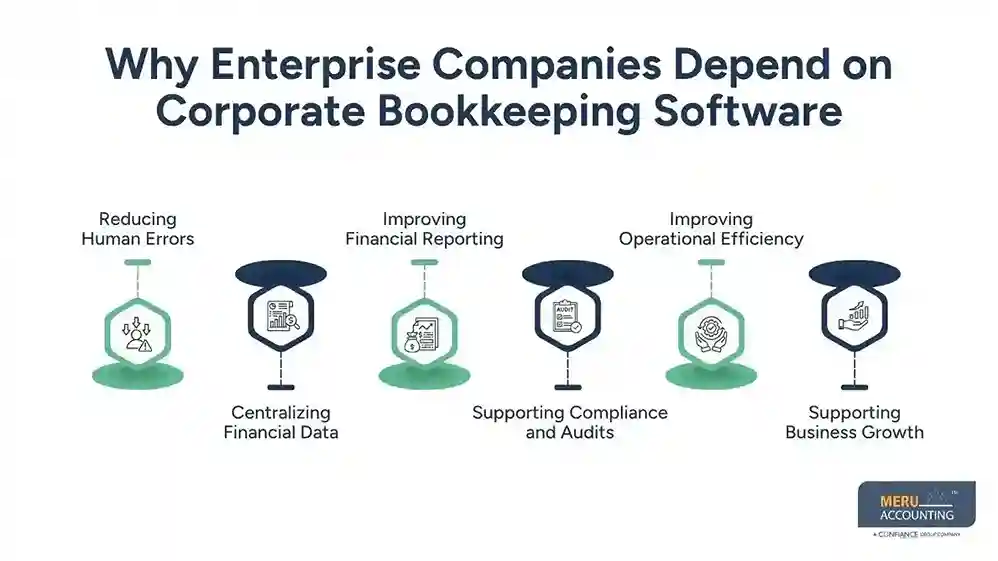
Supporting Compliance and Audits
Businesses must comply with tax regulations, accounting standards, and audit requirements. Poor financial records may lead to penalties and compliance risks.
Modern bookkeeping software maintains audit trails, approval records, and transaction histories that support compliance and simplify audit preparation.
Improving Operational Efficiency
Automated systems reduce repetitive tasks such as invoice matching, payment reminders, and bank reconciliations. Accounting teams can spend more time on analysis and strategic planning instead of manual processing.
Supporting Business Growth
As businesses expand, financial operations become more complex. Additional branches, international operations, and larger workforces require systems that can scale with the business.
Corporate bookkeeping software supports business growth by managing higher transaction volumes while maintaining accuracy and efficiency.
How Software for Bookkeepers Supports Large Business Operations
Enterprise bookkeeping requires close coordination between accounting teams, finance managers, payroll staff, auditors, and department leaders. Managing these responsibilities manually can slow operations and create communication gaps. This is where software for bookkeepers provides significant value for large businesses.
Faster Transaction Management
Bookkeeping systems help businesses process large numbers of transactions quickly and accurately. Automated categorization and bank reconciliation features reduce workload while improving consistency across records.
This helps accounting teams maintain organized financial records even during periods of high activity.
Improved Team Collaboration
Enterprise bookkeeping often requires multiple users to work within the same system. Accountants, auditors, and financial managers may all need access to reports and financial data.
Modern software allows role-based access, which means employees can only access the information related to their responsibilities.
Better Payroll Management
Payroll mistakes can impact employee trust and create compliance issues. Automated systems help businesses manage payroll calculations, deductions, tax filings, and payment records more accurately.
Integrated payroll features also help reduce manual corrections and reporting errors.
Real-Time Financial Insights
Business leaders need immediate access to financial data. Bookkeeping software provides live dashboards and updated reports that support faster decision-making.
Management teams can review cash flow, expenses, profitability, and operational costs in real time without waiting for manual reports.
Simplified Bank Reconciliation
Manual bank reconciliation can take a significant amount of time and increase the possibility of errors.
Software for bookkeepers helps businesses automatically match bank transactions with internal records, making it easier to identify discrepancies quickly.
Organized Vendor and Customer Records
Large businesses often manage relationships with many vendors and customers. Bookkeeping systems help organize invoices, payment records, account balances, and transaction histories in one place.
This improves payment tracking and financial transparency.
Better Audit Preparation
Accurate documentation is essential during audits. Bookkeeping software stores transaction histories, approval records, and supporting documents securely within one system.
This helps businesses complete audits more efficiently while reducing the risk of missing records.
Stronger Data Security
Financial information is highly sensitive. Modern bookkeeping systems use data encryption, secure backups, and user access controls to protect financial records from unauthorized access or data loss.
These security features also support compliance with financial and data protection regulations.
Best Practices for Choosing the Right Corporate Bookkeeping Software
Choosing the right bookkeeping software is an important decision for enterprise businesses. The wrong system can create workflow problems, reporting delays, and operational limitations.
Businesses should evaluate several important factors before implementing a bookkeeping solution.
Understand Business Requirements
Every business has unique financial operations. Some companies require advanced payroll integration, while others need stronger inventory or international accounting support.
Businesses should first identify their operational requirements, reporting goals, and compliance needs before selecting software.
Select Scalable Software
Business operations change over time. Companies should choose bookkeeping systems that can support increasing transaction volumes, additional employees, and future expansion.
Scalable software reduces the need for expensive system replacements later.
Evaluate Integration Capabilities
Bookkeeping systems should integrate smoothly with ERP software, payroll systems, CRM platforms, and banking applications.
Strong integrations reduce duplicate work and improve data consistency across departments.
Prioritize Ease of Use
Complicated software can slow employee adoption and increase training requirements. Businesses should choose systems with user-friendly dashboards, clear navigation, and simple reporting tools.
Easy-to-use systems improve productivity and reduce operational mistakes.
Review Data Security Features
Protecting financial data is essential for enterprise companies. Businesses should review security features such as:
- User access permissions
- Multi-factor authentication
- Data encryption
- Backup systems
- Audit tracking
Strong security systems help reduce financial and compliance risks.
Analyze Reporting Features
Enterprise businesses need accurate and customizable financial reports for planning, compliance, and performance analysis.
The software should provide detailed reporting features that support informed decision-making.
Assess Training and Customer Support
Software implementation and maintenance may require technical support. Businesses should choose providers that offer onboarding assistance, training resources, and reliable customer support.
Strong support services help businesses resolve issues more efficiently.
Test the Software Before Full Implementation
Before fully adopting a new system, businesses should test the software through pilot programs or trial implementations.
This allows organizations to identify workflow gaps and compatibility issues before company-wide deployment.
Meru Accounting’s Corporate Bookkeeping Services
Meru Accounting provides professional bookkeeping and accounting support designed for enterprise businesses and growing companies.
Managing bookkeeping internally can become difficult as transaction volumes increase and reporting requirements become more complex. Our team helps businesses maintain accurate financial records, improve reporting quality, and streamline financial operations using advanced bookkeeping systems and industry knowledge.
At Meru Accounting, we support businesses with:
- Bookkeeping system management
- Financial record organization
- Payroll and expense tracking
- Bank reconciliation support
- Financial reporting assistance
- Tax-ready bookkeeping processes
- Multi-location bookkeeping support
- Cloud-based bookkeeping solutions
Our team understands the operational challenges large businesses face while managing financial data across multiple departments and locations. We work closely with businesses to improve bookkeeping efficiency and maintain accurate reporting standards.
We also help businesses implement modern corporate bookkeeping software to reduce manual processes and improve operational performance.
By combining accounting expertise with technology-driven solutions, Meru Accounting helps enterprise businesses maintain stronger financial control and better operational visibility.
Our Expert Perspective
At Meru Accounting, we often see that large businesses face challenges not because of low revenue, but because they lack clear financial visibility. Small gaps in cash flow tracking, expense management, or profit reporting across departments can slowly create larger operational and financial problems over time.
Based on our experience, effective bookkeeping works best when financial records are accurate, updated regularly, and connected to daily business operations. A clear process for recording transactions, reviewing reports, and managing financial data across all business units helps reduce errors, improve cash flow management, and support long-term business growth with greater clarity and lower risk.
Key Takeaways
- Enterprise businesses manage large financial operations that require accurate bookkeeping systems.
- Corporate bookkeeping software helps reduce manual errors and improve reporting efficiency.
- Centralized bookkeeping systems improve financial visibility across departments and locations.
- Software for bookkeepers supports payroll management, bank reconciliation, audit preparation, and transaction tracking.
- Automated bookkeeping systems help businesses maintain compliance and improve operational efficiency.
- Businesses should select secure and scalable bookkeeping software for long-term growth.
- Meru Accounting helps businesses improve financial management and reporting accuracy through expert bookkeeping support.
FAQs
Corporate bookkeeping software is a financial management system that helps businesses record, organize, track, and manage financial transactions more accurately and efficiently.
Enterprise companies use bookkeeping software to reduce manual errors, improve reporting accuracy, automate financial processes, and manage financial data across multiple departments or locations
Software for bookkeepers improves accuracy by automating calculations, bank reconciliations, payroll processing, and transaction tracking, which helps reduce human error and maintain organized records.
Enterprise bookkeeping software should include financial reporting, payroll integration, bank reconciliation, audit tracking, multi-user access, data security, and scalability features.
Yes. Modern bookkeeping software can manage increasing transaction volumes, additional users, and expanding business operations while maintaining financial accuracy and operational efficiency.