
Managing one business site is already a hard task. Managing multiple stores at the same time brings even more financial stress. Multi-store firms often handle large amounts of daily sales, vendor payments, payroll records, tax filings, stock purchases, and running costs. Without a proper system in place, it becomes hard to maintain accuracy and control across all sites. With proper corporate bookkeeping, multi-store businesses can organize financial records, track results by site, lower reporting errors, and maintain steady financial visibility across every store. Whether a firm runs retail shops, food chains, service hubs, or franchise sites, maintaining structured financial records is vital for long-term growth.
Many multi-site firms also face gaps in communication between branch offices and the head office. Delayed reports, missing cost records, and uneven bookkeeping methods can lead to confusion and poor choices. Correct office bookkeeping practices help standardize systems and improve coordination between sites.
In today’s fast-moving business market, owners need correct financial data to make quick and smart choices. Let’s explore how reliable corporate bookkeeping services can improve cash flow management, track profit levels, prepare for taxes, and grow operations with greater confidence.
What You Will Learn From This Blog
In this blog, you will learn:
- The main financial challenges faced by multi-store firms
- Why corporate bookkeeping is vital for multi-site operations
- How bookkeeping helps track store-wise performance
- Ways firms can manage daily transactions well across sites
- How organized bookkeeping supports business growth and expansion
- How expert bookkeeping support from Meru Accounting can simplify financial management
Understanding the Financial Challenges of Multi-Store Businesses
Running many stores creates financial complexity that many growing firms underestimate. As the number of sites grows, so does the amount of financial data that must be tracked and organized.
Some common financial challenges include:
Inconsistent Financial Reporting
Different store managers may use different methods to record costs, sales, or stock transactions. This creates reporting gaps that make it hard to compare results across sites.
Without standard corporate bookkeeping systems, firms often struggle to prepare correct monthly or quarterly reports.
Difficulty Tracking Cash Flow
Multi-store firms usually deal with many bank accounts, payment systems, suppliers, and running costs. Tracking incoming and outgoing cash across all sites becomes hard without centralized bookkeeping systems.
Poor cash flow tracking may lead to delayed vendor payments, budget problems, or missed growth chances.
Inventory Management Issues
Stock is one of the biggest areas for retail and product-based firms. Tracking stock movement across many stores can become hard without correct bookkeeping records.
Errors in stock records may cause excess stock, stock shortages, or wrong profit calculations.
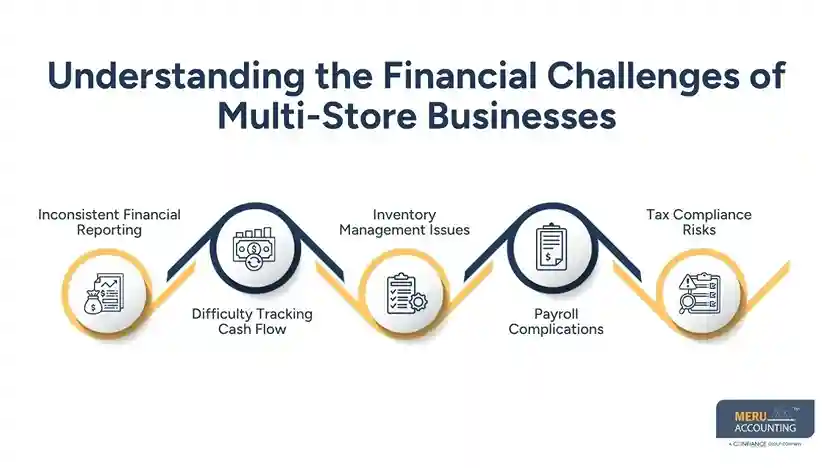
Payroll Complications
Firms working in many sites often manage large staff teams with different work plans, overtime rules, and payroll needs. Poor organization may lead to payroll errors or compliance issues.
Tax Compliance Risks
Multi-site firms may face different local tax duties based on where they work. Missing records or wrong reporting can create compliance problems and raise the risk of penalties.
Reliable office bookkeeping help firms maintain organized records for tax filing and audits.
Why Accurate Corporate Bookkeeping Matters for Multi-Location Operations
Corporate bookkeeping gives the foundation that multi-store firms need to work smoothly. It helps business owners maintain control over tasks while improving work transparency.
Better Financial Visibility
One of the biggest gains of structured bookkeeping is visibility. Business owners can view financial data from all sites in one place. This makes it easier to understand how the firm is performing overall and spot problem areas quickly.
With centralized financial reporting, management teams can:
- Track income trends
- Track running costs
- Review store-level profit
- Compare results across sites
- Study seasonal business trends
Improved Decision-Making
Accurate records allow business owners to make smart choices based on real data rather than guesses.
For example, corporate bookkeeping helps management determine:
- Which sites bring the highest profits
- Which stores need cost cuts
- When to grow into new markets
- Which products perform best in certain sites
Reliable bookkeeping reports help leaders plan well and lower financial uncertainty.
Easier Budget Management
Managing budgets across many stores needs correct cost tracking. Organized bookkeeping allows firms to create realistic budgets for each site while tracking actual spending.
This helps prevent overspending and improves financial discipline across departments.
Stronger Internal Controls
Multi-store firms are more open to accounting errors and misuse because of the large number of daily transactions involved.
Proper office bookkeeping procedures help establish stronger internal controls by:
- Recording transactions in a steady way
- Monitoring cash handling
- Tracking approvals for costs
- Lowering duplicate payments
- Detecting unusual financial activity
These controls help protect business funds and improve accountability.
How Corporate Bookkeeping Helps Track Store-Wise Financial Performance
Understanding how each store performs in financial terms is vital for business growth. Without store-specific financial reporting, owners may struggle to identify profitable sites or work problems.
Corporate bookkeeping makes store-wise tracking much more smooth.
Separate Financial Reporting for Each Store
A clear bookkeeping system allows firms to maintain separate records for each site while still creating combined reports for the whole firm.
This helps management review:
- Sales results
- Running costs
- Payroll costs
- Stock usage
- Profit margins
- Customer spending trends
Store-specific reporting allows business owners to compare sites correctly and make better work choices.
Identifying High-Performing Locations
Some stores naturally perform better than others because of site, customer demand, or management skill. Corporate bookkeeping helps identify these high-performing stores through detailed financial analysis.
Business owners can then use strong methods from top-performing stores to improve weak sites.
Detecting Financial Problems Early
Bookkeeping helps identify issues before they become major problems.
For example, firms can quickly detect:
- Rising running costs
- Falling sales trends
- Stock losses
- Poor cash flow
- Unusual transaction patterns
Early detection allows management teams to respond faster and lower financial risks.
Measuring Profitability Accurately
Many business owners focus heavily on sales numbers but overlook actual profits. A store may generate high sales while still producing low profits because of high running costs.
With the correct office bookkeeping approach, a store may get detailed reports that help in calculating true profits by tracking all costs linked with each site.
Managing Daily Transactions Efficiently Across Multiple Locations
Multi-store firms process large amounts of transactions every day. These transactions may include:
- Customer payments
- Supplier invoices
- Refunds
- Payroll entries
- Utility bills
- Stock purchases
- Tax payments
Without correct systems, transaction management can quickly become overwhelming.
Centralized Transaction Recording
Corporate bookkeeping helps firms maintain centralized records for transactions from all sites. This creates consistency and lowers the risk of missing or duplicate entries.
Centralized bookkeeping systems also improve reporting speed and financial accuracy.
Automated Financial Processes
Modern bookkeeping systems often connect with accounting software, point-of-sale systems, payroll tools, and banking platforms. Automation lowers manual work and improves speed.
Firms can automate:
- Bank reconciliations
- Invoice generation
- Cost categorization
- Payroll calculations
- Sales tracking
- Financial reporting
Automation also lowers human error and saves time for management teams.
Better Expense Tracking
Tracking costs across many sites is one of the most vital functions of office bookkeeping. Firms need accurate records of all the costs to maintain profits and control running costs.
Organized bookkeeping systems allow firms to monitor:
- Rent costs
- Staff costs
- Marketing costs
- Stock purchases
- Utility bills
- Equipment upkeep costs
This helps management identify wasteful spending and improve cost control.
Easier Bank Reconciliation
Reconciling bank accounts across many stores can be time-consuming without proper bookkeeping systems.
Corporate bookkeeping helps firms:
- Match transactions correctly
- Detect missing entries
- Identify bank errors
- Monitor cash balances
- Prevent accounting gaps
Regular reconciliation improves financial accuracy and strengthens cash management.
How Corporate Bookkeeping Helps Business Owners Scale with Confidence
Business growth needs strong management of finances. Firms that grow without proper bookkeeping systems often face work confusion, reporting delays, and cash flow problems.
Corporate bookkeeping supports business growth by creating scalable accounting systems.
Supporting Expansion Planning
Before opening new sites, business owners need clear business insights. Correct bookkeeping provides the business data needed to review growth chances.
Firms can study:
- Income growth trends
- Store profits
- Cash flow stability
- Running costs
- Available capital
This data helps management make smarter growth choices.
Improving Investor and Lender Confidence
Investors and lenders expect firms to maintain accurate records. Bookkeeping shows professionalism and financial stability.
Corporate bookkeeping provides reports that help firms:
- Secure funding
- Attract investors
- Support loan applications
- Show business health
Poor records often create concerns for banks and investors.
Enhancing Operational Efficiency
As firms grow, business operations become more complex. Organized office bookkeeping systems help firms maintain speed even as transaction volume grows.
Standard bookkeeping procedures improve communication between stores, accounting teams, and management.
Reducing Financial Stress
Business owners managing many stores often deal with constant pressure. Wrong records and delayed reporting create uncertainty and stress.
Reliable corporate bookkeeping provides peace of mind by ensuring financial data remains correct, current, and organized.
How Meru Accounting Helps Multi-Store Businesses with Corporate Bookkeeping Services
At Meru Accounting, we help multi-store businesses across the US and global markets maintain accurate, scalable, and audit-ready bookkeeping systems that support long-term growth. We provide expert corporate bookkeeping solutions designed to support growing multi-store firms. Managing money across many sites needs accuracy, consistency, and timely reporting, and our team helps firms maintain complete business organization.
Our bookkeeping experts understand the challenges faced by firms working through many stores, branch offices, or franchise sites. We help simplify financial management by creating streamlined bookkeeping systems tailored to each business structure.
Our corporate bookkeeping services include:
- Daily transaction recording
- Store-wise financial reporting
- Bank reconciliation
- Accounts payable and receivable management
- Payroll bookkeeping support
- Cost tracking and categorization
- Financial statement preparation
- Cash flow monitoring
- Stock-related bookkeeping support
- Tax-ready records
At Meru Accounting, we focus on helping firms maintain correct records while improving money visibility across all sites. Our office bookkeeping solutions support better reporting, improved work control, and smoother business growth.
By outsourcing bookkeeping duties to skilled experts, business owners can spend more time focusing on customer service, growth plans, and business success instead of dealing with complex administration.
Key Takeaways
- Multi-store firms face complex financial management challenges that need sorted systems.
- Corporate bookkeeping helps maintain records across many sites.
- Proper bookkeeping improves financial visibility, reporting accuracy, and decision-making.
- Store-wise reporting helps firms review profits and work results.
- Organized office bookkeeping supports better cost tracking and cash flow management.
- Centralized bookkeeping systems improve work speed and lower errors.
- Accurate records help firms grow with greater confidence.
- Expert bookkeeping support from Meru Accounting can simplify multi-site financial management.
FAQs
Corporate bookkeeping refers to the process of recording, sorting, and managing transactions for firms working through many sites. It helps maintain records across all stores.
Office bookkeeping helps firms sort daily tasks, maintain correct records, improve reporting consistency, and support better decision-making.
Corporate bookkeeping allows firms to maintain separate reports for each store. This helps management study sales, costs, profits, and work speed by site.
Yes. Bookkeeping lowers manual errors, improves transaction accuracy, supports bank reconciliation, and strengthens internal controls.
Outsourcing bookkeeping helps firms save time, improve accuracy, access skilled experts, and maintain accurate records without building a large in-house accounting team.