
Real Estate is one of the largest cost areas for many firms. From office space and warehouses to stores and other work sites, firms must track leases, vendors, site costs, and property data while also meeting key business goals. As Real Estate holdings grow, this work gets harder and needs more time, skill, and team support. Many firms now see that managing all Real Estate work in-house is not the best use of time or funds. In-house teams often deal with more work, new business needs, rising costs, and a need for clear facts that help guide plans. As a result, firms are looking for smart ways to improve results without adding more staff or cost. This shift has led to more use of corporate Real Estate outsourcing.
By working with skilled and professional teams, firms can handle Real Estate work efficiently. Outsourcing also gives in-house teams more time to focus on core business goals rather than routine site tasks.
As firms place more focus on speed, cost control, and growth, corporate Real Estate outsourcing is becoming a top choice in many fields. In this blog, we will see how it helps firms manage Real Estate work in a more efficient and cost-effective way.
What You Will Learn From This Blog
In this blog, you will learn:
- What corporate Real Estate outsourcing means
- The answer to the question, What is corporate Real Estate management
- Why firms are moving Real Estate work to outside teams
- The top benefits of this model
- How outsourcing helps improve workflow and cost control
- The role of accounts payable work in real estate
Understanding Corporate Real Estate Outsourcing
Corporate Real Estate outsourcing means a firm hires an outsourced team to handle some or all of its Real Estate work. The goal is to make work smoother, lower costs, and gain access to skills that may not be found in-house.
Real Estate work can cover a wide range of tasks. As firms grow, these tasks can place a heavy load on staff. An outsourced team can take over much of this work and help keep things on track.
Tasks that firms often outsource include:
- Lease administration
- Real Estate accounting
- Vendor management
- Facilities management
- Space utilization analysis
- Property data management
- Financial reporting
- Budget support
The use of corporate Real Estate outsourcing has grown because firms now face more change than ever. New sites, new lease deals, and new work styles all add to the load. An outside team can help a firm keep pace with these changes.
Another key benefit is scale. A firm may need more help one year and less the next. With outsourcing, it is much easier to scale support up or down as needs change. This gives firms more control over costs while still getting the help they need.
What Is Corporate Real Estate Management and Why Does It Matter?
Many firms ask, What is corporate Real Estate management, and why does it matter so much?
In simple terms, corporate real estate management is the way a firm plans, runs, tracks, and supports the sites and space it uses for work.
These sites may include:
- Office space
- Retail stores
- Warehouses
- Plants
- Labs
- Mixed-use sites
- Work hubs
The main goal is to make sure each site helps the firm meet its goals while keeping costs low.
Key tasks may include:
- Lease management
- Space plans
- Site upkeep
- Vendor control
- Cost tracking
- Risk checks
- Budget work
- Financial reporting
A good Real Estate plan helps a firm use space well. It can help lower costs, raise staff output, and support growth. A weak plan can lead to poor use of space, high costs, missed lease dates, and weak data.
That is why firms that ask what is corporate Real Estate management soon learn that it plays a key role in business success. Since these tasks take time and skill, many firms now use corporate Real Estate outsourcing to gain expert help and improve results.
Major Benefits of Corporate Real Estate Outsourcing for Enterprises
Lower Costs
One of the top reasons firms choose corporate Real Estate outsourcing is cost savings. An in-house team can be costly. Firms must pay wages, staff benefits, taxes, software costs, and training fees. These costs can add up fast. With outsourcing, firms gain the help they need while keeping costs under better control. Many firms find that they spend less while still getting strong support.
Access to Skilled Teams
Real Estate work takes skill and knowledge. Outsourced firms often have teams that work on lease administration, property data, accounts payable tasks, and financial reporting each day. This helps lower the risk of errors and can lead to better work quality.
More Flexibility
Business needs can shift fast. A firm may add sites, close sites, move staff, or enter new markets. An outside team can scale support up or down with less strain than an in-house team.
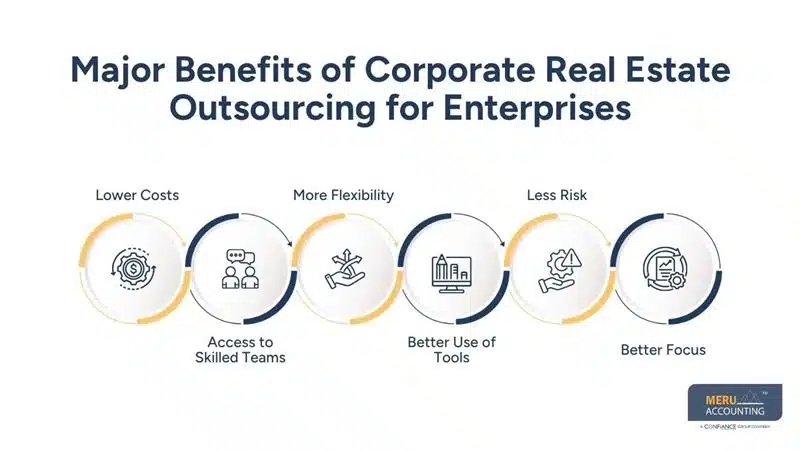
Better Use of Tools
Many service firms use modern tools to track site costs, lease dates, accounts payable tasks, and key data. Clients gain the value of these tools with no need to buy or run them on their own.
Less Risk
Real Estate work often has key due dates and lease terms. A skilled team can help track these items and lower the risk of missed tasks.
Better Focus
When staff spend less time on real estate work, they can focus more on sales, growth, client care, and other core goals. This helps firms gain more value from their teams.
How Corporate Real Estate Outsourcing Improves Enterprise Efficiency
Most firms use corporate Real Estate outsourcing because they want to work in a faster and more cost-effective way.
Faster Workflow
Outside teams use tested work steps. These steps help move tasks from one stage to the next with less delay. This helps firms save time and keep work on pace.
Better Data
Good data helps firms make smart choices. Outsourced teams often give clear reports that show lease facts, costs, and site trends. Leaders can then act with more trust in the facts.
More Time for Core Work
Real estate work can take many hours each week. When these tasks move to an outside team, staff gain more time to focus on work that helps the firm grow.
Better Vendor Management
Many firms work with a large group of vendors. These may include repair crews, site teams, lease groups, and trade firms. An outsourced team can help track vendor work and keep ties strong.
Strong Cost Control
Cost data is key to good planning. Corporate Real Estate outsourcing helps firms track spend, review bills, and keep a close watch on cash use. This can lead to less waste and better use of funds.
More Consistent Work
A firm with many sites may find it hard to keep work the same at each site. Outsourced teams use one set of work steps and checks. This helps create steadier results.
Better Growth Support
As firms grow, their real estate needs often grow as well. Outsourcing gives firms a way to add support with less effort than hiring and training new staff.
Key Benefits of Accounts Payable Outsourcing for Real Estate Companies
Accounts payable work plays a large role in real estate tasks. A Real Estate firm may get bills from site owners, trade crews, power firms, repair teams, and many more groups. When accounts payable work is slow or has errors, it can hurt cash flow and vendor trust.
This is why many firms choose to outsource this work.
Faster Invoice Processing
A trained team can sort, check, and pay invoices in less time. This helps keep work on pace and cuts delays.
Better Vendor Trust
Vendors want fast and correct payment. Good accounts payable support helps build trust and long-term ties.
Fewer Errors
A skilled team uses checks to help spot issues. This can cut repeat bills, wrong data, and poor payments.
Better Cash Flow
A clear view of bills due helps firms plan cash use. This can help avoid late fees and cash gaps.
Less Staff Load
Accounts payable work can take many hours. When it moves to a third-party team, staff gain more time for key tasks.
Better Records
Good accounts payable systems help keep records neat and easy to find. This helps with reviews, reports, and future plans.
For these reasons, many firms pair accounts payable support with corporate Real Estate outsourcing.
Why Choose Meru Accounting for Corporate Real Estate Outsourcing Services?
At Meru Accounting, we know that Real Estate work can place a heavy load on a firm’s team. Our Corporate Real Estate Outsourcing Services help firms save time, lower costs, and gain clear insight into their real estate work.
We help clients with:
- Real Estate accounting
- Lease administration support
- Accounts payable management
- Financial reporting
- Budget support
- Vendor management support
- Property data management
- Account review
Our team uses sound work steps and modern tools to help clients keep track of costs, lease facts, and key data. We work with each client to build a plan that fits their needs.
Whether you run a few sites or a large group of sites, our team can help make your real estate work more smooth and cost-wise. At Meru Accounting, our goal is to help firms gain more value from their real estate work while keeping costs low and work quality high.
With skilled staff, strong work steps, and a client-first view, we help firms improve output and support long-term growth.
Key Takeaways
- Corporate Real Estate outsourcing helps firms save time and lower costs.
- More firms now use outsourcing to manage real estate work.
- Knowing what is corporate Real Estate management helps firms make smart site and space choices.
- Outsourcing gives firms access to skilled teams and modern tools.
- Better data and cost control help firms work better.
- Accounts payable support can improve payment accuracy and vendor trust.
FAQs
Corporate real estate management is the way a firm plans, tracks, and runs the sites and space it uses for work.
More firms use corporate Real Estate outsourcing to save time, cut costs, gain expert help, and improve workflow.
Firms may outsource lease administration, Real Estate accounting, facilities management, vendor management, accounts payable management, and financial reporting.
Outsourcing helps speed up work, improve data flow, lower costs, and free staff to focus on core goals.
Yes. Small and mid-size firms can gain from skilled support, lower costs, more flexibility, and more time for growth.