Managing the books for one rental property is very different from managing the finances of a portfolio. Once several properties, loans, tenants, vendors, and legal entities are involved, a simple income-and-expense sheet no longer gives owners enough detail. A cpa for real estate businesses needs to structure financial data so each property can be reviewed on its own while the entire portfolio can still be reported as one business.
Consider a portfolio with six rental properties. The total rent may look strong, but one building could be losing cash because of high repairs, another may carry a large mortgage, and a third may have unpaid tenant balances. A consolidated number alone will not show these differences.
This is why property-level financial reporting matters. A cpa for real estate businesses can organize revenue, operating costs, fixed assets, debt, cash, and equity by property and then consolidate those figures into reports for owners, investors, lenders, and tax professionals.
The IRS also requires rental property owners to maintain records that substantiate income and expenses reported for tax purposes.
What You Will Learn From This Blog
- Why multi-property real estate businesses need property-level financial reporting.
- How a cpa for real estate businesses can structure accounting data for individual properties.
- Which financial reports matter most for owners, investors, and managers.
- How rental income and expenses should be assigned across properties.
- How a real estate accounting CPA can consolidate data without losing property-level detail.
- Which common reporting errors can distort property performance.
- How professional accounting services can create a more reliable reporting process.
Why Multi-Property Financial Reporting Requires Specialized Accounting
Different Properties Have Different Financial Results
Two properties can generate the same annual rent but produce very different net results. One may have high repair costs, while another may carry lower debt and stronger operating margins.
A cpa for real estate businesses reviews these differences at the property level instead of relying only on portfolio totals.
Property Debt Must Be Clearly Tracked
Mortgage balances, interest, principal payments, refinancing costs, and loan fees can vary across properties. If debt transactions are combined without clear property tracking, owners may struggle to determine the true financial position of each asset.
A cpa for real estate businesses can connect debt records to the correct property or legal entity.
Capital Spending Requires Proper Treatment
A new roof, major renovation, or building improvement may not be treated in the same way as a routine repair. The accounting and tax treatment can affect both current expenses and future depreciation.
A real estate accounting CPA can review major property costs and ensure the books distinguish routine maintenance from qualifying capital expenditure.
Portfolio Profit Can Hide Property-Level Problems
Suppose six properties produce $500,000 in combined operating income. That figure alone does not show whether one property is producing a loss or whether another is carrying most of the portfolio’s earnings.
Real estate accounting professionals can provide property-level reports so management can identify these differences before making investment or operating decisions.
Financial And Tax Reporting Have Different Purposes
Financial statements are designed to show business performance and financial position. Tax reporting follows specific tax rules that may differ from book accounting.
A cpa for real estate businesses can maintain detailed books that provide a sound base for tax reporting while keeping management reports useful for business decisions.
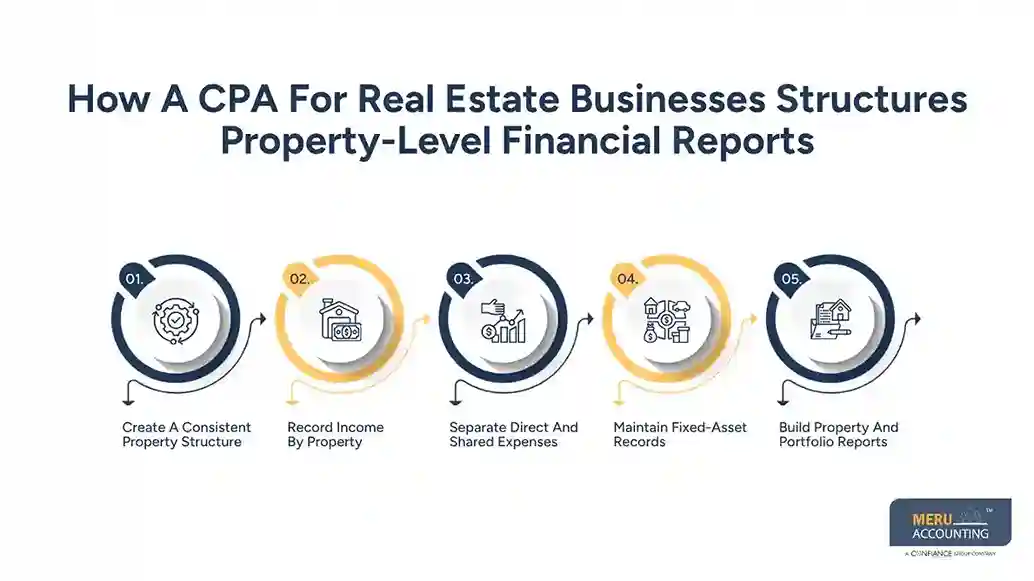
How A CPA For Real Estate Businesses Structures Property-Level Financial Reports
Create A Consistent Property Structure
Each property should have a unique code, class, location, project, or similar tracking field within the accounting system. A cpa for real estate businesses can use this structure to trace rent, repairs, insurance, taxes, utilities, and other transactions to the correct property.
Record Income By Property
Rental income should be assigned to the property that generated it. Other receipts, such as parking fees, storage income, late charges, or tenant reimbursements, should also be classified correctly.
This gives real estate accounting professionals a reliable base for preparing accurate property-level income statements.
Separate Direct And Shared Expenses
A plumbing invoice for Property A is a direct expense of Property A. A software subscription used by the whole portfolio is different and may need allocation.
A real estate accounting CPA can establish rules for shared expenses based on factors such as units, square footage, usage, or another reasonable basis.
Maintain Fixed-Asset Records
Property purchases and qualifying improvements need more detail than ordinary operating costs. Records should include purchase cost, improvement cost, date placed in service, and other relevant details.
Build Property And Portfolio Reports
Property-level reports should not replace consolidated reporting. Owners often need both.
A cpa for real estate businesses can prepare individual property reports and then consolidate the relevant figures into a portfolio-level view.
optional anymore
on running the business
Key Financial Reports For Multi-Property Real Estate Businesses
Property-Level Profit And Loss Statement
The property P&L shows revenue and operating costs over a defined period. It may include rent, vacancy, repairs, insurance, taxes, utilities, management fees, and other property costs.
A cpa for real estate businesses can use this report to compare operating performance across properties.
Balance Sheet By Property
The balance sheet provides information about assets, liabilities, and equity. For real estate, this can include property assets, cash, mortgages, payables, deposits, and equity balances.
A real estate accounting CPA can use property-level balance sheet data to review debt and asset positions across the portfolio.
Cash Flow Statement
Net income does not equal cash available. Loan principal payments and capital spending can reduce cash even when they do not appear as ordinary operating expenses on the income statement.
A cpa for real estate businesses can use cash flow reporting to show operating, investing, and financing cash movements.
Rent And Operating Expense Reports
Rent reports can show billed rent, collections, unpaid amounts, and tenant balances. Expense reports can show how much each property spends on repairs, insurance, taxes, utilities, and other costs.
A real estate accounting CPA can compare these figures over time and flag unusual changes for review.
Owner And Investor Reporting
Owners and investors usually need a concise view of revenue, expenses, net income, cash movement, debt, and major capital spending.
A cpa for real estate businesses can prepare reports that provide these figures in a format suited to monthly, quarterly, or annual review.
How Real Estate Accounting CPA Services Handle Income And Expenses Across Properties
Rental Income
The accounting treatment for rent depends on the accounting method used by the business. The IRS generally states that cash-basis taxpayers report rental income when received, while accrual taxpayers generally report it when earned.
A real estate accounting CPA can ensure the bookkeeping method is applied consistently to the property’s transactions.
Tenant Reimbursements
Tenants may reimburse owners for utilities, maintenance, or other costs under lease terms. These receipts should be classified based on what the payment represents.
A cpa for real estate businesses can review the lease terms and accounting treatment so reimbursements are not simply mixed with ordinary rent.
Repairs And Maintenance
Routine maintenance can include minor plumbing work, painting, cleaning, or similar costs. Major improvements may require different accounting and tax treatment.
A real estate accounting CPA can review larger invoices and maintain the supporting records needed for proper classification.
Shared Portfolio Expenses
A portfolio may have one accounting subscription, management team, insurance policy, or office cost serving multiple properties.
A cpa for real estate businesses can establish a consistent allocation method so shared costs are not placed entirely on one property.
Depreciation And Fixed Assets
Depreciation can have a major effect on real estate financial and tax reporting. Property type, cost basis, placed-in-service date, and applicable tax rules all matter.
A real estate accounting CPA can maintain the fixed-asset records needed to calculate and review depreciation. IRS Publication 946 provides guidance on depreciation rules for property used to produce income.
How To Consolidate Financial Data Across Multiple Properties
Standardize The Chart Of Accounts
If one property records repairs under one account while another uses several unrelated accounts, portfolio comparisons become difficult.
A cpa for real estate businesses can establish a consistent chart of accounts so similar costs are classified in a similar manner.
Use Property Locations
Modern accounting platforms often provide classes, locations, projects, or tracking fields. The exact setup depends on the software and business structure.
Real estate accounting professionals can select a structure that keeps property data separate while still allowing consolidated reporting.
Reconcile Bank Accounts
Bank reconciliation can identify missing deposits, duplicate payments, bank fees, outstanding checks, and timing differences.
A real estate accounting CPA can complete or review reconciliations before final monthly reports are issued.
Review Transfers Between Properties
Money moving between properties or entities should not automatically be treated as revenue or an expense. It may be an owner contribution, distribution, intercompany loan, or transfer.
Consolidate Only After Review
Consolidation should come after property-level records have been reviewed.
A cpa for real estate businesses can check each property first and then combine the approved figures into a portfolio report. This creates a cleaner reporting process.
Common Financial Reporting Mistakes In Multi-Property Real Estate Accounting
Mixing Expenses Between Properties
A repair for Property A should not be assigned to Property B simply because both are owned by the same business.
A cpa for real estate businesses can use property codes and transaction reviews to reduce this type of error.
Treating Improvements As Ordinary Repairs
Posting every large construction or improvement cost as a current expense can distort both profit and asset balances.
A real estate accounting CPA can review major projects and determine whether capitalization or depreciation treatment needs consideration under applicable rules.
Ignoring Balance Sheet Accounts
Focusing only on rent and operating expenses leaves out important information. Loans, security deposits, fixed assets, accounts payable, cash, and equity also need regular review.
A cpa for real estate businesses should examine these accounts as part of the reporting cycle.
Skipping Reconciliations
A report can look complete while still containing errors. Bank and loan reconciliations provide an important check against the accounting records.
A real estate accounting CPA can compare book balances with external statements and investigate material differences.
Changing Allocation Methods Without Reason
If shared expenses are divided using one method in one month and another method in the next, property comparisons become less reliable.
A cpa for real estate businesses can document the allocation method and apply it consistently unless there is a valid reason to change it.
Why Choose Meru Accounting For Real Estate Financial Reporting Services
Managing financial data across several properties requires clear records, consistent accounting rules, and reports that owners can review without sorting through every transaction. Our accounting services are structured around these needs, from property-level bookkeeping to multi-property reporting.
- We organize income, expenses, assets, liabilities, and cash activity by property for clearer financial review.
- Our team provides bookkeeping services for real estate businesses using consistent account and property classifications.
- We prepare multi-property financial reports that give owners a clear view of individual assets and the overall portfolio.
- We work with QuickBooks, Xero, Zoho Books, NetSuite, and Odoo to fit different accounting workflows.
- Our bank and credit card reconciliation process identifies unmatched transactions, duplicate entries, missing activity, and unusual balances.
- A cpa for real estate businesses can use properly maintained records for financial review, tax preparation, and year-end reporting.
- We structure accounting records for U.S. real estate businesses based on their property, entity, and reporting requirements.
With organized records and consistent reporting, owners can review property performance, cash activity, expenses, and financial positions with greater clarity. Our focus remains on maintaining accurate accounting records that are ready for regular management review and professional reporting.
Our Expert Perspective
A reliable multi-property report starts with properly classified property-level records, including income, expenses, bank activity, invoices, loans, and supporting documents.
A cpa for real estate businesses should review major changes in rent, repairs, expenses, and cash flow, while keeping operating profit separate from actual cash available after debt payments and capital spending.
The reporting process should also answer practical questions about property margins, rising costs, loan balances, and future capital needs so owners can make decisions based on clear and complete financial data.
Key Takeaways
- A cpa for real estate businesses can structure financial data at both property and portfolio levels.
- Each property should have clearly assigned income, expenses, assets, liabilities, and cash activity.
- P&L statements show operating results, while balance sheets show financial position.
- Cash flow reports provide information that profit reports cannot show on their own.
- A real estate accounting CPA can establish consistent rules for shared expenses and internal transfers.
- Bank, credit card, loan, and tenant balances should be reconciled on a regular basis.
- Major improvements should be reviewed before being classified as ordinary repairs.
- Consolidated reporting should follow property-level review.
- The IRS requires records that substantiate rental income and expenses.
FAQs
Real estate businesses should track income, expenses, assets, debt, and cash flow for each property before combining the results into portfolio-level reports.
The key reports are property-level profit and loss statements, balance sheets, cash flow statements, rent reports, expense reports, and owner or investor reports.
Financial statements can be consolidated by using a common chart of accounts, assigning transactions to each property, reconciling accounts, and then combining reviewed property-level data.
Shared expenses should be divided using a consistent and reasonable method based on factors such as property size, units, usage, or another relevant cost driver.
A CPA for real estate businesses is often useful when a portfolio has multiple properties, loans, entities, investors, or complex property-level reporting needs.
optional anymore
on running the business