
E commerce taxation can become hard to manage when an online store sells goods to buyers in many states. Each state can have its own rules for sales tax, nexus, tax rates, product types, filing dates, exemptions, and registration. A seller may also have tax duties even when there is no shop or office in the buyer’s state.
Good records make the process easier. A seller should track sales by state, check nexus rules, register when required, charge the right tax, and file returns on time. Ecommerce accounting services can also bring sales data, tax records, refunds, and accounting entries into one clear process.
What You Will Learn From This Blog
- How e commerce taxation works for online sellers.
- Why selling across states creates more tax work.
- What sales tax nexus means for an online store.
- How to find states where tax may be due.
- How economic nexus can affect remote sellers.
- How to check state registration rules.
- How to collect the right tax from buyers.
- How marketplace sales can affect tax duties.
- How to keep tax records in good order.
- How ecommerce tax compliance can reduce filing risk.
- How professional ecommerce accounting services can fit into the process.
What Is E Commerce Taxation?
E commerce taxation refers to the tax rules that may apply to online sales. Sales tax is usually added to the customer’s order and collected by the seller at checkout. The seller then sends the collected amount to the required state tax agency.
The tax duty can depend on the seller’s business activity, customer location, product type, sales channel, and state rules. Selling through a website does not remove sales tax duties. An online store may need to collect tax when its activities create a connection, known as nexus, with a state.
Nexus can come from physical business activity or from sales that cross a state’s economic threshold. Sales and use tax are also important parts of e commerce taxation. Sales tax may apply when a taxable product is sold, while use tax can apply when taxable goods are bought without sales tax and later used in a state.
Product tax rules can also vary by location, with items such as clothing, food, medicine, software, and digital goods receiving different treatment. Sellers should check the tax status of their products before setting up tax rules in their online store.
Why E Commerce Taxation Becomes Complex Across States
Different State Rules
Each state can set its own rules for remote sellers. A rule that applies in one state may not apply in another.
For this reason, online sellers should not use one tax rule for every state.
Different Tax Rates
Tax rates can vary by state, county, city, and other local areas. The rate may depend on where the customer receives the order. Accurate rate management is therefore a key part of e commerce taxation for online sellers.
Different Nexus Limits
States can set different sales or transaction limits for remote sellers. Some states use sales alone, while others may consider both sales and transaction counts.
Regular checks are needed because a growing store can cross a limit during the year.
Different Filing Dates
A state may require monthly, quarterly, or yearly tax returns. The filing cycle can also depend on the amount of tax collected.
A central tax calendar should show every return date and payment date.
Different Product Rules
A product may be taxable in one state and exempt in another. Some states may also have special rates or rules for certain goods.
Ecommerce accounting services can help businesses maintain product tax records as their product range changes.
More Sales Channels
Many sellers now use their own website, marketplaces, social platforms, and other sales channels. Each channel can produce different sales reports.
A single state tax review should bring these sales records together before a return is prepared. Bringing all channels together makes e commerce taxation easier to monitor and reconcile.
Understanding State Sales Tax Nexus For E Commerce Businesses
Physical Nexus
Physical nexus may exist when a business has a store, office, warehouse, employee, or other business activity in a state.
Inventory stored in a state may also matter. Online sellers should check their storage and staff setup before deciding that they have no state tax duty.
Economic Nexus
Economic nexus is based on business activity within a state. A seller may create nexus after crossing a state sales or transaction limit.
This means an online store can have tax duties in a state even without a local office.
Sales Thresholds
A state may set a sales amount that triggers registration and collection duties. The amount and period used for the test can vary. Understanding these thresholds is an important part of managing e commerce taxation for online sellers.
Ecommerce accounting services can support regular sales tracking and help businesses compare state totals with applicable nexus thresholds.
Transaction Counts
Some states may also consider the number of transactions made with customers in the state.
A seller with many small orders should therefore track both sales value and order count where needed.
Nexus Review
Nexus should be checked as the business grows. New warehouses, staff, trade events, fulfillment plans, and sales channels can change the result.
A monthly or quarterly review gives the business a better chance to act before a filing problem occurs. It also helps keep e commerce taxation requirements aligned with business growth.
How To Determine Where Your E Commerce Business Must Collect Sales Tax
List Business Locations
Start with every location linked to the business. Include offices, warehouses, storage sites, employees, and other places tied to sales activity.
This list helps establish the physical presence factors that affect e commerce taxation before remote sales are reviewed.
Track Sales By State
Create a report that shows sales by customer state. Include gross sales, taxable sales, exempt sales, refunds, and transaction counts where needed.
The report should cover every sales channel used by the business.
Check Nexus Limits
Compare monthly sales data with the rules for each state. Do not wait until a return is due to perform this check.
A good process can flag states that are getting close to a nexus limit.
Check Product Status
Review whether each product is taxable in the states where the store sells it. Keep a simple product tax table for this task.
The table can show the product name, state, tax status, and tax code.
Review Customer Location
Accurate customer location data is important for tax calculation. A full delivery address can provide the information needed by the tax system.
Poor address data can lead to the wrong state or local tax being charged.
Review Every Sales Channel
Marketplace rules can change who collects the tax, but they do not always remove every seller duty. Ecommerce accounting services can help reconcile sales records across these channels and keep tax-related information organized.
optional anymore
on running the business
State-By-State Sales Tax Registration Requirements
Find States With Nexus
First, identify the states where physical or economic nexus may exist. Keep a state list with the reason for registration.
This gives the business a clear record of why a tax account was opened.
Register Before Collection
Once a state requires registration, follow its registration process before collecting tax when the rules require it. Understanding e commerce taxation rules can help businesses determine when registration should begin.
Keep Permit Records
Keep copies of tax permits, account numbers, state notices, and registration confirmations.
Ecommerce accounting services can help organize permits, registration confirmations, state notices, and related tax records in one place.
Track Filing Frequency
Record the filing frequency for every registered state. Add the due date and payment date to one tax calendar.
The calendar should be updated when a state changes the filing schedule.
File Required Returns
Registration does not end the tax duty. A business may still need to file returns even when sales are low.
Some states may require a zero return when no tax is due, so filing rules should be checked. Such requirements are easy to overlook when e commerce taxation is managed across many states.
Close Old Accounts
If a business stops selling in a state, it should not simply stop filing. The state may require a formal account closure.
Professional ecommerce tax compliance work can include checking inactive accounts and required final returns.
How To Calculate And Collect Sales Tax Across Multiple States
Use The Customer Address
Tax calculation often depends on the place where goods are delivered. The store should capture a complete address before the final tax amount is set.
Accurate address data is key to state and local tax calculation.
Set Product Tax Codes
Each product should have the correct tax code in the store or tax system. The code should reflect the type of item being sold.
Review codes when products change, or new products are added.
Apply State and Local Rates
The tax system should apply the correct state and local rate based on the transaction details, which is essential for accurate e commerce taxation.
Manual rate entry can create errors when rates change, so sellers should use a reliable tax setup.
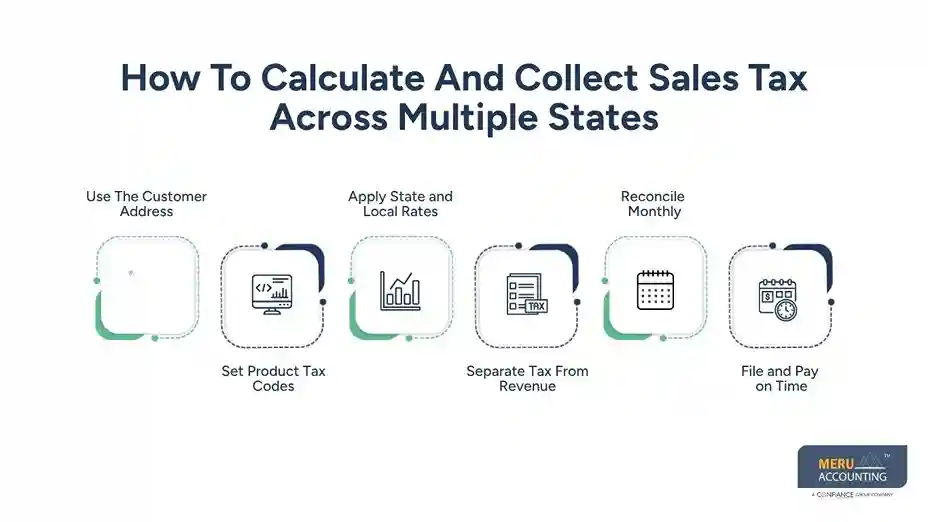
Separate Tax From Revenue
Sales tax collected from customers should be tracked as a tax liability rather than normal business income.
Separate records make it easier to know how much tax remains due to each state.
Reconcile Monthly
Compare store reports, payment reports, tax reports, refunds, and accounting records each month to maintain accurate e commerce taxation records.
A difference should be found and fixed before the related state return is filed.
File and Pay on Time
Prepare each return from verified records. Submit the return and payment by the required date.
Good ecommerce tax compliance requires correct collection, accurate reporting, and timely payment. Together, these practices support effective e commerce taxation management across multiple states.
Common E Commerce Taxation Mistakes To Avoid
Using One Tax Rate
Using one tax rate for every customer is a common error. State and local rates can differ, so a single rate may produce wrong charges.
Tax settings should be based on customer location and product rules.
Ignoring Economic Nexus
Some sellers check only for offices and warehouses. That can cause them to miss economic nexus created by remote sales.
State sales should be checked on a regular schedule.
Missing Marketplace Sales
Marketplace sales should not be ignored when reviewing state activity. A marketplace may collect tax, but the seller may still have registration or reporting duties.
Review marketplace reports along with direct website sales for a complete view of e commerce taxation activity.
Mixing Tax and Revenue
Tax collected should not be treated as normal sales income. Mixing these amounts can create poor financial records.
Separate tax accounts make reconciliation easier and give owners a clearer liability balance.
Missing Refund Adjustments
Refunds can change the tax amount that was collected. A return should account for refunds and other adjustments under the applicable state rules.
Failing to match refunds with tax records can cause overpayment or underpayment.
Filing Without Review
A return should be checked before submission. Compare sales, exemptions, refunds, tax collected, and prior adjustments.
Ecommerce accounting services can provide an additional review of sales, exemptions, refunds, and tax liabilities before filing.
Manage E Commerce Taxation With Meru Accounting
State Tax Tracking
Meru Accounting can organize sales by state and review possible nexus points. Our team can bring sales data into a clear tax tracking process.
Regular tracking can give business owners a better view of where e commerce taxation duties may arise across different states.
Accounting Data Review
Tax work depends on reliable sales data. Our team can compare store reports, payment records, refunds, fees, and accounting entries.
Ecommerce accounting services can reduce gaps between sales records and the books.
Filing Data Support
Each state return needs the right sales and tax figures to support accurate e commerce taxation reporting. We can organize the data needed for the filing process and maintain a clear due-date calendar.
Marketplace Sales
Online sellers may use several marketplaces along with their own store. Our team can organize these reports and separate marketplace-collected tax from tax collected through direct sales.
Monthly Reconciliation
Regular reconciliation can identify differences before they become larger problems. We can compare tax reports with sales and accounting records.
Ecommerce accounting services can make this monthly review part of a regular bookkeeping process.
Our Expert Perspective
From Our Expert Perspective, online sellers should not wait for a state notice before reviewing tax exposure. Sales growth, new fulfillment sites, staff, and new sales channels can change state obligations.
A monthly review of sales by state is a practical step for growing sellers. Ecommerce tax compliance should be treated as an ongoing task, not a once-a-year activity.
Key Takeaways
- Understand each state’s nexus, sales tax, product tax, registration, and filing rules before managing e commerce taxation obligations.
- Track sales, transactions, customer locations, refunds, and marketplace orders by state to spot new tax duties.
- Register for sales tax when physical or economic nexus creates a state filing and collection obligation.
- Use accurate customer addresses, product tax codes, and state rates to calculate the right tax at checkout.
- Keep sales tax collected separate from business revenue and reconcile tax records with sales and payment reports.
- Maintain a tax calendar for filing dates, payment deadlines, permits, state notices, and account updates.
- Review business changes, such as new warehouses, employees, products, or sales channels, because they can create new state tax duties.
- Use ecommerce accounting services when multi-state tax work becomes difficult.
- Maintain ecommerce tax compliance throughout the year rather than only at tax time.
FAQs
E commerce taxation refers to tax rules that apply to online sales. Depending on the state, an online seller may need to collect, report, and pay sales tax.
No. An online store does not always need to collect tax in every state. The duty depends on factors such as nexus, sales activity, product rules, and marketplace laws.
Economic nexus means that sales or transactions in a state can create a tax duty even when the seller has no office or store there. Each state can set its own threshold and rules.
A marketplace may collect and send sales tax for certain orders. However, sellers may still have registration or filing duties in some states. The seller should check the rules for each state.
Track sales by state, check nexus limits, register when required, use correct tax settings, reconcile tax records, and file returns on time. Ecommerce tax compliance requires regular checks as the business grows.
optional anymore
on running the business