
Bookkeeping is about keeping track of the amount you are earning and the amount of profit you are making. It helps you keep your money records clean and easy to understand. One big part of bookkeeping is learning about debits and credits in bookkeeping. It might seem hard at first, but once you learn it, it gets easy.
This blog will show you what debits and credits in bookkeeping mean, how to use them, and why they matter. By the end, you’ll see how simple it is to keep track of your money with these two helpful tools.
What You Will Learn From This Blog
By reading this blog, you will learn:
- What debits and credits mean and why they are the foundation of accurate bookkeeping.
- How debit and credit entries work in everyday business transactions.
- How different account types like assets, liabilities, equity, income, and expenses are affected by debits and credits.
- Why do bookkeeping services use the double-entry system to maintain accurate financial records?
- How proper bookkeeping helps reduce errors, simplify tax filing, prepare for audits, and support better business decisions.
What are Debits and Credits in Bookkeeping?
In bookkeeping, every time you work with money, you write down two parts. One part is called a debit, and the other is called a credit. These two sides must always be the same. This is called double-entry bookkeeping. You can think of it like a balance scale. If one side goes up, the other goes down. This helps keep your records neat, clear, and correct.
Here are the basics:
- Debit means money is going into something.
- Credit means money is going out of something.
Each time you do a business task, like buying paper for your office or getting paid by a customer, you write two entries:
- One as a debit
- One as a credit
This makes sure you always know what changed in your business.
How to Use Debits and Credits in Bookkeeping
In bookkeeping, we use debits and credits to write down every financial transaction. Think of them as two sides of a story.
You buy supplies with cash
- Debit: Supplies account (you now have more supplies)
- Credit: Cash account (you used money to pay)
You get paid for work
- Debit: Bank account (you now have more money in your bank)
- Credit: Sales account (you earned money)
You pay rent
- Debit: Rent expense account (you spent money on rent)
- Credit: Bank account (your bank balance went down)
You borrow money from a bank
- Debit: Bank account (you received money)
- Credit: Loan account (you now owe money to the bank)
You buy furniture on credit
- Debit: Furniture account (you now own furniture)
- Credit: Accounts Payable (you still need to pay later)
Using debits and credits in bookkeeping makes sure every move is recorded. It helps you see what you own, what you owe, and how your money is being used.
optional anymore
on running the business
How Debits and Credits Work
To understand debits and credits in bookkeeping, you need to learn about five main parts of accounting. These help you know how to organize your money records.
Assets
Assets are things your business owns. These can be cash, tools, computers, buildings, or furniture. When you get more assets, that’s a debit. If you use or lose assets, that’s a credit.
Liabilities
Liabilities are the things your business owes to others. This could be a bank loan, an unpaid bill, or the money you need to give back. Credit is when you borrow money because you now owe more. When you start paying it back, that’s a debit because your debt goes down.
Equity
Equity means how much your business is worth after you pay off everything you owe. If the owner puts more money into the business, that’s called an equity credit. It shows the business is growing and becoming more valuable to the owner.
Income
Income is the money your business makes when you sell something or provide a service. When your business earns money, you record it as a credit because it adds more value to your business.
Expenses
Expenses are the things you spend money on to keep your business running. This includes rent, paying workers, buying tools, or getting supplies. These are called debits because they lower the money your business keeps.
Recorded as debits because they lower how much money your business keeps. When you use debits and credits in bookkeeping, you always write down two parts of every transaction. For example, if you buy a chair with cash, you record the chair as a debit and the cash spent as a credit. This keeps your books balanced and helps you know exactly what happened with your money.
Importance of Debits and Credits in Bookkeeping Services
Understanding debits and credits in bookkeeping services is very important for any business. Here are some reasons why:
Keeps Books Balanced
Your total debits must always match your total credits. This keeps your bookkeeping balanced, just like a scale. If one side is off, something is wrong.
Helps Track Money
Debits and credits show where your money is going and coming from. This helps you plan better and know how to spend your money wisely.
Makes Reports Easy
If your records are written properly using debits and credits, you can make business reports easily. Reports like profit and loss statements and balance sheets help you see if your business is doing well.
Helps File Taxes
When your books are clean and balanced, it’s much easier to file taxes. You’ll know exactly how much money you made and how much you spent.
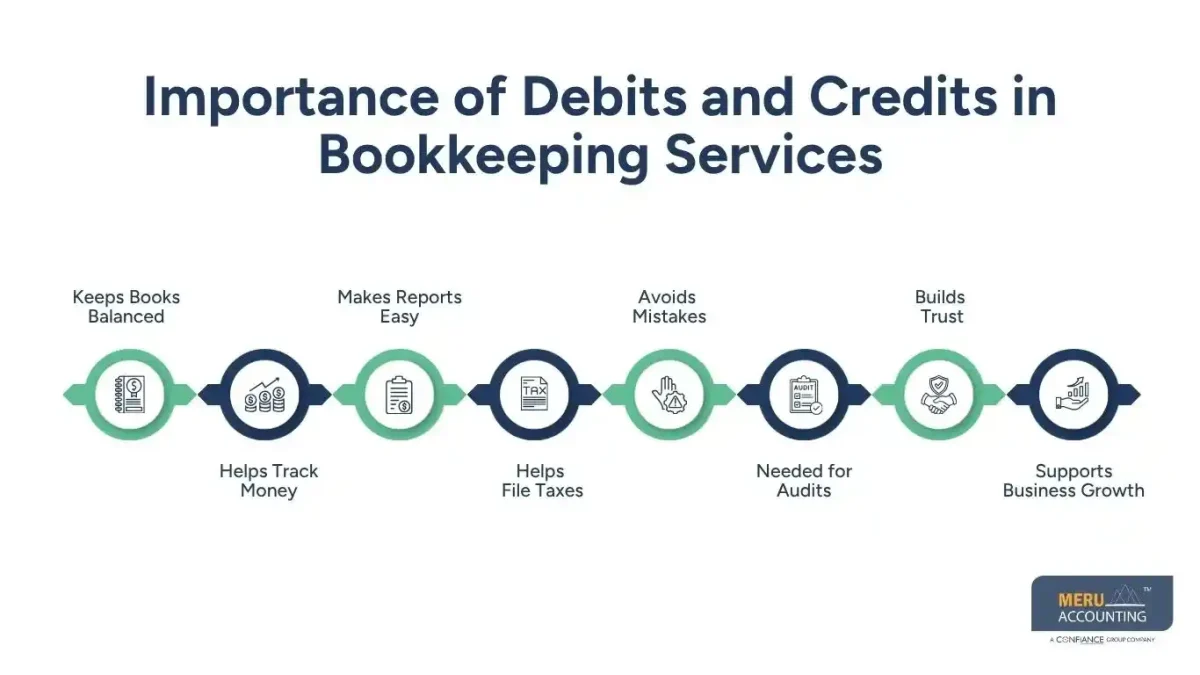
Avoids Mistakes
If your debits and credits don’t match, it means something might be wrong. This helps you catch mistakes early. You can fix them before they turn into bigger problems.
Needed for Audits
Sometimes, a tax officer or accountant might want to check your money records. They will look at your debit and credit entries to see if everything is correct. This shows that you are following the rules and being honest.
Builds Trust
When your records are neat and correct, people trust your business more. Banks, partners, and customers feel safe working with you when they see your books are well-managed.
Supports Business Growth
Knowing how debits and credits in bookkeeping services work helps you understand your business better. When your financial records are clear, it’s easier to grow, plan, and make smart choices for the future.
Debits and credits in bookkeeping services may sound tricky at first, but they are just tools to show what happens to your money. Every time you spend, earn or move money, debits and credits help you record it the right way.
Learning how to use them keeps your business safe, smart, and strong. When you keep your records clean and clear, you don’t have to worry about tax season or audits. You will always be ready.
If you need help with bookkeeping services or want someone to do it for you, Meru Accounting is here. We work with small businesses and know how to use debits and credits in bookkeeping the right way. Let us help you keep your books organized and help your business grow with our bookkeeping services.
Our Expert Insight
Accurate bookkeeping is not just about recording transactions—it is about maintaining a balanced financial system that supports confident business decisions. Professional bookkeeping services apply the principles of debits and credits consistently to ensure every transaction is recorded correctly, reducing errors and improving financial transparency. When your books remain accurate and up to date, you gain reliable reports, smoother tax compliance, and a stronger foundation for long-term business growth.
Key Takeaways
- Debits and credits are the core of the double-entry bookkeeping system and keep financial records balanced.
- Every business transaction requires both a debit entry and a corresponding credit entry.
- Different account types increase or decrease based on specific debit and credit rules.
- Professional bookkeeping services help maintain accurate records, identify errors early, and simplify financial reporting.
- Well-managed books improve tax preparation, audit readiness, cash flow tracking, and overall business decision-making.
- Consistent and accurate bookkeeping creates a solid financial foundation that supports sustainable business growth.
FAQs
Because each action in business has two parts: what you get and what you give. Using both helps show the full story.
No. It depends on the account type. A debit in expenses means you spent money. But a debit in assets means you own more.
Not always. You can use software like Xero, QuickBooks, or Zoho Books. These tools help you record debits and credits automatically. You can also get help with our bookkeeping services, and we’ll take care of the rest.
That means there’s a mistake. Go back and check your entries. A number might be wrong or missing.
Yes! We help set up your bookkeeping system, record your data, and keep everything balanced. We are experts in debits and credits with our bookkeeping services.