
Ecommerce businesses selling on platforms like Amazon, Shopify, Flipkart, and WooCommerce often struggle with scattered financial data, as each channel generates separate records for sales, fees, returns, and taxes. Ecommerce accounting services solve this by consolidating all financial information into one system, ensuring every transaction is recorded accurately and reflected in a clear financial view.
Without a proper accounting structure, businesses often deal with mismatched data, incorrect tax calculations, and poor cash flow visibility. These issues can lead to wrong business decisions and financial stress over time.
Ecommerce accounting services help reduce these problems by improving accuracy, maintaining consistency across channels, and giving business owners a clear view of overall performance.
What You Will Learn From This Blog
- How selling on multiple platforms increases financial complexity and makes data management difficult
- The role of structured accounting systems in supporting online business growth and stability
- Common challenges ecommerce businesses face while managing sales, expenses, and financial records
- How automation helps improve accuracy and reduce manual effort in financial reporting
- Practical ways to reduce errors in sales tracking, expense recording, and tax calculations
- Why compliance with tax laws is important for online businesses operating across regions
- Key benefits of using professional accounting support for ecommerce sellers to improve efficiency and control
Introduction To Ecommerce Accounting Services
Ecommerce accounting services help businesses record and manage financial transactions across multiple online platforms. This includes handling sales, refunds, shipping costs, and platform fees in a structured way. Proper tracking ensures that financial records remain clean, accurate, and easy to understand, which is important for day-to-day decision-making.
Organized financial data also helps business owners clearly understand profit margins and overall performance. It supports better decisions related to pricing, inventory control, and cost management. Along with this, these services play an important role in daily operations by managing tasks such as bank reconciliation and expense tracking, which reduces manual work and improves accuracy.
As businesses grow, ecommerce accounting services help scale financial processes without confusion or errors. They also integrate with platforms like Shopify and Amazon, allowing real-time updates and faster reporting. This integration ensures smoother financial management and better control over expanding operations.
Why Multi-Channel Selling Creates Financial Complexity
Different Platforms, Different Reports
Selling on multiple ecommerce platforms creates separate and unconnected data sets for each channel.
Every platform has its own reporting structure, format, and timing, which makes it difficult to combine and analyze financial information in one place.
Fee Structures And Hidden Costs
Each marketplace applies different types of fees, such as commission, shipping charges, and service costs.
Tracking all these manually increases the chances of missing important expenses and leads to incorrect profit calculations over time.
Inventory Synchronization Issues
Stock levels must be continuously updated across all sales channels to avoid confusion.
Without a proper system in place, businesses may face problems like overselling products or running into unexpected stockouts.
Tax Differences Across Regions
Different regions and countries follow different tax rules, rates, and compliance requirements.
Managing all these variations manually increases the risk of errors and can lead to serious compliance issues.
High Transaction Volume
Large order volumes generated from multiple channels make manual bookkeeping difficult and unreliable.
Ecommerce accounting services help manage this high flow of transactions efficiently and ensure accurate financial records.
Role Of Ecommerce Accounting Services In Streamlining Financial Operations
Centralized Financial Management
Ecommerce accounting services bring all sales channels and financial data into a single unified system for better control. This helps businesses clearly view overall performance without switching between multiple platforms.
Real-Time Reporting
Live reporting allows business owners to track profit, loss, and expenses instantly and more accurately. This improves decision-making speed and helps in responding quickly to business changes.
Automated Reconciliation
Transactions are automatically matched with bank statements and payment gateways in a structured way. This reduces manual errors, saves time, and improves accuracy in financial records.
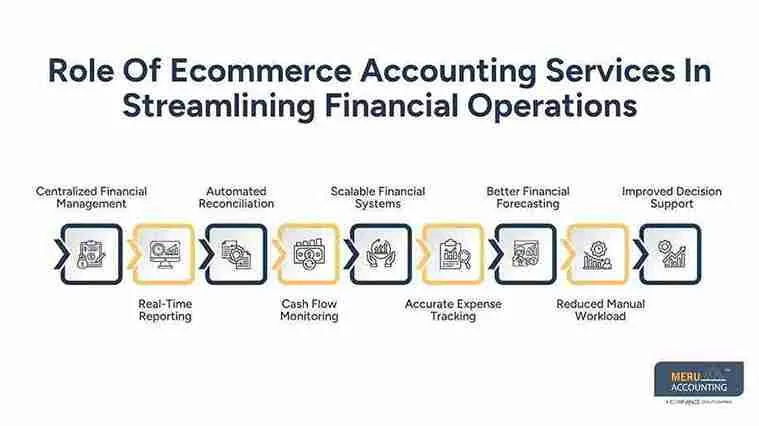
Cash Flow Monitoring
Proper tracking of cash inflow and outflow helps maintain financial stability in daily operations. Businesses can plan expenses, investments, and payments in a more controlled manner.
Scalable Financial Systems
As the business grows, e-commerce accounting solutions adjust easily to higher transaction volumes and new sales channels. This ensures smooth financial management without disruption during expansion.
Accurate Expense Tracking
All business expenses, such as advertising, shipping, packaging, and platform charges, are recorded in a structured way. This helps businesses understand true cost and improve profit margins.
Better Financial Forecasting
Historical sales and expense data are used to predict future revenue trends. This supports better planning for inventory, budgeting, and business expansion decisions.
Reduced Manual Workload
Automation reduces the need for repetitive manual bookkeeping tasks across multiple platforms. This allows business owners to focus more on growth and operations instead of data entry.
Improved Decision Support
Clear and updated financial reports help business owners make faster and more confident decisions. It becomes easier to identify profitable channels and areas that need improvement.
Key Challenges In Multi-Channel Sales Accounting
Data Fragmentation Across Platforms
Sales data is scattered across different ecommerce systems and marketplaces without a single view. Consolidating it manually is time-consuming, complex, and highly prone to human errors that affect reporting accuracy.
Difficulty In Profit Calculation
Different platform fees, discounts, refunds, and shipping costs make profit tracking more complicated than expected. Ecommerce accounting services help standardize this process to calculate true and consistent profitability.
Inventory Management Errors
Incorrect or delayed stock updates across channels can easily lead to overselling or lost sales opportunities. Over time, this also creates financial losses and affects customer trust.
Tax Filing Confusion
Different tax rules across sales channels and regions create confusion during filing periods and increase compliance risks. Missing or incorrect tax data can also lead to penalties and audits.
Lack Of Financial Visibility
Without a proper accounting system, business owners cannot clearly see overall performance across all platforms. This makes it harder to plan growth, control costs, and make informed decisions.
How E-Commerce Accounting Solutions Simplify Financial Management
Automated Data Integration
E-commerce accounting solutions connect all sales platforms such as Amazon, Shopify, and other marketplaces into one unified system. This removes the need for manual data entry and reduces the chances of reporting errors.
Simplified Expense Tracking
All business-related expenses, including shipping charges, advertising costs, packaging, and platform fees, are recorded in a single system. This helps businesses clearly understand their total costs and improve cost control.
Accurate Revenue Reporting
Revenue is calculated after adjusting platform commissions, refunds, discounts, and service fees. This provides a more realistic and accurate picture of actual business profit.
Multi-Currency Handling
For global ecommerce sellers, transactions in different currencies are automatically converted into a single reporting currency. This reduces confusion and ensures consistency in financial records.
Better Financial Forecasting
Historical sales and expense data are analyzed to identify trends and patterns in business performance. This helps in planning future growth, inventory needs, and financial strategies more effectively.
Reducing Errors And Improving Accuracy In Accounting Processes
Elimination Of Manual Entry
Manual data entry often leads to mistakes such as duplicate records, missing transactions, or incorrect figures.
Ecommerce accounting services reduce these risks by using automation to capture and record financial data directly from sales platforms.
Consistent Data Updates
Financial systems update information in real time across all connected channels. This helps maintain consistency in records and avoids mismatched or outdated data during reporting.
Error Detection Systems
Built-in validation tools and checks help identify mismatches, missing entries, or unusual transactions at an early stage. This improves data reliability and reduces the chance of reporting errors.
Improved Audit Readiness
Well-structured and accurately maintained financial records make audit processes smoother and faster. Businesses can easily provide the required reports without last-minute corrections or confusion.
Better Financial Control
Accurate and updated financial data helps business owners monitor spending more effectively. This improves cost control, strengthens profit margins, and supports better financial planning.
Tax Management And Compliance In Multi-Channel Ecommerce
Handling Multiple Tax Rules
Each sales region and marketplace follows its own tax structure, rates, and compliance requirements. E-commerce accounting solutions help manage these variations correctly by applying the right tax rules to each transaction.
GST And Sales Tax Tracking
Proper systems automatically track GST, VAT, and sales tax for every order across different channels. This ensures correct tax calculation and reduces the chances of misreporting.
Filing Accuracy
Accurate financial records support correct tax filing without missing or duplicated entries. This helps businesses avoid penalties, notices, and unnecessary corrections during filing periods.
Compliance With Global Standards
Businesses selling across countries must follow different tax laws and reporting standards. Structured accounting systems help maintain compliance with these global requirements in an organized way.
Audit Support
Clear and well-maintained financial records make audit processes easier and less time-consuming. Businesses can quickly provide required documents without confusion or last-minute stress.
Benefits Of Using Professional Ecommerce Accounting Services
- Improved financial clarity helps business owners understand income, expenses, and overall profitability in a simple and organized way.
- Better decision-making becomes possible as accurate financial data supports pricing strategies, marketing planning, and business expansion choices.
- Time savings are achieved because automation reduces the need for manual bookkeeping and repetitive data entry work.
- Reduced financial risk is ensured as structured systems help minimize errors, prevent fraud, and improve record accuracy.
- Business growth support is provided as ecommerce accounting services allow companies to scale operations without financial confusion or reporting issues.
How Meru Accounting Supports Ecommerce Businesses
- Meru Accounting provides structured financial support for online sellers by offering ecommerce accounting services that are tailored to specific business needs and sales models.
- Multi-platform accounting support is delivered by integrating data from Amazon, Shopify, and other ecommerce channels into one unified system for clear financial visibility.
- At Meru Accounting, our team consists of experienced finance professionals with strong knowledge of global ecommerce operations, accounting practices, and taxation rules.
- Modern accounting tools are used to enable real-time reporting and accurate reconciliation, which helps reduce manual work and improves efficiency.
- Strong tax and compliance support is provided to ensure accurate filing and adherence to both local and international regulations.
- Scalable financial solutions are delivered so that e-commerce accounting solutions can grow alongside the business without interruption or loss of accuracy.
Our Expert Perspective
From practical experience working with online sellers, one clear point stands out: most financial issues in ecommerce do not come from low sales, but from weak accounting systems. When businesses adopt structured ecommerce accounting services, better control over cash flow is achieved, errors are reduced, and long-term financial planning becomes more reliable.
In real cases, sellers who shifted from manual tracking to structured systems experienced a noticeable reduction in accounting errors and gained much clearer visibility into their profit and loss. This shift shows how important proper financial systems are for stable ecommerce growth.
Key Takeaways
- Multi-channel selling increases financial complexity and makes data management more challenging
- Manual accounting often leads to errors, delays, and inconsistent financial records
- Automation helps improve accuracy, reduces manual work, and saves valuable time
- Tax rules vary across regions and require structured tracking for correct compliance
- Ecommerce accounting services improve financial clarity and help maintain organized records
- E-commerce accounting solutions support better decision-making through accurate and timely data
- Professional accounting support helps ecommerce businesses scale safely and manage growth with control
FAQs
Ecommerce accounting services help online sellers record sales, expenses, taxes, and fees from platforms like Amazon, Shopify, and Flipkart in one system. This gives a clear view of total profit and cost.
E-commerce accounting solutions combine data from Amazon, Shopify, and other platforms into one financial report. This helps avoid confusion caused by separate sales reports.
Multi-channel sellers deal with different fees, taxes, and stock updates on each platform. Ecommerce accounting services help organize all this data and reduce mistakes in reporting.
Manual accounting needs data entry from each platform, which can lead to errors. Ecommerce accounting services use systems that automatically collect and match financial data.
Yes, e-commerce accounting solutions help track taxes from different regions and platforms. This makes tax filing more accurate and reduces the risk of penalties.