
You want to know if you’re making a profit, spending too much, or growing your work. To get their best business, they are now shifting to financial ratios in accounting. These ratios are like smart tools. They take your big money numbers and turn them into simple facts. These facts tell you if your business is doing well or if there’s a problem. You don’t need to be a math expert.
Even a small business owner or student can learn to use them. In this guide, you will learn what financial ratios in accounting are, why they matter, and how they help people make smart choices.
What You Will Learn From This Blog
- What financial ratios and accounting ratios are, and how they help you read your business numbers.
- The main types of financial ratios and what each one tells you about your business.
- How financial ratios help you check profit, cash, debt, and business growth.
- Who uses accounting ratios and why they matter to business owners, lenders, managers, and investors.
- How to use financial ratios to spot issues early and make better business choices.
- Simple ways to start using financial ratios to track business health and plan for growth.
What Are Financial Ratios in Accounting?
Financial ratios in accounting are numbers that help you understand your business better. The results you can get are by comparing the numbers of the money. For example, you might compare your profit to your sales. Or what you owe to what you own.
These ratios help you:
- See if your business is earning money
- Know if you can pay your bills
- Track if you are growing
- Compare your business to others like you
When you use financial ratios, you get a clearer picture of how your money is working. It helps you catch problems early and plan ahead.
Types of Financial Ratios in Accounting
There are different types of financial ratios in accounting, and each one tells a different part of the story.
Profitability Ratios
These ratios show if your business is making a profit.
- Net Profit Margin = Net Profit ÷ Sales
Tell me how much money you keep after all costs. - Return on Assets (ROA) = Net Income ÷ Total Assets
Shows how well your things (like tools or machines) make money.
Liquidity Ratios
These show if you have enough money to pay your bills soon.
- Current Ratio = Current Assets ÷ Current Liabilities
Can you pay what you owe this month or next? - Quick Ratio = (Cash + Short-Term Assets) ÷ Current Liabilities
A fast check to see if you have enough ready cash.
Debt Ratios
These show how much you owe compared to what you own.
- Debt-to-Equity Ratio = Total Debt ÷ Owner’s Equity
Tell me if your business is using too much borrowed money.
Efficiency Ratios
These show how well you use your money or items.
- Inventory Turnover = Cost of Goods Sold ÷ Average Inventory
Shows how fast you sell and replace your stock. - Accounts Receivable Turnover = Net Sales ÷ Average Accounts Receivable
Tells how fast you collect money from customers.
Valuation Ratios
These are mostly used by people who want to buy a business.
- Price to Earnings Ratio (P/E) = Share Price ÷ Earnings Per Share
Helps know how much a company is worth.
Even if you’re not selling your business, these are still good to know.
Use of Financial Ratios in Accounting
The use of financial ratios in accounting makes your money story easy to read. Here’s how they help:
Easy to Understand
Big money reports can be hard to read. But ratios give you one clear number that is easy to see. It tells you if things are good or need work. This makes it easy for all team members to read the results.
Quick Checks
You do not need to read every file or report. Just check a few key ratios and you will know how your business is doing. This saves time and helps you act much faster.
Track Growth
Use financial ratios to compare your results and see where your business is going. You can tell if you are growing or slowing down. This also helps you see if your plans are working well.
Spot Problems
If a ratio is too high or too low, it may lead to a problem later. You may be spending too much or not making enough. Ratios help you spot these signs early. This gives you time to fix the issue.
Make Plans
You can use ratios to set clear goals. If one ratio is weak, you can work to make it better. This helps you make smart plans for the days ahead.
Measure Profit
If you want to know how much money is left after all your costs, ratios can help. They show if your work brings in good returns. This makes it easy to see if your business is doing well.
Manage Cash
Cash is key for every business. Ratios help you see if you have enough cash to pay bills or buy stock. They also help you avoid cash flow gaps.
Control Spending
Some ratios show where you spend too much money. You can use this to cut waste and save more. Small cuts can add up to big savings over time.
Compare with Others
You can use financial ratios in accounting to compare your business with others in your field. This helps you see if you are ahead or behind. It also shows where you can do better.
Who Uses Financial Ratios in Accounting?
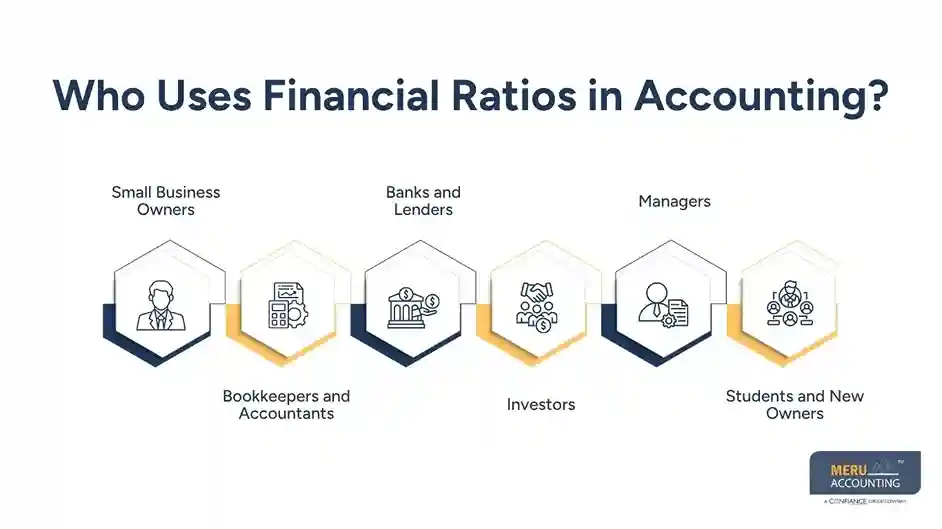
Small Business Owners
Ratios help them keep track of cash, profit, and how much they spend. This helps them make good business choices. They can see where they need to cut costs. They can also plan for steady growth with more trust.
Bookkeepers and Accountants
They use ratios to make easy-to-read reports. They also give advice based on the results. Ratios help them find money issues fast. This helps their clients make smart money choices.
Banks and Lenders
Banks check ratios when you ask for a loan. This helps them see if you can pay the loan back. Strong ratios build more trust with lenders. Good results can also help you get better loan terms.
Investors
They check ratios to see if your business is strong and worth their money. This helps them judge the risk before they invest. They also use ratios to compare many businesses. Good results can bring in more new investors.
Managers
They use ratios to set goals, lead teams, and make smart plans. Ratios also help them track how well the business is doing. They can spot weak areas with ease. This helps them make better day-to-day choices.
Students and New Owners
Even if you are just starting, learning ratios can help grow your dream. It gives you a good base for running a business. You will learn how to read key money facts. This builds trust as your business grows.
Financial ratios in accounting help you see how your business is doing in a quick and simple way. You don’t need to be great at math to use them. These smart tools help you find problems, plan better, check how well you’re doing, and compare your business with others. They also help you stay in control of your money. You can use them to look at your profit, debt, and cash. These ratios work for both small and big businesses. If you don’t know how to begin, that’s okay.
Meru Accounting can help you. We know how to read your numbers, choose the right ratios, and guide you to make good plans. With our help, using financial ratios in accounting becomes easy and helps your business grow.
If you’re not sure where to start, don’t worry. Meru Accounting can help. We are experts who can look at your numbers, pick the right ratios, and help you make smart plans. With the right help, the use of financial ratios in accounting becomes easy and powerful.
Our Expert Insight
Financial ratios are one of the best ways to turn raw numbers into clear business facts. Instead of looking through long reports, business owners can use accounting ratios to check profit, cash flow, debt, and overall business health in less time. At Meru Accounting, we help businesses choose the right financial ratios, understand what the numbers mean, and use those insights to improve performance, reduce risk, and support steady business growth.
Key Takeaways
- Financial ratios make it easy to measure business performance using simple number comparisons.
- Different accounting ratios help you review profit, cash flow, debt, efficiency, and business value.
- Financial ratios help you find problems early, set goals, and make smarter business decisions.
- Business owners, accountants, banks, investors, managers, and students all use financial ratios for different needs.
- Checking financial ratios on a regular basis helps you stay in control of your business finances.
- Using the right accounting ratios can help improve planning, track growth, and support long-term success.
FAQs
No, start with simple ones like profit margin or current ratio. You can learn more over time.
Yes! Tools like Excel, Xero, and QuickBooks can do the math for you.
Try to check them once a month or every 3 months.
That’s okay. Bad ratios help you find what’s wrong so you can fix it.
Yes! Meru Accounting can help you check your books, explain the ratios, and help improve your results.
optional anymore
on running the business