You check your Form 1098 and notice that Box 10 is blank—or the amount listed does not match what you paid in property taxes. That can leave you wondering whether something was missed and if it could affect your tax return. Form 1098 Box 10 Real Estate taxes can be especially confusing because Box 10 is an “Other” box, not a box used only for property taxes.
Before you report anything, it helps to check your escrow statement, property tax bill, and payment records. Real Estate taxes on Form 1098 may help confirm what your lender paid, but a blank or incorrect amount does not always mean your property tax deduction is lost. Knowing what Box 10 means—and what records to check—can help you avoid a tax filing mistake.
What You Will Learn From This Blog
This blog explains:
- What Box 10 on Form 1098 means.
- How to read Real Estate taxes on Form 1098.
- Why Box 10 may be blank.
- What to do when the amount looks wrong.
- When real estate taxes may be deductible.
- Common errors when claiming the deduction.
- When professional accounting help may be useful.
What Is Form 1098 Box 10 for Real Estate Taxes?
Form 1098 is a Mortgage Interest Statement. Mortgage lenders generally use it to report mortgage interest paid during the year. The form also has several other boxes that may show points, mortgage insurance, property details, or other information.
Form 1098 Box 10 Real Estate taxes, refers to information a lender may place in Box 10 when it reports other items to the borrower. Under the IRS instructions, Box 10 may include real estate taxes or insurance paid from an escrow account.
This point matters. Box 10 is not a dedicated property tax reporting box.
A lender can use Box 10 to give you useful tax information. However, the amount shown there should not be treated as the final answer for your property tax deduction without checking your own records.
For example, suppose your mortgage payment includes an escrow amount. Your lender may collect money each month and later send part of that money to your local taxing authority. The amount actually paid to the taxing authority is important when determining your federal deduction.
So, Form 1098 Box 10 Real Estate taxes can be a helpful record, but you should compare it with your annual escrow statement and property tax bill.
How to Read Real Estate Taxes on Form 1098
When reviewing Real Estate taxes on form 1098, first look at Box 10 and identify what the lender says the amount represents.
Do not assume every number in Box 10 is a deductible property tax amount. The box can contain other information, including insurance paid from escrow.
Next, compare the amount with your escrow account history.
Your annual escrow statement may show:
- Property tax payments.
- Insurance payments.
- Escrow deposits.
- Escrow shortages or surpluses.
- Payments made to your taxing authority.
The key question is not simply how much you placed into escrow. It is how much qualifying tax was actually paid and when it was paid.
For example, if you put $6,000 into escrow during the year but your lender paid only $5,400 in property taxes, you should not assume the full $6,000 is your property tax deduction.
The IRS says that when mortgage payments include real estate taxes, you can include only the amount the mortgage company actually paid to the taxing authority during the tax year.
This is why your escrow statement and property tax records matter when reviewing Form 1098 Box 10 Real Estate taxes.
What Are Form 1098 Box 10 Real Estate Taxes Used For?
Form 1098 Box 10 Real Estate taxes can help you identify property tax payments made through your mortgage escrow account.
The information may be useful when you prepare Schedule A if you itemize deductions. The IRS says qualifying state and local real estate taxes are generally reported on Schedule A, line 5b.
However, Box 10 does not automatically create a tax deduction.
You still need to determine whether the tax is deductible under federal rules. You also need to consider whether you itemize deductions and whether the applicable SALT limit affects your deduction.
The IRS allows a deduction for qualifying state and local taxes imposed on real property that you own. The tax generally must be assessed at a uniform rate and used for general community or government purposes.
Therefore, Real Estate taxes on form 1098 should be viewed as supporting information, not as a standalone tax calculation.
Are Real Estate Taxes on Form 1098 Tax Deductible?
Real Estate taxes on form 1098 may be deductible if they meet IRS requirements.
For a homeowner, qualifying real estate taxes are generally deductible when they are paid to the taxing authority during the year. Taxes paid through an escrow account may qualify when the lender actually sends the payment to the taxing authority.
You generally claim qualifying property taxes on Schedule A if you itemize deductions.
For 2025, the overall federal SALT deduction limit increased to $40,000, or $20,000 for married taxpayers filing separately. The limit can be reduced for taxpayers with modified adjusted gross income above the applicable threshold.
This means you should not look at Form 1098 Box 10 Real Estate taxes in isolation.
Your total state and local taxes may include other amounts, such as qualifying state and local income or sales taxes. The SALT rules can limit the amount you can deduct.
Also, not every charge on a property tax bill qualifies. The IRS says certain charges for services, such as specific trash or water services, are not deductible as real estate taxes. Charges for local improvements that increase the value of your property may also need different treatment.
If you sold or purchased a home during the year, closing documents also matter. Property taxes may be divided between the buyer and seller based on the ownership period. The settlement statement can help determine the amount treated as paid by each party.
optional anymore
on running the business
Common Mistakes When Claiming Real Estate Tax Deductions
Treating a blank Box 10 as proof that no taxes were paid
A blank Box 10 does not necessarily mean you paid no property taxes. Box 10 is an optional “Other” information field. Your lender may choose not to report property taxes there.
Check your escrow statement and property tax records instead.
Using the escrow deposit instead of the tax payment
This is a common mistake. Money placed into escrow is not the same as money paid to the taxing authority.
When reviewing Form 1098 Box 10 Real Estate taxes, compare the reported figure with the actual tax payments made by your lender.
Assuming every Box 10 amount is deductible
Box 10 can contain more than property tax information. The lender may also use it for insurance paid from escrow or other information.
Read the statement and supporting records before entering an amount on your return.
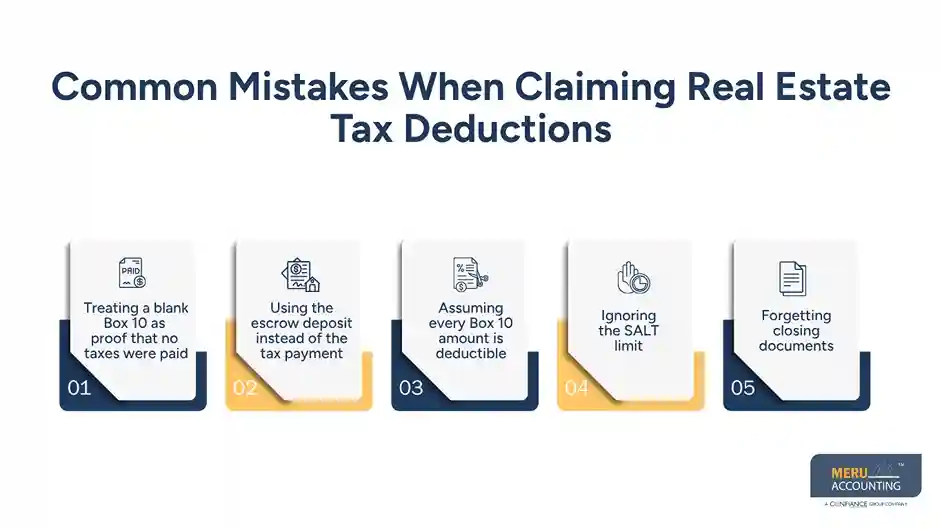
Ignoring the SALT limit
Even when your Real Estate taxes on form 1098 are fully eligible, your federal deduction can still be limited by the SALT rules.
Do not claim the Box 10 amount without considering your other state and local taxes.
Forgetting closing documents
If you bought or sold a home, the settlement statement can contain key tax details. Property taxes paid at closing may need to be split between the buyer and seller.
Your Form 1098 may not tell the whole story.
Meru Accounting’s Services for Mortgage and Real Estate Tax Records
Real Estate tax records often involve more than one source. A lender statement, escrow record, property tax bill, and accounting file may each show part of the picture. Meru Accounting helps bring those records together so your books are ready for tax work and easier to review.
Our real estate accounting services include:
- Real estate bookkeeping – Recording and reconciling property income and expenses.
- Property tax and expense tracking – Keeping tax payments and property costs properly classified.
- Account reconciliation – Matching bank, lender, and escrow records to the books.
- Year-end bookkeeping support – Organizing financial records and reports for your tax preparer.
- Real estate accounting support – Maintaining clear books for agents, investors, and property owners.
Our approach is simple: keep the books clean throughout the year instead of trying to fix gaps at tax time. That gives you a stronger record when a Form 1098 amount needs to be checked or a tax professional asks for supporting details.
Our Expert Insight
A key point for homeowners is that Form 1098 Box 10 Real Estate taxes is not a dedicated tax field. So, a blank box or a figure that looks unusual does not, by itself, tell you whether your property tax records are right or wrong.
From an accounting standpoint, the bigger concern is reliable source records. Keeping property tax bills, escrow records, and payment details together gives you a stronger record than relying on the form alone. It also makes it easier to spot a missing payment, timing issue, or other error before it affects your tax return.
Key Takeaways
- Form 1098 Box 10 Real Estate taxes is not a dedicated property tax field.
- Box 10 is an “Other” box that lenders may use for real estate taxes or insurance paid from escrow.
- A blank Box 10 does not mean you cannot deduct eligible property taxes.
- Compare Real Estate taxes on Form 1098 with your escrow statement and tax bill.
- Only qualifying taxes paid during the year generally count for the federal deduction.
- Property taxes are generally reported on Schedule A, line 5b, when you itemize.
- The 2025 SALT deduction limit is generally $40,000, subject to applicable income-based limits.
- Keep your escrow, tax bill, and closing records with your tax documents.
- When Form 1098 Box 10 Real Estate taxes looks wrong, verify the payment records before changing your tax return.
FAQs
No. Box 10 is not required to claim a qualifying property tax deduction. Your deduction depends on the taxes you paid and the IRS rules for claiming them.
The difference may be due to the timing of payments, escrow adjustments, or taxes paid in a different tax year. Compare the records before filing.
No. Form 1098 does not guarantee that every property tax payment will appear in Box 10. Your own tax and payment records still matter.
Keep your Form 1098, escrow statements, property tax bills, payment records, and closing documents when applicable. These records can help support the amount reported on your return.
Generally, no. Real estate taxes are generally claimed as an itemized deduction on Schedule A, so they do not provide a separate deduction when you take the standard deduction.
optional anymore
on running the business