
Choosing between Generally Accepted Accounting Principles (GAAP) and International Financial Reporting Standards (IFRS) can affect how you report revenue, assets, liabilities, and expenses. The right framework depends on where you operate, your reporting obligations, and the needs of your stakeholders. When you look at GAAP vs IFRS, the differences aren’t limited to terminology.
The frameworks take different approaches to areas such as inventory, leases, impairment, research and development, and financial statement presentation. GAAP is primarily used in the United States, while IFRS is used or permitted in many jurisdictions worldwide.
At Meru Accounting, we help you understand these differences in the context of your business—not just as accounting theory. Our GAAP and IFRS comparison can help you identify the rules that apply to your reporting requirements and understand how they may affect your financial statements.
What You Will Learn From This Blog
- Understand the purpose of GAAP and IFRS through a practical GAAP and IFRS comparison.
- Learn the key differences between the standards in this GAAP vs IFRS guide.
- See how GAAP and IFRS handle revenue recognition differently.
- Compare financial statement presentation requirements under both standards.
- Identify which reporting standard may fit your business and reporting needs.
- Consider compliance requirements, flexibility, implementation costs, and ongoing accounting work.
- Understand how international expansion can affect your choice of accounting standard.
What are Generally Accepted Accounting Principles (GAAP)?
Generally Accepted Accounting Principles (GAAP) are the accounting standards used in the U.S. to prepare and present financial statements. The Financial Accounting Standards Board (FASB) sets and maintains GAAP, covering how businesses recognize, measure, and report financial transactions.
If you report under U.S. GAAP, you have a consistent framework for presenting your company’s financial position and performance.
What are International Financial Reporting Standards (IFRS)?
International Financial Reporting Standards (IFRS) are accounting standards developed by the International Accounting Standards Board (IASB) and adopted in many countries. They guide businesses on recognizing, measuring, presenting, and disclosing financial information.
When you’re assessing GAAP vs IFRS, the key point is that the frameworks don’t always treat transactions the same way. At Meru Accounting, we help you understand the applicable requirements and their impact on your financial reporting. A GAAP and IFRS comparison can be useful when you operate internationally or need to report under different accounting standards.
GAAP vs IFRS: Key Differences
Recognition and Measurement
GAAP: In a GAAP vs IFRS comparison, GAAP provides very detailed, industry-specific rules for how transactions should be recognized and measured. For example, there are clear guidelines for sectors like construction or software, ensuring that businesses follow a consistent approach within their specific industry.
IFRS: International Financial Reporting Standards (IFRS), on the other hand, uses a more general, principle-based approach. This allows companies more flexibility in applying the rules because it focuses on the overall economic impact of a transaction rather than providing detailed rules for specific industries.
Financial Statement Presentation
GAAP: Under Generally Accepted Accounting Principles (GAAP), businesses must follow strict formats when presenting financial statements, like income statements, balance sheets, and cash flow statements. This means businesses must present their financial information in specific ways that are consistent across similar companies, making comparisons easier.
IFRS: A GAAP and IFRS comparison shows that IFRS generally provides more flexibility in financial statement presentation. For instance, it allows them to choose how to organize their assets and liabilities. While Generally Accepted Accounting Principles (GAAP) requires businesses to separate current and noncurrent assets and liabilities on the balance sheet, International Financial Reporting Standards (IFRS) gives companies the option to organize their financial data in a way that best fits their operations.
Revenue Recognition
GAAP: Revenue recognition is another important area when comparing GAAP vs IFRS. Under U.S. GAAP, ASC 606 provides a five-step framework for recognizing revenue from customer contracts. GAAP also includes detailed guidance for certain industries and transactions, so you need to consider the specific terms of each contract before recognizing revenue.
IFRS: IFRS 15 also uses a five-step model and focuses on when control of goods or services transfers to the customer. Revenue is generally recognized when you satisfy a performance obligation, not simply when you receive cash. GAAP and IFRS are closely aligned in this area, but differences in detailed guidance and application can affect certain transactions.
GAAP vs IFRS: Choosing the Right Financial Reporting Standard for Your Business
Global Reach
If your business operates internationally or plans to expand, IFRS may be a better fit because it’s used in many countries. It can also make your financial statements easier for international investors and stakeholders to compare.
Regulatory Compliance
If your business is based in the U.S. or has reporting obligations to U.S. regulators or investors, GAAP may be required. You should confirm the specific rules that apply to your company before choosing a reporting framework.
Flexibility vs. Specificity
IFRS generally relies more on principles and professional judgment, while GAAP often provides more detailed guidance. You still need sound accounting judgment under either framework.
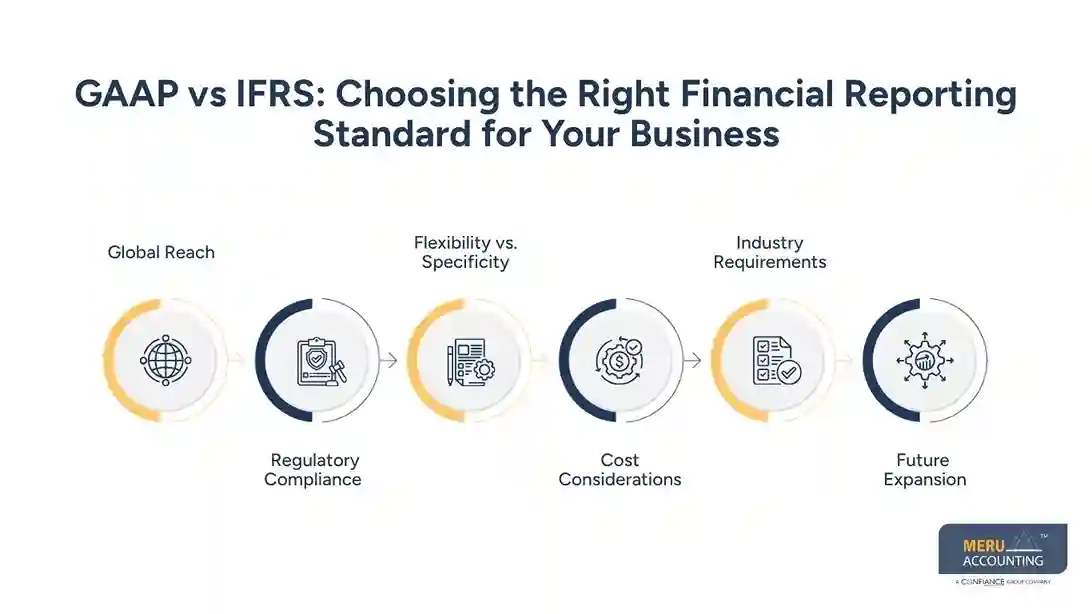
Cost Considerations
A GAAP and IFRS comparison should include the cost of changing accounting systems, reporting processes, internal controls, and staff training. We recommend considering these costs before switching frameworks.
Industry Requirements
Certain industries, such as banking and insurance, have specialized accounting requirements. Your industry and transaction types can affect which guidance you need to follow, so we recommend reviewing these requirements before making a decision.
Future Expansion
If you’re planning to attract international investors, enter new markets, or pursue a foreign stock exchange listing, IFRS may become relevant to your future reporting needs. Planning ahead can help you avoid unnecessary reporting changes later.
Choosing between GAAP and IFRS depends on your location, regulatory requirements, industry, stakeholders, and long-term plans. At Meru Accounting, we can help you compare the requirements and determine how each framework could affect your financial reporting.
At Meru Accounting, we help businesses understand the differences between GAAP vs IFRS and apply the right accounting framework to their financial reporting. While both standards aim to provide accurate and transparent financial information, they follow different rules for areas such as revenue recognition, inventory, leases, financial instruments, and asset measurement.
Our GAAP and IFRS comparison focuses on what these differences mean for your business. If you operate across countries, work with international investors, or prepare financial statements under more than one framework, the right accounting treatment can affect your reported income, assets, liabilities, and financial ratios.
We work with businesses in the US and internationally to assess their reporting needs, apply relevant accounting guidance, and maintain reliable financial records. We keep track of changes to accounting standards so you can make decisions based on current requirements. With Meru Accounting, you get practical accounting support tailored to your business—not a one-size-fits-all approach.
Our Expert Perspective
A GAAP vs IFRS comparison shows that both frameworks aim to make financial reporting reliable and comparable, but their approaches differ. GAAP provides detailed guidance that can support consistent reporting, while IFRS allows greater professional judgment in many situations.
Our experience shows that a GAAP and IFRS comparison should consider a business’s location, industry, reporting requirements, investors, and expansion plans before selecting or transitioning between standards. Proper accounting guidance can also help businesses maintain compliance and produce financial statements that support informed business decisions.
Key Takeaways
- GAAP is primarily used by businesses operating in the United States.
- IFRS is widely adopted across many international markets.
- GAAP generally provides more detailed guidance for financial reporting.
- IFRS generally allows greater professional judgment when applying accounting principles.
- Revenue recognition requirements may differ between GAAP and IFRS, making revenue treatment an important part of GAAP vs IFRS comparisons.
- A GAAP and IFRS comparison should consider business location and regulatory requirements when selecting an accounting standard.
- Industry requirements and investor expectations should also be considered when assessing which approach is appropriate in GAAP vs IFRS.
- Switching between standards may require changes to systems, processes, and employee training.
- Professional accounting advice can help businesses select the most appropriate reporting framework.