If you’re ready to hire a bookkeeper for real estate agent work, don’t make your choice based on price alone. Real estate bookkeeping has its own challenges, from tracking commission income and brokerage fees to sorting marketing costs, mileage, and other business expenses. The right bookkeeper should understand how your business works, not just know how to enter transactions.
Before you hand over your books, ask a few direct questions. The answers can help you find a real estate bookkeeper who fits your needs, keeps your records accurate, and gives you financial information you can use to run your business with more confidence.
This blog covers 10 essential questions to ask before you make the hire, along with key red flags to watch for.
What You Will Learn From This Blog
You will learn:
- Why real estate agents may need a bookkeeper.
- What a real estate bookkeeper should handle.
- 10 key questions to ask before you hire a bookkeeper for real estate agent needs.
- Red flags to watch for when choosing a bookkeeper.
- How professional real estate bookkeepers can support your business.
- What to look for in a long-term bookkeeping partner.
Why Should a Real Estate Agent Hire a Bookkeeper?
Real estate income does not always follow a simple monthly pattern. One month may bring several large commission checks, while the next may have little income. At the same time, business costs still need to be tracked and paid.
This makes clean books very important.
A skilled real estate bookkeeper can track income, costs, bank activity, credit card charges, and other records. They can also help you see where your money goes and how your business is doing.
When you hire a bookkeeper for real estate agent work, you can also save time on routine tasks. Instead of sorting receipts or matching bank charges, you can spend more time on your clients and sales work.
Good books can also make tax time less stressful. Your tax pro can work from records that are well kept and up to date.
The goal is not just to enter numbers. It is to build a clear view of your business finances.
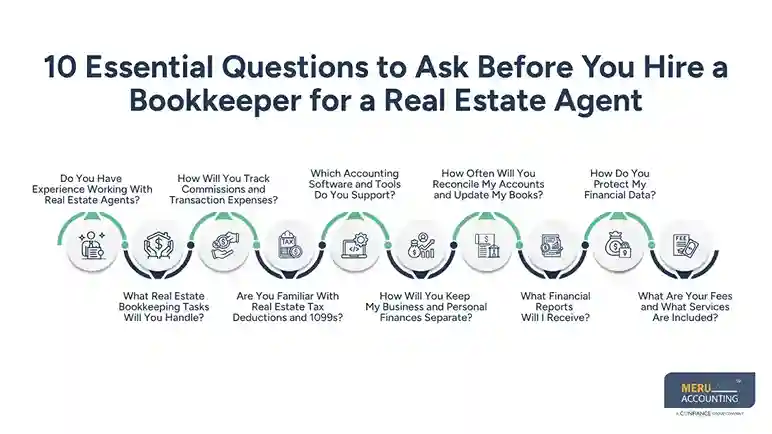
10 Essential Questions to Ask Before You Hire a Bookkeeper for a Real Estate Agent
1. Do You Have Experience Working With Real Estate Agents?
Start with industry experience.
Real estate bookkeeping has needs that may not be common in other small businesses. Commission income, brokerage splits, referral fees, transaction costs, MLS dues, marketing costs, and mileage can all need careful tracking.
Ask how many real estate clients the bookkeeper has worked with. Ask what types of real estate businesses they know, too. An agent who works alone may have different needs from a large team.
When you hire a bookkeeper for real estate agent work, real estate experience can help reduce the time needed to explain your books and business model.
A bookkeeper should also know what questions to ask you. That is often a good sign that they understand the industry.
2. What Real Estate Bookkeeping Tasks Will You Handle?
Do not assume every bookkeeper offers the same service.
Ask for a clear list of tasks. This may include bank reconciliation, credit card reconciliation, income tracking, expense coding, account reviews, and monthly reports.
You may also need help with commission records, business expenses, contractor payments, or year-end book cleanup.
A good real estate bookkeeper should explain what is included in the service and what is not. This helps avoid gaps later.
If you hire a bookkeeper for real estate agent needs without asking this question, you may find that key tasks are outside the service plan.
Get the scope in writing before work starts.
3. How Will You Track Commissions and Transaction Expenses?
Commission income is a major part of an agent’s books. But the full picture may include brokerage splits, referral fees, transaction costs, and other deal-related charges.
Ask how the bookkeeper will track these items.
You should be able to see your income and costs in a way that makes sense for your business. Clear records can help you review each month and spot unusual changes.
Ask whether they can work with your commission statements and other records. Also ask how they handle income that is earned at one time but paid later.
Experienced Real Estate bookkeepers should have a clear process for these records.
4. Are You Familiar With Real Estate Tax Deductions and 1099s?
This is an important question, but there is a key line between bookkeeping and tax work.
A bookkeeper should understand the types of records that real estate agents often need for tax review. These may include marketing costs, vehicle use, education, software, office costs, dues, and other business expenses.
Ask how they classify and document these costs.
You should also ask about 1099 records if you pay eligible contractors or service providers. Your bookkeeper should help keep the needed records organized, while your tax professional can handle tax advice and filing.
When you hire a bookkeeper for real estate agent work, make sure they understand where bookkeeping ends and tax advice begins.
5. Which Accounting Software and Tools Do You Support?
Your bookkeeper should be comfortable with the software you already use or be able to guide you toward a suitable system.
Common accounting tools may include QuickBooks Online, Xero, and other cloud accounting platforms. Real estate agents may also use tools for transaction management, expense tracking, mileage, banking, or document storage.
Ask whether the bookkeeper has experience with your current setup.
Also ask how data will move between your tools and accounting system. Manual work can create more room for errors.
The best real estate bookkeeper is not simply someone who knows accounting software. They should know how to use that software for your type of business.
optional anymore
on running the business
6. How Will You Keep My Business and Personal Finances Separate?
Mixing personal and business spending can make your books hard to review.
Ask how the bookkeeper will handle personal charges that appear in a business account. Also ask how they will flag items that need your review.
Ideally, you should have separate business bank and credit card accounts for business use. Your bookkeeper can then keep business activity clearer and easier to review.
This matters when you hire a bookkeeper for real estate agent work because agents often have many small charges across the month.
Clean separation can also make reports more useful and help your tax pro review records with less cleanup.
7. How Often Will You Reconcile My Accounts and Update My Books?
Ask how often your books will be updated.
Monthly bookkeeping is common for many small businesses, but your needs may vary based on transaction volume and business size.
Reconciliation is also important. It helps match your accounting records with your bank and credit card activity.
Ask when the work will be done each month and when you will receive reports.
A good real estate bookkeeper should have a set process and clear deadlines.
If you hire a bookkeeper for real estate agent needs, do not wait until tax season to learn that your books have not been kept current.
8. What Financial Reports Will I Receive?
Reports should help you understand your business, not just satisfy a bookkeeping task.
Ask which reports are included. A profit and loss statement can show income, costs, and profit over a set period. A balance sheet can show what the business owns and owes.
You may also want reports that help you review expenses, cash flow, or changes in income.
Ask how often reports are sent and whether your bookkeeper will explain unusual changes.
The right Real Estate bookkeepers should make financial data easier for you to use when making business choices.
9. How Do You Protect My Financial Data?
Bookkeeping gives a service provider access to sensitive financial information. Data security should therefore be part of your hiring decision.
Ask how your records are stored and shared. Find out who can access your accounting files and how account access is managed.
You should also ask how documents such as bank statements, receipts, and tax records are handled.
A professional bookkeeper should have a clear process for protecting client information.
When you hire a bookkeeper for real estate agent work, trust matters as much as accounting skill. You need to know that your financial records are handled with care.
10. What Are Your Fees and What Services Are Included?
Price matters, but it should not be the only factor.
Ask whether the fee is monthly, hourly, or based on the amount of work. Find out if cleanup work, catch-up bookkeeping, reports, or extra accounts cost more.
Also ask what happens if your business grows and your bookkeeping needs change.
A low fee may not be the best deal if important tasks are left out. A higher fee may make sense if it includes a wider scope and better support.
Before you hire a bookkeeper for real estate agent needs, compare the full service, not just the monthly price.
Red Flags to Watch for When Hiring a Bookkeeper
Knowing what to avoid can be just as useful as knowing what to look for.
Watch for these warning signs:
- No real estate experience: The bookkeeper cannot explain how they handle commission income or deal costs.
- Unclear scope: You cannot get a clear list of what the service includes.
- Poor communication: Messages are often missed or left without a clear answer.
- No regular reconciliation: Bank and credit card accounts are not checked on a set schedule.
- Unclear pricing: You cannot tell what you are paying for each month.
- No data security process: The bookkeeper has no clear answer about protecting your records.
- Tax advice beyond their role: They make tax claims without working with your tax professional or understanding the limits of their role.
These issues can create more work later. Take time to ask questions before you hire a bookkeeper for real estate agent needs.
Get an Advantage With Meru Accounting's Real Estate Bookkeepers
Real estate accounting requires attention to transactions that are specific to an agent’s business. Meru Accounting’s real estate bookkeepers work with these details as part of a structured bookkeeping process.
Our Real Estate Bookkeeping Services
- Commission income and brokerage split tracking
- Referral fees and transaction expenses
- Marketing, advertising, and MLS expenses
- Mileage and other business expenses
- Bank and credit card reconciliation
- Monthly bookkeeping and transaction categorization
- Profit and loss and other financial reports
- Records organized for tax preparation
Our team can also work with the accounting software you already use, helping keep your bookkeeping process consistent as your business grows.
If you want to hire a bookkeeper for real estate agent needs, Meru Accounting provides industry-focused bookkeeping support backed by experience with the financial details that matter to real estate professionals.
Our Expert Insight
Real estate income can look uneven from month to month, so one slow month doesn’t always mean the business is underperforming. We recommend looking at commission income and expenses across several months before making decisions about spending or growth.
This broader view can help separate a normal sales cycle from a real cash-flow issue. It also gives agents a better basis for deciding when to increase marketing, build cash reserves, or take on a new business expense.
Key Takeaways
- Real estate agents have bookkeeping needs that differ from many other small businesses.
- Ask about industry experience before you hire a bookkeeper for real estate agent work.
- Make sure commission income and transaction costs are tracked in a clear way.
- Confirm which bookkeeping tasks are included in the service.
- Ask about software, account reconciliation, financial reports, and data security.
- Do not judge a bookkeeping service by price alone.
- Choose real estate bookkeepers who can provide clear records and useful financial insight.
- Keep your bookkeeper and tax professional’s roles clear.
FAQs
When commissions, expenses, and monthly transactions become difficult to keep up with, it’s a good time to get bookkeeping help.
Yes. A bookkeeper can organize financial records and reports for your tax preparer, but tax advice and returns are typically handled by a CPA or tax professional.
A separate business account helps keep business transactions apart from personal spending and makes bookkeeping easier to manage.
Monthly bookkeeping is common, but agents with frequent transactions may benefit from more frequent updates.
A bookkeeper handles routine financial records and reconciliations, while a CPA may provide tax, accounting, and financial planning services.
optional anymore
on running the business