
The federal tax treatment of a small business can affect how much income remains available for business needs. The small business tax rate may influence decisions about hiring, investments, expansion, and profit distribution. These factors can directly shape the pace at which a business can pursue its growth plans.
Understanding the applicable federal tax rules helps business owners plan growth with greater financial clarity. A well-planned tax strategy can also help businesses manage cash flow and prepare for future opportunities. Regular reviews of the small business tax rate and tax strategy can help owners adjust their plans as the business and tax rules change
What You Will Learn From This Blog
Understanding federal tax rules can help small business owners make better financial and growth decisions. Tax obligations can affect available cash, investment choices, hiring plans, and long-term business strategies.
After reading this blog, you will learn:
- How federal tax treatment differs by business structure.
- Why there is no single federal tax rate for every small business.
- How taxes can influence investment and expansion decisions.
- Which business structures have different federal tax implications.
- How deductions and credits can reduce overall tax liability.
- Why regular tax planning supports better financial decisions.
- How changing federal tax rules can affect business planning.
- Which common tax mistakes small businesses should avoid.
What is the Federal Small Business Tax Rate
The small business tax rate is not a single rate that applies to every U.S. small business. Federal income tax treatment depends on the business structure, tax classification, taxable income, deductions, credits, and elections. Sole proprietorships, partnerships, S corporations, C corporations, and LLCs can have different federal tax treatments.
Different tax rates apply to different structures:
- Sole Proprietorships and Partnerships: The income is taxed based on the owner’s income tax rate.
- S Corporations and LLCs: Typically taxed similarly to partnerships.
- C Corporations: Subject to a flat corporate tax rate.
Knowing the small business tax rate helps entrepreneurs plan better and make informed decisions. Managing a business involves much more than simply offering products or services. It’s about planning smartly for the future, and one major factor that impacts this is the federal small business tax rate. Understanding how the small business tax rate works can help business owners shape their growth strategies more effectively.
How the Small Business Federal Tax Rate Affects Growth Strategies
1. Investment Decisions
The small business federal tax rate can influence the amount of after-tax income available for business investments. However, tax savings do not automatically lead to higher investment because decisions also depend on cash flow, demand, financing costs, and expected returns.
2. Hiring Plans
A lower federal small business tax rate can lead to business owners hiring more employees. Reducing tax expenses means more cash is available to grow teams and scale operations.
3. Expansion Timing
Businesses may time their expansion based on favorable small business tax rate changes. For example, if tax cuts are announced, companies may move faster to open new locations.
4. Profit Retention and Distribution
Higher federal business tax rates might lead companies to retain more profits instead of distributing them to shareholders. Retaining profits can fund future projects without taking loans.
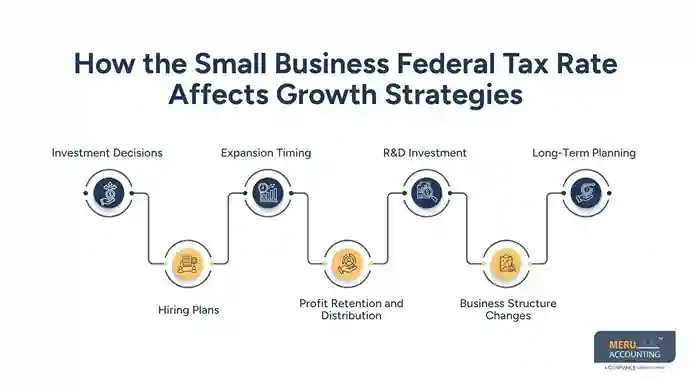
5. R&D Investment
A reasonable federal small business tax rate gives businesses the flexibility to invest more in research and development. Innovation usually needs an upfront investment, and it’s easier to make that investment when taxes are lower and more predictable.
6. Business Structure Changes
Sometimes changes in the federal tax rate push business owners to rethink their company structure. They might switch from a sole proprietorship to an LLC or a corporation to get better tax benefits.
7. Long-Term Planning
When taxes are stable and manageable, businesses can make longer-term plans with more confidence. Predictable tax costs make it easier to set goals for the next few years without worrying about sudden financial pressure.
Small Business Structures and Their Tax Implications
Sole Proprietorships and Partnerships
- Pass-through entities.
- Income is subject to taxation at the individual’s personal tax rate
LLCs
- Flexible in choosing their federal tax classification.
- Depending on the number of owners and elections made with the IRS, an LLC may be taxed as a sole proprietorship, partnership, S corporation, or C corporation.
S Corporations
- Pass-through taxation.
- Owners pay taxes at their individual rates.
C Corporations
- Flat 21% federal business tax rate.
- Double taxation issue (corporate and dividends).
Choosing the right structure can minimize the small business tax rate burden and maximize growth potential.
Strategies to Manage Federal Small Business Tax Rate
1. Choosing the Right Entity
Selecting the best entity structure is crucial. For instance, shifting from a sole proprietorship to an S Corporation can help save on self-employment taxes.
2. Smart Deductions
Businesses should maximize deductions like office expenses, employee benefits, and travel costs to lower their federal small business tax rate impact.
3. Income Splitting
Paying family members for legitimate business services may provide tax benefits when the arrangement meets applicable IRS requirements. Payments should reflect actual work performed, reasonable compensation, and proper payroll and reporting rules.
4. Tax Credits
Taking advantage of tax credits for research, hiring veterans, or going green can offset the federal business tax rate.
5. Professional Help
Hiring an accountant or tax advisor can help navigate the complexities of the small business tax rate.
Importance of Keeping Up with Federal Business Tax Changes
- Tax rules change often: Federal tax laws, deductions, credits, thresholds, and other requirements may be updated through new legislation or policy changes. Businesses should review current tax rules to understand how changes may affect their tax obligations.
- Tax rates can go up or down: If the federal tax rate changes, your profits can be affected. It’s important to know the latest rate.
- Deductions and credits may change: Some expenses you could deduct last year might not be allowed this year. New credits may also come up.
- Affects your growth plans: You should slow down your plans, like recruiting or buying new types of equipment, if the taxes increase.
- Helps you plan better: Knowing the latest tax rules lets you make smarter choices for the future.
Common Mistakes Businesses Make with Taxes
- Not setting aside enough for taxes
- Mixing personal and business expenses
- Missing deductions
- Failing to plan for estimated tax payments
Avoiding these mistakes helps manage the small business tax rate effectively.
How Favorable Federal Small Business Tax Rates Support Economic Growth
A lower federal small business tax rate has broader economic benefits, such as:
- Increased employment
- More innovation
- Higher consumer spending
- Greater investment in infrastructure and new markets
Communities also get stronger when the business grows.
It’s important to know the federal tax rate for your business. It can help you plan better and avoid unexpected errors at tax time. By keeping track of things like deductions and the structure of your business, you can make sure you are paying the right amount without overdoing it. Meru Accounting can help you stay updated on these changes, so you do not have to worry about it. You can just focus on running your business.
Our Expert Perspective
Federal tax planning should be part of regular business planning, not only a year-end activity.
Business owners should consider how entity structure, income, deductions, credits, payroll, and investments affect tax obligations. Tax planning is especially important before hiring employees, purchasing equipment, expanding, or changing the business structure.
Choosing an entity based only on its tax rate may overlook ownership, compliance, payroll, and long-term business needs. Regular reviews can identify eligible deductions, credits, estimated tax requirements, and other planning opportunities. Accurate financial records provide better information for tax decisions and cash-flow planning.
Key Takeaways
- There is no single federal tax rate for all small businesses.
- Business structure plays an important role in federal tax treatment.
- Sole proprietorships, partnerships, S corporations, and LLCs may receive pass-through tax treatment depending on their classification.
- C corporations are generally subject to the federal corporate income tax rate.
- Tax costs can influence hiring, investment, expansion, and profit distribution decisions.
- Eligible deductions and credits can reduce overall federal tax liability.
- Reinvesting profits does not automatically make those profits tax-free.
- Tax planning should consider both current obligations and future business goals.
- Federal tax rules, deductions, credits, and thresholds can change over time.
- Annual tax reviews can help businesses respond to financial and regulatory changes.
- Accurate bookkeeping supports better tax planning and financial decision-making.
- Professional accounting and tax support can help owners evaluate available planning options.