An employee works 45 hours, receives a bonus, and has tax withheld from their wages. The owner sends the payment, but the accounting records still show a different amount. Where did the difference go? This is exactly why learning how to do payroll for a small business requires more than calculating salaries and sending money.
Every pay run creates several connected records: wages earned, taxes withheld, employer tax costs, employee payments, and amounts still due to tax agencies or benefit plans. If even one entry is missed, the payroll report and general ledger (GL) may no longer agree.
This blog explains how to do payroll for a small business through practical examples, from the first employee record to the final GL check. It also covers small business payroll management, tax deadlines, common posting errors, and ways to keep payroll records accurate.
What You Will Learn From This Blog
- How to do payroll for a small business without missing key processing steps.
- How to calculate regular wages, overtime, bonuses, deductions, and net pay.
- Which payroll tax forms and deadlines US employers need to check.
- How to record payroll costs and liabilities in the general ledger.
- How to trace differences between payroll reports, bank records, and tax payments.
- How small business payroll management can keep payroll and accounting records aligned.
What Small Business Owners Need to Know Before Processing Payroll
Confirm Worker Status
A new hire may work set hours, use company equipment, and report to a manager. These facts can affect whether the person is an employee or an independent contractor under the applicable law. Check the actual working arrangement before setting up payroll.
Collect Employee Details
A missing tax form or wrong bank number can delay the first payment. Collect the required tax details, pay rate, bank information, and benefit choices before the first pay run, then update the records when any detail changes.
Set Pay Dates
Choose a pay cycle that meets the laws for the work location. For example, a biweekly cycle has 26 regular pay periods in most years, while a semimonthly cycle usually has 24. The choice affects cash planning and payroll processing dates.
Choose a Payroll Method
Manual calculations may work for a small team with fixed salaries, but overtime, bonuses, and tax changes add more work. Software can calculate pay and produce reports, while a payroll service may handle certain filing tasks. Confirm what each option covers before choosing one.
Assign Review Duties
The person who enters hours should not automatically approve every payment without review. Set clear roles for data entry, pay approval, bank release, and account checks. Even in a small firm, a second review of key totals can catch mistakes before payday.
optional anymore
on running the business
How to Do Payroll for a Small Business: Step-by-Step Process
Set Up Employee Records and Payroll Details
Suppose a new employee joins on the 12th of the month. If the start date or agreed salary is entered incorrectly, the first payment may be too high or too low. Check the hire date, pay rate, tax forms, and payment details before adding the worker to the payroll system. Accurate setup is the first step in how to do payroll for a small business.
Track Employee Hours, Salaries, and Paid Leave
A worker may have 38 regular hours, two hours of approved leave, and five overtime hours in one week. Each item must be recorded under the correct pay rule. Review time sheets, shift logs, and leave records before calculations begin, and resolve missing hours with the relevant manager.
Calculate Gross Pay, Overtime, and Bonuses
Gross pay includes regular wages and other earnings before employee deductions. For a worker paid $20 an hour, 40 regular hours equal $800. If the worker qualifies for five overtime hours at $30 an hour, another $150 is due, making gross pay $950 before any bonus or deduction. Covered nonexempt workers generally qualify for federal overtime after 40 hours in a workweek, subject to applicable rules and exemptions.
Deduct Taxes, Benefits, and Other Withholdings
Gross pay is not the amount an employee receives. Payroll must account for federal income tax withholding, Social Security, Medicare, and valid benefit deductions. For example, if total employee deductions are $190 on $950 in gross pay, net pay is $760. The actual tax amount depends on the employee’s details and current rules.
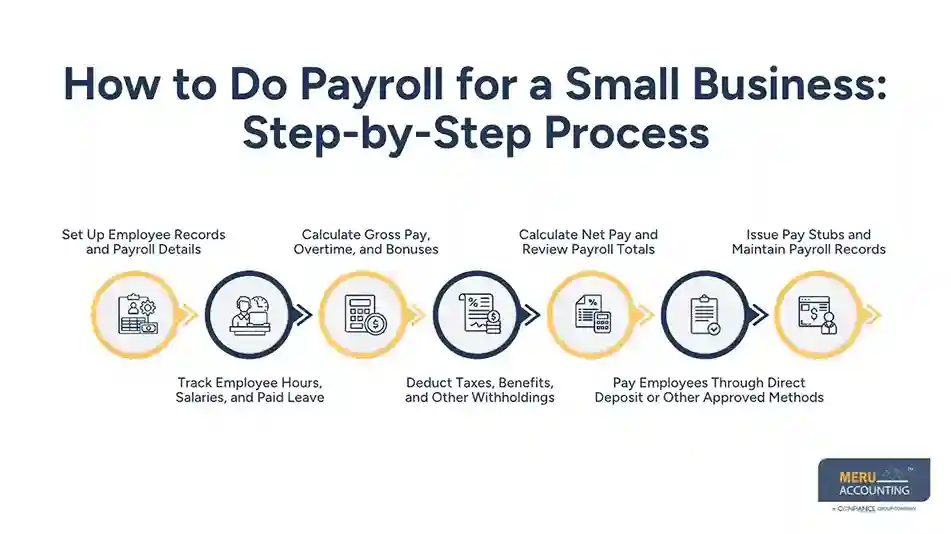
Calculate Net Pay and Review Payroll Totals
Before approving payroll, compare each worker’s current pay with the expected amount. A sudden rise may come from overtime or a bonus, while a lower amount may reflect unpaid leave or a changed benefit deduction. Check the source records rather than assuming the difference is correct.
Pay Employees Through Direct Deposit or Other Approved Methods
Once payroll is approved, send the payment file to the bank or prepare checks using the correct net pay amounts. Compare the total payment with the payroll register before release. If a deposit fails, keep the amount open until the employee receives the funds and the records reflect the outcome.
Issue Pay Stubs and Maintain Payroll Records
A pay stub gives the employee a record of earnings and deductions for the period. Keep payroll registers, time records, tax forms, deposit confirmations, and related journal entries in a secure place. If an employee questions a payment months later, these records let the business trace the calculation instead of relying on memory.
Small Business Payroll Management and Tax Compliance
Federal, State, and Local Payroll Tax Requirements
A business with employees in two states may face different withholding rules, filing dates, and unemployment tax duties. Federal rules do not replace state or local requirements. Small business payroll management must account for the work location and the duties that apply to each employee.
Employer Payroll Taxes and Employee Tax Withholding
When learning how to do payroll for a small business, distinguish employee tax withholding from employer payroll taxes, which add to the business’s cost. For 2026, Social Security tax is 6.2% for both the employer and employee on covered wages up to $184,500. Medicare tax is 1.45% each, with no wage cap. Extra Medicare withholding may apply to certain employees.
Payroll Tax Deposits, Returns, and Filing Deadlines
Calculating tax correctly does not mean the duty is complete. Employers must deposit the amount on the assigned schedule and file the required returns. Many file Form 941 quarterly, while certain employers may qualify to file Form 944 annually. Track deposit dates and return deadlines separately to avoid missing one while meeting the other.
W-2, W-4, and Other Payroll Tax Forms
Each form serves a different purpose. Form W-4 provides information used to calculate federal income tax withholding, while Form W-2 reports an employee’s annual wages and taxes. Form W-3 sends summary data to the Social Security Administration, and Form 940 is used for federal unemployment tax when required.
Recordkeeping Requirements and Penalties for Noncompliance
A tax payment can be correct while the supporting records are incomplete. Keep wage details, time sheets, tax filings, and payment proof for the required period. Federal wage rules generally require covered employers to retain payroll records for at least three years and wage calculation records for two years. Late deposits or incorrect returns may lead to penalties and interest.
How to Record Payroll Transactions in the General Ledger
Recording Gross Wages, Employee Deductions, and Net Pay
Consider a pay run with $4,000 in gross wages, $700 in employee deductions, and $3,300 in net pay. The entry debits wage expense by $4,000, credits deduction liabilities by $700, and credits cash or wages payable by $3,300. When learning how to do payroll for a small business, record the full wage cost even though the employee receives less after deductions.
Posting Employer Payroll Taxes and Employee Benefits
Employee deductions are not the same as employer tax costs. If the business owes $306 in employer Social Security and Medicare taxes on eligible wages, record the amount as payroll tax expense and a matching liability, subject to the applicable wage limits and rules. Post employer-paid benefits to their own accounts so the full labor cost remains visible.
Understanding Payroll Expense, Liability, and Cash Accounts
Think of these accounts as three parts of the same transaction. Payroll expense shows what the business incurred, liabilities show what remains due, and cash shows what was paid. When tax deposits or benefit payments clear a liability, reduce that liability and credit cash rather than recording the same cost a second time.
Matching Payroll Journal Entries With the Chart of Accounts
A business may record office salaries separately from factory wages because the costs serve different purposes. Effective small business payroll management requires mapping each payroll item to the correct account and applying consistent rules for every pay period. This keeps department costs clear and makes unexpected changes easier to spot in monthly reports.
Payroll GL Reconciliation: A Step-by-Step Guide
Compare Payroll Reports With General Ledger Entries
Start with the final payroll register, then compare gross wages, employee deductions, net pay, and employer taxes with the GL. If the payroll register shows $18,000 in gross wages but the ledger shows $17,500, look for a missing entry, a duplicate reversal, or a posting assigned to the wrong period.
Reconcile Payroll Bank Transactions and Employee Payments
Compare the approved payroll total with bank activity and payment confirmations. If the payroll register shows $12,000 in employee payments but the bank shows $11,400, check for failed deposits, outstanding checks, or payments posted on a different date. Keep valid outstanding items on the reconciliation list until they clear.
Match Payroll Tax Liabilities With Tax Payments
Compare the tax liability accounts with payroll reports, filed returns, and bank confirmations. A balance may remain before the deposit due date, but a paid tax should not stay open without an explanation. Check the tax period and agency reference before clearing the account.
Investigate Differences in Wages, Deductions, and Payroll Accruals
Differences often come from late time sheets, benefit changes, missed overtime, or wages earned before month-end but paid later. Trace each gap to the source record. For instance, wages earned in December and paid in January may need a year-end accrual under the business’s accounting method.
Correct Errors and Document Reconciliation Adjustments
After finding the cause, post a correction to the proper account and period. Maintaining these records strengthens small business payroll management by creating an audit trail for payroll corrections and general ledger adjustments. Never post a general adjustment just to force the balances to match; the correction must explain the actual difference.
Common Small Business Payroll Mistakes and How to Prevent Them
Using Outdated Employee Details
An old pay rate or tax form can cause incorrect wages or withholding. Review employee details when a worker joins, changes roles, updates benefits, or leaves the business.
Missing Overtime or Leave Pay
When learning how to do payroll for a small business, check timesheets for missing hours that can lead to underpayment. Set a clear deadline for time entry and review overtime and leave records before approving each pay run.
Missing Tax Deadlines
Even a correct tax calculation can still lead to a penalty if the deposit is late. Keep a calendar for deposits and returns, assign each task to an owner, and retain proof of payment.
Posting Net Pay as Wage Expense
Recording only the amount sent to staff understates gross wage expense. Post gross wages, employee deductions, employer taxes, and net pay to the correct accounts.
Skipping Reconciliation
A balanced payroll report does not prove that bank and tax records are right. Compare all three sets of records on a set schedule and investigate every unexplained difference.
Why Choose Meru Accounting for Small Business Payroll and GL Reconciliation?
Understanding how to do payroll for a small business involves more than paying employees; every wage, deduction, and tax entry must match the accounting records. Meru Accounting provides payroll and accounting services that keep these records organized and ready for review.
- Trace Every Payroll Entry: We record wages, employee deductions, and employer taxes in the right accounts so each amount has a clear place in the books.
- Find Gaps Before Closing the Books: Our team compares payroll reports with general ledger entries and bank records to identify unmatched amounts and entries that need review.
- Keep Payroll Costs Visible: Separate wage, tax, and benefit accounts make it easier to see what the business spends on its workforce each month.
- Work With Your Accounting Software: We use platforms such as QuickBooks and Xero to maintain consistent entries and clear financial reports.
- Prepare Records for Review: We document reconciliation differences and approved corrections so business owners can trace changes during month-end checks.
With Meru Accounting, small businesses can assign payroll accounting tasks to an experienced accounting team while retaining control over employee payments, payroll approvals, and tax obligations as agreed in the service arrangement.
Our Expert Perspective
The most useful payroll check is often the one that explains a difference, not the one that merely confirms a total. If wages, tax liabilities, and bank payments do not agree, the reviewer should find the source before closing the period.
A simple routine can make this practical: approve the pay register, post the entries, compare bank payments, check tax balances, and document open items. Small business payroll management becomes easier to control when each amount can be traced from the source record to the final account.
Key Takeaways
- Check employee details before the first pay run.
- Record regular hours, overtime, leave, and bonuses correctly.
- Review gross pay, deductions, and net pay as part of how to do payroll for a small business accurately.
- Follow the payroll tax rules and filing dates for each location.
- Post wage expense, deduction liabilities, and employer taxes separately.
- Compare payroll reports with bank records and tax payments.
- Investigate differences and document each correction.
FAQs
Process payroll by verifying employee records, tracking work hours, calculating wages and deductions, paying employees, filing taxes, and recording transactions.
Small businesses calculate payroll taxes using employee tax forms, taxable wages, current federal tax rates, and applicable state and local rules.
Record gross wages as an expense, employee deductions as liabilities, net pay as cash or wages payable, and employer payroll taxes as separate expenses.
Compare payroll registers with GL entries, bank payments, tax deposits, and liability balances, then investigate and correct any unexplained differences.
Keep employee tax forms, time sheets, wage records, payroll registers, tax returns, payment confirmations, and reconciliation reports for the legally required period.
optional anymore
on running the business