If you run a business in Singapore and charge GST (Goods and Services Tax), there is good news for you. You can get back some of the Goods and Services Tax you pay when you buy things for your business. This is called claiming input tax. It means you can recover the Goods and Services Tax paid on business items like stock, rent, tools, or services. Claiming input tax in Singapore helps your business save money. It keeps your costs low and gives you more money to use for other things your business needs.
When you understand how the claiming process works, it becomes much easier to manage your money. You won’t lose the Goods and Services Tax you paid on business buys. By learning the steps of claiming input tax in Singapore, you can run your business in a smart, simple, and stress-free way.
What You Will Learn From This Blog
- What input tax is and how it works under Singapore’s GST system.
- Who can claim ITC and the Goods and Services Tax registration requirements.
- The step-by-step process for claiming input tax in Singapore correctly.
- Which business expenses qualify for recoverable tax claims and which do not.
- How the de minimis rule affects your Goods and Services Tax credit claims.
- The documents and records you must keep to support your claims.
- The key benefits of claiming ITC for better cash flow and lower business costs.
- Common mistakes to avoid when filing Goods and Services Tax returns and claiming ITC.
What Is Input Tax?
Input tax is the Goods and Services Tax you pay when you buy things for your business. These things could be stock for your store, tools for your job, rent for your office, or services like cleaning or repairs. The Goods and Services Tax can be claimed back if your business is registered for it.
Example: You own a small café in Singapore. You buy a big bag of rice to cook food. You pay SGD 3 in Goods and Services Tax for the rice. That SGD 3 is input tax. Because you bought it for your business and you are GST-registered, you can claim that money back.
Now let’s look at how Goods and Services Tax works for your business:
- The Goods and Services Tax from your customers is collected whenever you sell any services, and this is under the output tax.
- When you buy things for your business, you pay Goods and Services Tax. This is your claimable tax.
At the end of every Goods and Services Tax filing period (usually every 3 months), you compare your input tax and output tax:
- If your output tax is more, you must pay the difference to IRAS.
- If your tax paid on purchases is more, IRAS will give the extra back to you.
This makes claiming ITC in Singapore a very smart way to save money. It means you don’t lose the Goods and Services Tax you already paid for your business. The amount to get back can be used for the business growth and development.
Step-by-Step: Claiming Input Tax in Singapore
To get back the Goods and Services Tax you paid for your business, you need to follow some easy steps to make sure that claiming input tax in Singapore is conducted correctly.. Let’s walk through the steps one by one.
Register for GST
Before you can start claiming ITC, your business must be registered for GST with the IRAS (Inland Revenue Authority of Singapore).
- If your business earns more than SGD 1 million a year, you must register.
- If your business earns less, you can still register voluntarily.
Once you are registered, you can start claiming ITC in Singapore for your business purchases.
Keep Good Records
To claim back the Goods and Services Tax you paid, you must save your documents. This includes:
- All receipts and invoices
- Bills that show the Goods and Services Tax amount
- Papers with your supplier’s name and details
Make sure each document shows clearly how much Goods and Services Tax you paid. These records help you prove your ITC to IRAS when needed.
Separate Business and Personal Use
You can claim input tax for:
- Stock for your shop
- Office rent
- Tools or machines used at work
You cannot claim ITC for:
- Family groceries
- Toys for your kids
- Personal holidays
Claiming input tax in Singapore only works if the items are for your business.
Enter Into Your System
Next, you need to keep track of what you buy.
- You can go with the simple spreadsheet or even the accounting software.
- Add everything the amount you paid, and the Goods and Services Tax paid
- Label each Goods and Services Tax amount as “input tax”
This will help you when you file your Goods and Services Tax return later.
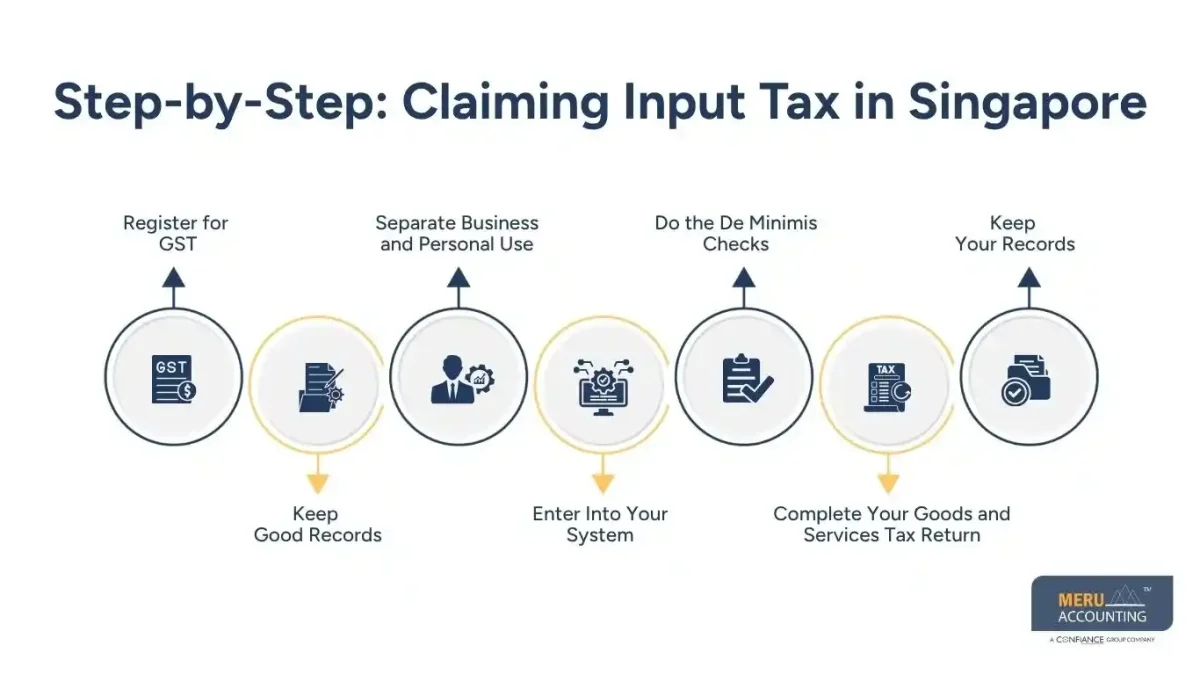
Do the De Minimis Checks
Sometimes, your business might have exempt income, like interest from a bank. You need to do two checks to see if you can claim all your tax paid on purchases:
- Test 1: Your exempt sales are 5% or less of your total sales
- Test 2: The Goods and Services Tax on your exempt purchases is SGD 10,000 or less and 5% or less of all your tax credit.
If you pass one of these, you can claim all your tax credits. If you fail both, you have to prorate, which means you only claim part of it.
Doing these tests is a key part of claiming tax credit in Singapore the right way.
Complete Your Goods and Services Tax Return
Every three months, you need to file a report with IRAS. This is called your GST return.
- Input tax and output tax both are added.
- Report them both in the return
- IRAS returns the extra money if the tax paid on purchase is more.
This is how claiming ITC helps your business save money and keep your cash flow strong.
Keep Your Records
After you file your Goods and Services Tax return, don’t throw away your papers!
- Keep all your receipts, bills, and files for at least five years
- IRAS may want to check your records to make sure everything is correct
Good records make it easy to prove that your claiming ITC in Singapore was done the right way.
Importance of Claiming Input Tax in Singapore
Here are the main reasons why claiming input tax in Singapore is very helpful for your business:
Saves You Money
When your business pays Goods and Services Tax on items or services, you can get that money back by claiming ITC. This helps your business spend less and keep more money.
Keeps Business Costs Low
Getting back the Goods and Services Tax you paid means lower costs for your business. Claiming tax credit in Singapore helps you avoid paying more than you need.
Gives You More Cash to Use
When you claim tax credit, you may get a refund from IRAS. This gives your business more cash to use for things like supplies, rent, or staff.
Makes You Follow the Rules
By claiming ITC the right way, you follow the Goods and Services Tax rules from IRAS. This keeps your business safe and helps you avoid fines or mistakes.
Helps Your Business Grow
Saving money and keeping good records means your business is in better shape. Claiming tax credit in Singapore gives you more tools to grow your business the smart way.
Claiming input tax in Singapore is a smart way to save money on GST you pay for your business. To succeed, you need:
- Claiming input tax in Singapore – done correctly
- Save proper invoices
- Choose only what is for business
By sticking to these steps, you keep your books accurate and your refund fast. Meru Accounting can help you set it all up, help you through each step, and make sure your claiming ITC is easy and stress-free.
optional anymore
on running the business
Our Expert Insight
Claiming input tax in Singapore is more than a tax-saving opportunity—it is an important part of effective Goods and Services Tax compliance and financial management. Businesses that maintain accurate records, claim only eligible business expenses, and understand rules such as the de minimis test can maximize GST recoveries while reducing the risk of penalties or rejected claims. Working with experienced accounting professionals ensures your Goods and Services Tax returns are accurate, compliant with IRAS requirements, and optimized for the highest eligible tax credit recovery.
Key Takeaways
- Input tax is the Goods and Services Tax paid on eligible business purchases and can be claimed back by GST-registered businesses.
- Your business must be registered for GST before you can claim tax credit.
- Maintain valid tax invoices, receipts, and supporting documents for at least five years.
- Claim recoverable tax only on purchases used for business purposes, not personal expenses.
- Businesses with exempt income should apply the de minimis rule to determine the amount of tax credit they can claim.
- File accurate Goods and Services Tax returns on time to receive eligible GST refunds and remain compliant with IRAS regulations.
- Proper tax credit claims improve cash flow, reduce operating costs, and support better financial management.
FAQs
You can claim after you register for GST with IRAS.
Keep copies for at least five years. If missing, you may not claim it.
Yes, if you use them for business. Just keep invoices.
It helps small exempt sales/services claim full ITC if they pass one of two simple tests.
When you file your Goods and Services Tax return, IRAS will check it. If all is right, you get your refund in a few weeks.