
Tax time becomes difficult and challenging when you are not sure what date you are going to get your tax refund. If you have any idea about the IRS Tax Refund Schedule 2026, it will let you approach the whole process normally. Whether your refund is big or small, understanding the IRS tax refund timeline is important so you know when to expect your refund and can plan your finances more effectively. No matter if you are filing individually or filing taxes as a business, understanding the process can help you simplify what it is like to be financially planned.
What You Will Learn from This Blog
- How the IRS tax refund process works from filing your return to receiving your refund.
- The estimated IRS Tax Refund Schedule 2026, the IRS tax refund timeline, and the factors that can affect refund timing.
- Understanding the IRS tax refund timeline.
- How to check your IRS refund status using the official IRS tracking tool and the IRS Tax Refund Schedule.
- Common reasons why tax refunds are delayed and how to avoid them.
- Practical tips to receive your tax refund faster through e-filing and direct deposit.
- When and how to amend a tax return using Form 1040-X if you discover errors after filing.
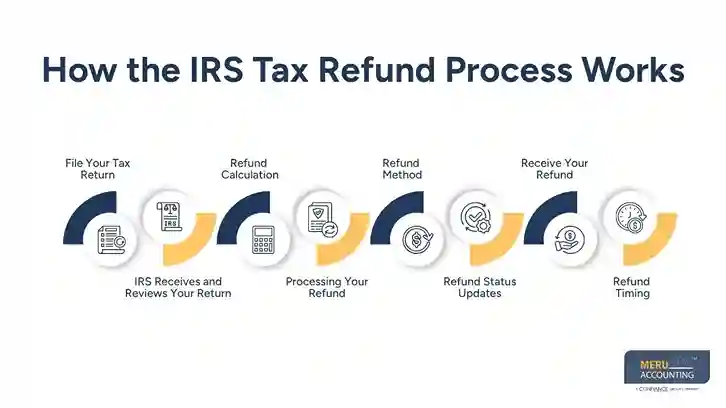
How the IRS Tax Refund Process Works
File Your Tax Return
- The procedure begins when you submit your tax return to the IRS, either in paper or electronic form. The return itself includes information about your income, deductions, credits, and taxes due.
IRS Receives and Reviews Your Return
- The IRS processes your return after you submit it to them. They check the information for correctness, look for discrepancies, and confirm that all the particulars are indeed accurate under the IRS refund schedule 2026 process.
Refund Calculation:
- The refund or tax owed by the IRS is dependent on the tax return filed by the taxpayer. The amount thus determined is worked out by considering several aspects such as income, tax withholdings, deductions, and credits.
Processing Your Refund
- Once the IRS has checked the information in your return, the refund is initiated. In the case of credits such as EITC (Earned Income Tax Credit) or CTC (Child Tax Credit), this can involve some extra checks.
Refund Method
You will get your refund from the IRS through one of the following methods:
- Direct Deposit: This is the fastest method to have your refund directly deposited into your bank account.
- Paper Check: In this method, paper checks will be sent to your home address if you do not select direct deposit.
- Prepaid Debit Card: In some instances, the refunds are given on prepaid debit cards.
Refund Status Updates
- To cross-check the status of your refund, you can use the IRS “Where’s My Refund?” feature, which provides immediate feedback on the progress of the refund.
Receive Your Refund
- You will thereafter receive your refund according to your selected method of delivery once processed. In case of any problems, e.g., lack of details or errors, the IRS will also call you for additional information
Refund Timing
- The refund is generally within reach after a period of 21 days if the return is filed digitally and in a complete and accurate manner. Paper returns may take longer because they need additional processing.
Estimated IRS Tax Refund Schedule 2026
The IRS Tax Refund Schedule 2026 will differ based on a few different factors. For the most part, only around 21 days after the IRS receives the return are taxpayers usually expecting refunds. But then again, there are reasons that would affect the refund.
- Early Filers: Generally, if you file your tax return in January or February, a refund will be made within 21 days. Other delays are possible if you are claiming Tax Credits such as the Earned Income Tax Credit (EITC) or the Child Tax Credit (CTC), which might require additional IRS review.
- Mid-Season Filers: If you file in March or April, the IRS Tax Refund Schedule can become more unpredictable. While many refunds are still processed within three weeks, it may take longer due to an increased volume of returns.
- Last-Minute Filers: If you file your return nearing the deadline in the month of April, there may be undue delays, especially if issues were pending earlier on with your return, since the demand from other taxpayers is too high. Processing of your refund can be delayed the longer you defer filing.
- Direct Deposit vs. Paper Check: Selecting direct deposit can speed up the process. Paper checks can take longer to arrive, particularly when mailed to the incorrect address.
The above deadline is only an estimate; There may be a delay, so stay updated and track your return position.
How to Check Your IRS Refund Status
You might want to know the status of the refund immediately after your tax return is filed. The IRS provides a useful tool called “Where’s My Refund?” that allows you to check your refund status in real time.
To utilize this tool, the following information will be required:
- Social Security Number (SSN) or Individual Taxpayer Identification Number (ITIN)
- Your filing status – for example – single, married filing jointly, etc
- The exact amount of your refund (as reported on your tax return)
You just have to go to the IRS website and enter this information into the “Where’s My Refund?” tool. After a few seconds, it will give you the most current information about your refund status. You can check it anytime, but it is better to wait at least 24 hours after you file your return before looking up your refund status.
Tracking your refund online is the easiest way to stay updated on the IRS tax refund timeline and know whether your return is still being processed or your refund has been approved.
Common Reasons for Refund Delays
Even if you file early, some things can slow down your refund. Here are the most common reasons:
1. Errors in the Return
- Wrong numbers, names, or bank info can cause delays.
- Fixing errors takes time.
2. Identity Checks
- If the IRS flags your return for identity verification, they’ll send you a letter.
- Respond quickly to avoid long delays.
3. EITC or ACTC Claims
- These are held until mid-to-late February, even if you file early.
- This rule is part of fraud prevention laws.
4. Paper Filing
- Paper returns take much longer to process.
- Always e-file if you want your refund quickly.
Tips to Get Your Tax Refund Faster
If you want to speed up the process and get your refund rapidly, then some useful tips are as follows:
- File Early: The sooner you file, the faster the IRS will begin processing your tax return. Moreover, filing early means less likelihood of problems, allowing you to deal with them.
- Choose Direct Deposit: The quickest way to obtain your reimbursement is through the mechanism of direct deposit, by which it is forwarded into your checking or savings account.
- Information Verification: Errors and mistakes during filing the tax can cause a delay in the returns process. It is important to verify all features like Social Security Number, bank details, and income information before submitting them.
- Use E-Filing: E-Filed returns are the fastest. If you are still preparing a paper return, it will take longer for the IRS to process and generate refunds.
- Check Your Refund Status Regularly: Once you file, check the IRS “Where’s My Refund?” option to check the status of your refund. If there are any issues, you can address them promptly.
How to Change a Tax Return After Filing
Yes, you can file an amended return to fix mistakes after filing your federal tax return. The IRS lets you correct errors.
Math or entry errors: If you made a mistake, like in math, you may need to amend.
Forgotten income: If you missed income, such as freelance work or interest, update your return.
Missed deductions or credits: If you missed a deduction or credit, amend your return to get it.
Wrong filing status: If you filed as Single but should have used Head of Household, you need to correct your return by filing an amendment.
Corrected tax documents: If you get a new W-2 or 1099, file an amendment.
Wrong dependent info: If the dependent’s info is wrong, like the Social Security number, fix it with an amendment.
Withholding errors: If you need to fix the amount of tax withheld, amend your return.
Switch deductions: You can change from itemized to standard deduction, or vice versa, with an amendment.
Use Form 1040-X to amend your return. These take longer to process, usually up to 16 weeks.
Why Choose Meru Accounting for Tax Filing?
We understand the complexities of tax filing and work precisely with our clients to make the most out of the IRS Tax Refund Schedule 2026. Our certified experts are well known for precise and error-free tax filing services. You should select Meru Accounting for the following reasons:
- Expert Guidance: Our specialists are up-to-date with the most recent tax laws and regulations to facilitate the correct and effective filing of returns.
- Personalized Service: We optimize our tax filing services to meet your unique financial demands and reduce your tax obligation.
- Fast and Accurate: We use innovative software and best practices to ensure that the return has been filed accurately and on time, increasing the refund process.
- Ongoing Support: Even after your tax returns have been filed, our team is here to assist with any questions or concerns you have about your refund or future tax plan.
The IRS Tax Refund Schedule 2026 is another step to help make the tax season. You can follow the recommendations given above and turn to Meru Accounting to help with tax filing, thereby making sure that the refund flows smoothly and on time. Tax season does not have to be very stressful for you; partner with Meru Accounting to file your taxes. With that, Meru Accounting is able to take care of your taxes without trouble.
Our Expert Insight
The IRS tax refund timeline is generally around 21 days for electronically filed, error-free tax returns with direct deposit. However, refund timing depends on several factors, including identity verification, refundable tax credits such as the Earned Income Tax Credit (EITC) and Additional Child Tax Credit (ACTC), filing accuracy, and the IRS’s processing workload. Rather than relying on estimated refund dates alone, taxpayers should focus on filing accurate returns early, choosing direct deposit, and monitoring their refund through the IRS “Where’s My Refund?” tool. Following these best practices can help reduce unnecessary delays and make tax season much less stressful.
Key Takeaways
- The IRS tax refund timeline for most electronically filed returns with direct deposit is approximately 21 days, although delays are possible.
- Filing early, submitting an accurate return, and selecting direct deposit can help you receive your refund sooner.
- Refunds claiming credits like the EITC or ACTC may take longer because of additional IRS verification requirements.
- The IRS “Where’s My Refund?” tool is the fastest way to track your refund status after filing.
- If you discover an error after filing, you can correct it by submitting Form 1040-X.
- Working with experienced tax professionals can help minimize filing errors, improve compliance, and make the refund process smoother.